From Surf Wiki (app.surf) — the open knowledge base
Cantú syndrome

| Field | Value |
|---|---|
| name | Cantú syndrome |
| synonyms | Hypertrychotic osteochondrodysplasia |
| image | Photo-of-the-person-with-cantu-syndrome.gif |
| caption | This photo shows a person with Cantú syndrome, who has coarse facial features that are characteristic of this syndrome. |
| symptoms | Cardiomegaly |
| causes | Mutation in ABCC9 gene |
| diagnosis | Echocardiogram, X-ray |
| treatment | Scoliosis is managed via bracing |
Cantú syndrome is a rare condition characterized by hypertrichosis, osteochondrodysplasia, and cardiomegaly. Fewer than 50 cases have been described in the literature; they are associated with a mutation in the ABCC9-gene that codes for the ABCC9-protein.
Signs and symptoms
The main features of this condition are hypertrichosis, osteochondrodysplasia, and cardiomegaly. There is also a characteristic facies. Other features include patent ductus arteriosus, congenital hypertrophy of the left ventricle, and pericardial effusions.
Neurodevelopmental outcome appears normal, but obsessive traits and anxiety have been reported. It may also be associated with recurrent infections with low immunoglobulin levels and gastric bleeding, and additional possible associations include lymphoedema and heterochromia iridis.
Cause
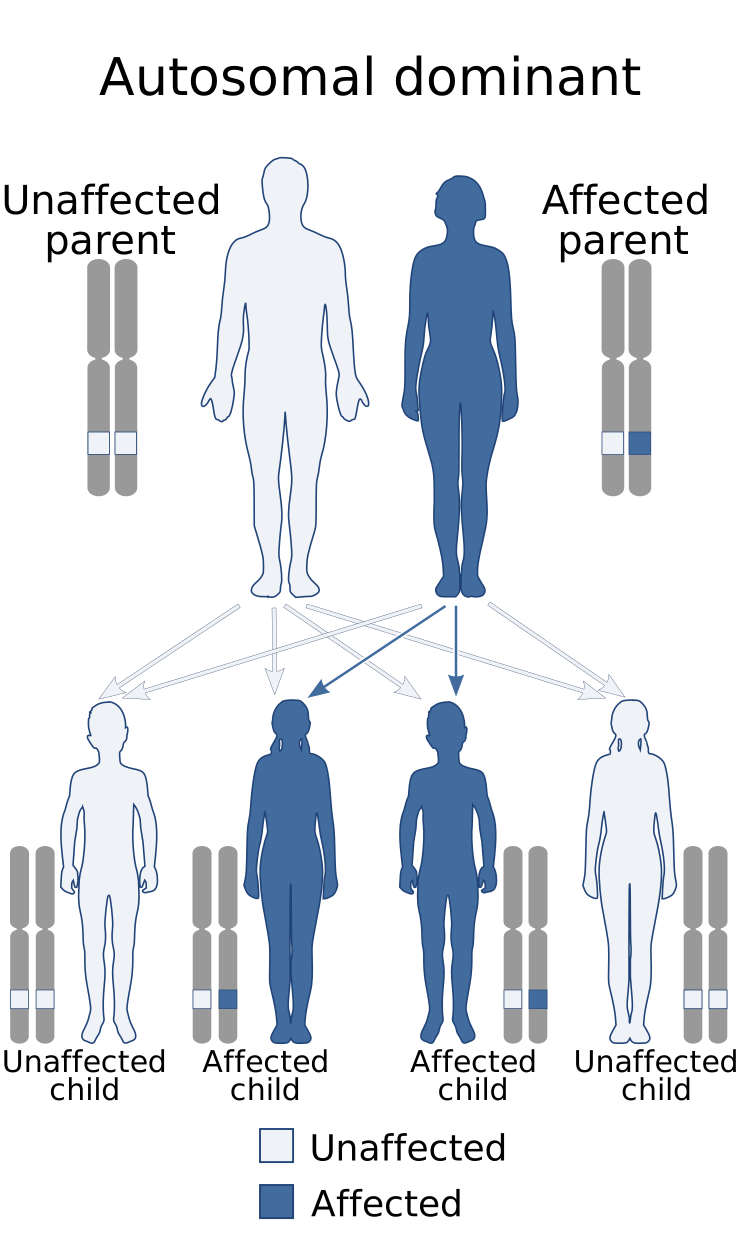
Cantú syndrome apparently is inherited in an autosomal dominant fashion and appears to be affected by the ABCC9 gene. ABCC9 gene provides a blueprint for creating the sulfonylurea receptor 2 in the human body.
Mechanism
In terms of the mechanism of Cantú syndrome, mutations in the ABCC9 gene total 25/31. Physiologically, sulfonylurea receptor 2 is significant in vascular relaxation.
An increase in O2 tension after birth, plus decreasing PGE2 (a common prostaglandin) causes inhibition of voltage-gated potassium channels and contraction of smooth muscle (in ductus).
Diagnosis

This condition can be diagnosed by genetic testing. Furthermore, an echocardiogram and X-ray may help in the diagnosis.
Differential diagnosis
The differential diagnosis of this condition consists of the following:
- Hypertrophic cardiomyopathy
- Beckwith-Wiedemann syndrome
- Berardinelli-Seip congenital lipodystrophy
Treatment
The treatment/management for Cantú syndrome is based on surgical option for patent ductus arteriosus in early life and management of scoliosis via bracing. Furthermore, regular echocardiograms are needed for the individual who has exhibited this condition.
History
This condition was described in 1982 by Cantú et al.
References
References
- "OMIM Entry - # 239850 - CANTU SYNDROME".
- (August 2002). "Further case of Cantú syndrome: exclusion of cryptic subtelomeric chromosome aberrations". Am. J. Med. Genet..
- Grange, Dorothy K.. (1993-01-01). "GeneReviews". University of Washington, Seattle.
- "Cantu syndrome {{!}} Genetic and Rare Diseases Information Center (GARD) – an NCATS Program".
- Grange, Dorothy K.. (2019). "Cantú syndrome: Findings from 74 patients in the International Cantú Syndrome Registry". American Journal of Medical Genetics Part C: Seminars in Medical Genetics.
- García-Cruz, Diana. (2011-01-20). "Cantu syndrome and lymphoedema". Clinical Dysmorphology.
- Scurr, Ingrid. (2011). "Cantú syndrome: Report of nine new cases and expansion of the clinical phenotype". American Journal of Medical Genetics Part A.
- Reference, Genetics Home. "Cantú syndrome".
- Reference, Genetics Home. "ABCC9 gene".
- Cooper, Paige E.. (2014). "Cantú Syndrome Resulting from Activating Mutation in the 8 Gene". Human Mutation.
- GeneCards Human Gene Database. "KCNJ8 Gene - GeneCards {{!}} KCNJ8 Protein {{!}} KCNJ8 Antibody".
- McClenaghan, Conor. (2020-03-02). "Glibenclamide reverses cardiovascular abnormalities of Cantu syndrome driven by KATP channel overactivity". The Journal of Clinical Investigation.
- Pubchem. "Prostaglandin E2 {{!}} C20H32O5 - PubChem".
- Nichols, Colin G.. (2013-03-29). "KATP channels and cardiovascular disease: Suddenly a syndrome". Circulation Research.
- "Hypertrichotic osteochondrodysplasia - Conditions - GTR - NCBI".
- Kirk, Edwin P.. (2017-04-01). "Clinical utility gene card for: Cantú syndrome". European Journal of Human Genetics.
- Cantu JM, Garcia-Cruz D, Sanchez-Corona J, Hernandez A, Nazara Z (1982) A distinct osteochondrodysplasia with hypertrichosis--individualization of a probable autosomal recessive entity. Hum Genet 60: 36-41
This article was imported from Wikipedia and is available under the Creative Commons Attribution-ShareAlike 4.0 License. Content has been adapted to SurfDoc format. Original contributors can be found on the article history page.
Ask Mako anything about Cantú syndrome — get instant answers, deeper analysis, and related topics.
Research with MakoFree with your Surf account
Create a free account to save articles, ask Mako questions, and organize your research.
Sign up freeThis content may have been generated or modified by AI. CloudSurf Software LLC is not responsible for the accuracy, completeness, or reliability of AI-generated content. Always verify important information from primary sources.
Report