From Surf Wiki (app.surf) — the open knowledge base
Cancún
City in Quintana Roo, Mexico
City in Quintana Roo, Mexico
| Field | Value | ||||
|---|---|---|---|---|---|
| <!-- Basic info --> | official_name | Cancún | |||
| settlement_type | City | ||||
| image_skyline | {{multiple image | ||||
| border | infobox | ||||
| total_width | 300 | ||||
| caption_align | center | ||||
| perrow | 1/3/2/2 | ||||
| image1 | Cancun Strand Luftbild (22143397586).jpg | ||||
| caption1 | Hotel Zone | ||||
| image2 | Boulevard Kukulcan, Zona Hotelera, Cancún, Mexico - panoramio (34).jpg | ||||
| caption2 | Kukulcan Boulevard | ||||
| image3 | Héroes Navales de Veracruz en 1914, Cancun, Quintana Roo, Mexico 01.jpg | ||||
| caption3 | Memorial obelisk | ||||
| image4 | San Miguelito Ruins (12973805005).jpg | ||||
| caption4 | San Miguelito ruins | ||||
| image5 | Museo Maya de Cancun.jpg | ||||
| caption5 | Mayan Museum of Cancún | ||||
| image6 | Palaciomun08.jpg | ||||
| caption6 | Municipal palace | ||||
| image7 | Another lighthouse (6902886929).jpg | ||||
| caption7 | Lighthouse | ||||
| image8 | El Rey Zona Arqueologica, Cancun, Mexico RFDZ1265.jpg | ||||
| caption8 | El Rey archaeological site | ||||
| color | white | ||||
| image_blank_emblem | Logotipo de Cancún.png | ||||
| blank_emblem_type | Logo | ||||
| motto | |||||
| mapsize | 180px | ||||
| pushpin_map | Mexico Quintana Roo#Mexico | ||||
| pushpin_label_position | left | ||||
| pushpin_map_caption | Location in Mexico | ||||
| <!-- Location --> | coordinates | ||||
| subdivision_type | Country | ||||
| subdivision_name | |||||
| subdivision_type1 | State | ||||
| subdivision_name1 | Quintana Roo | ||||
| subdivision_type2 | Municipality | ||||
| subdivision_name2 | Flag of Benito Juarez.svg Benito Juárez | ||||
| <!-- Politics --> | established_title | Founded | |||
| established_date | April 20, 1970 | ||||
| established_title1 | |||||
| established_date1 | |||||
| leader_party | MORENA | ||||
| leader_title | Mayor | ||||
| leader_name | Ana Patricia Peralta de la Peña | ||||
| unit_pref | |||||
| area_footnotes | |||||
| area_total_km2 | |||||
| area_land_km2 | 142.7 | ||||
| area_water_km2 | |||||
| elevation_footnotes | |||||
| elevation_m | 10 | ||||
| elevation_min_m | 0 | ||||
| population_total | 888,797 | ||||
| population_density_km2 | 4400 | ||||
| population_rank | 14th in Mexico | ||||
| 1st in Quintana Roo | |||||
| population_as_of | 2020 | ||||
| demographics_type1 | GDP | ||||
| demographics1_title1 | Metro | ||||
| demographics1_info1 | US$9.9 billion (2023) | ||||
| demographics1_title2 | Per capita | ||||
| demographics1_info2 | US$9,600 (2023) | ||||
| postal_code_type | Postal code | ||||
| postal_code | 77500 | ||||
| area_code | 998 | ||||
| website | |||||
| timezone | EST | ||||
| utc_offset | −5 | ||||
| elevation_max_m | 10 | ||||
| blank_name | Federal Routes | ||||
| blank_info | [[File:Carretera federal 180.svg | 20px | link=Mexican Federal Highway 180]] [[File:Carretera federal 307.svg | 20px | link=Mexican Federal Highway 307]] |
| population_metro | 1,045,005 |
1st in Quintana Roo
Cancún is the most populous city in the Mexican state of Quintana Roo, located in southeast Mexico on the northeast coast of the Yucatán Peninsula. It is a significant tourist destination in Mexico and the seat of the municipality of Benito Juárez. The city is situated on the Caribbean Sea and is one of Mexico's easternmost points. Cancún is located just north of Mexico's Caribbean coast resort area known as the Riviera Maya. It encompasses the Hotel Zone which is the main area for tourism.
Etymology and coat of arms
According to early Spanish sources, the island of Cancún was originally known to its Maya inhabitants as Nizuc (), meaning either 'promontory' or 'point of grass'.
The name Cancún, Cancum or Cankun first appears on 18th-century maps. In older English-language documents, the city's name is sometimes spelled Cancoon, an attempt to convey the sound of the name.
Cancún is derived from the Mayan name kàan kun, composed of kàan 'snake' and the verb kum ~ kun 'to swell, overfill'. Two translations have been suggested: the first is 'nest of snakes' and the second, less accepted one is 'place of the golden snake'. Snake iconography was prevalent at the pre-Columbian site of Nizuc.
The shield of the municipality of Benito Juárez, which represents the city of Cancún, was designed by the Mexican-American artist Joe Vera. It is divided into three parts: the color blue symbolizes the Caribbean Sea, the yellow the sand and the red the sun with its rays.
History
|1990 | 167730 |1995 | 297183 |2000 | 397191 |2005 | 526701 |2010 | 628306 |2015 | 743626 |2020 | 888797
In the years after the Spanish conquest of Yucatán, much of the Maya population died or left as a result of disease, warfare, and famines, leaving only small settlements on Isla Mujeres and Cozumel Island.
Cancún is a planned city, created to foster tourism. When development of the area as a resort was started on January 23, 1970, Isla Cancún had only three residents, all caretakers of the coconut plantation of Don José de Jesús Lima Gutiérrez, who lived on Isla Mujeres. Some 117 people lived in nearby Puerto Juárez, a fishing village and military base.{{Cite book
.jpg)
Due to the reluctance of investors to gamble on an unknown area, the Mexican federal government financed the first nine hotels.
The city began as a tourism project in 1974 as an Integrally Planned Center, a pioneer of FONATUR (Fondo Nacional de Fomento al Turismo, National Fund for Tourism Development), formerly known as INFRATUR. Since then, it has undergone a comprehensive transformation from being a fisherman's island to being one of the two most well-known Mexican resorts, along with Acapulco. The growth of Cancún outpaced the rest of Quintana Roo during the late 20th century, for example, from 1970 to 1980 the population grew annually on average by 62.3%. Once outside the main tourist areas of the World the growth of Cancún was part of a wider touristification of northern Quintana Roo while in the south and east of the state the timber industry developed more than tourism. From places like Cancún the tourism industry then expanded from the 1990s onward into indigenous territories and protected areas in inland sites.
Most 'Cancunenses' are from Yucatán and other Mexican states. A growing number are from the rest of the Americas and Europe. The municipal authorities have struggled to provide public services for the constant influx of people, as well as limiting squatters and irregular developments, which in 2006 occupied an estimated ten to fifteen percent of the mainland area on the fringes of the city.
In 2023, a record 21million tourists visited Cancún, topping the original estimate of 20.5million.
Public safety concerns

In the 21st century, Cancún had largely avoided the violence associated with the trade of illegal drugs; however, drugs are sold to tourists in bars and night clubs. Cancún has gradually been reported for being a center of money laundering. The links with Cancún date from the 1990s and early 2000s, when the area was controlled by the Juárez and Gulf drug cartels. By 2010, Los Zetas, a group that broke away from the Gulf Cartel, had taken control of many smuggling routes through the Yucatán, according to the U.S. Drug Enforcement Administration.
There have been a number of violent acts in the city related to drug trafficking. Between 2013 and 2016, there were 76 murders: 31 in 2016, and at least 193 in 2017, the vast majority related to drug trafficking. Most have occurred in the urban nucleus, and there have been various violent episodes with firearms in the so-called "Zona Hotelera". Beginning in 2018 with a high wave of violence, Cancún is above the national average in homicides. In January 2018 alone, there were 33 homicides, triple the number from January 2017.
Sargassum
Starting in 2015, Cancun tourism was significantly impacted by the appearance of large amounts of smelly, unsightly brown Sargassum seaweed on its white sand beaches every summer. By 2021, Sargassum season had become an annual occurrence at many Caribbean beach destinations, including Cancun.
Geography
City layout


Apart from the island tourist zone (part of the Mesoamerican Barrier Reef System), the Mexican residential section of the city, the downtown part of which is known as "El Centro", follows a master plan that consists of "supermanzanas" (superblocks), giant trapezoids with a central, open, non-residential area cut in by u-shaped residential streets.
Cancún's mainland or downtown area has diverged from the original plan; development is scattered around the city. The remaining undeveloped beach and lagoon front areas outside the Hotel Zone are now under varying stages of development, in Punta Sam and Puerto Juarez to the north, continuing along Bonampak and south toward the airport along Boulevard Donaldo Colosio. One development abutting the Hotel Zone is Puerto Cancún; Malecon Cancún is another large development.
Climate

Cancún has a tropical climate, specifically a tropical wet and dry climate (Köppen Aw), with little temperature difference between months, but pronounced rainy and dry seasons. The city is hot year-round, and moderated by onshore trade winds, with an annual mean temperature of 27.1 C. Unlike inland areas of the Yucatán Peninsula, sea breezes restrict high temperatures from reaching 36 C on most afternoons. Annual rainfall is around 1340 mm, falling on 115 days per year.
The rainy season runs from late August through November, and the dry season runs from November through April. The hurricane season runs from June through November. The Hotel Zone juts into the Caribbean Sea and is therefore surrounded by ocean keeping daytime temperatures around 1 to cooler. Windspeeds are higher than at the airport located some distance inland, which is the official meteorological station for Cancún; averages are shown below.
Thanks to the Yucatán current continually bringing warm water from further south, the sea temperature is always very warm, with lows of 79 °F in winter and highs of 84 °F in summer.
|Jan record high C = 33 |Feb record high C = 38 |Mar record high C = 39 |Apr record high C = 38 |May record high C = 39 |Jun record high C = 39 |Jul record high C = 39 |Aug record high C = 41.5 |Sep record high C = 38.5 |Oct record high C = 38 |Nov record high C = 37 |Dec record high C = 33.5 |year record high C = 41.5 |Jan record low C = 13 |Feb record low C = 12 |Mar record low C = 9.5 |Apr record low C = 14 |May record low C = 18 |Jun record low C = 20.5 |Jul record low C = 21 |Aug record low C = 20 |Sep record low C = 19 |Oct record low C = 15 |Nov record low C = 12 |Dec record low C = 12 |year record low C = 9.5 |access-date = 6 March 2015 |url-status = dead |archive-url = https://web.archive.org/web/20150705224131/http://smn.cna.gob.mx/climatologia/Normales5110/NORMAL23155.TXT |archive-date = July 5, 2015 |access-date= 8 Sep 2025
| Jan | Feb | Mar | Apr | May | Jun | Jul | Aug | Sep | Oct | Nov | Dec |
|---|---|---|---|---|---|---|---|---|---|---|---|
| 79 °F | 79 °F | 79 °F | 81 °F | 82 °F | 84 °F | 84 °F | 84 °F | 84 °F | 84 °F | 82 °F | 81 °F |
Tropical storms and hurricanes

The tropical storm season lasts from May to December, the rainy season extending into January with peak precipitation in October. February to early May tend to be drier with only occasional scattered showers. Cancún is located in one of the main Caribbean hurricane impact areas. Although large hurricanes are rare, they have struck near Cancún in recent years, Hurricane Wilma in 2005 being the largest. Hurricane Gilbert made a devastating direct hit on Cancún in September 1988 and the tourist hotels needed to be rebuilt. In both cases, federal, state and municipal authorities were well prepared to deal with most of the effects on tourists and local residents. Hurricane Dean in 2007 also made its mark on the city of Cancún.
Making landfall in 1988, Hurricane Gilbert was the second most intense hurricane ever observed in the Atlantic basin. It landed on the Yucatán peninsula after crossing over the island of Cozumel. In the Cancún region, a loss of $87 million (1989 USD) due to a decline in tourism was estimated for the months of October, November and December in 1988.
On October 21, 2005, Hurricane Wilma made landfall on Mexico's Yucatán Peninsula as a powerful Category 4 hurricane, with strong winds in excess of 150 mph. The hurricane's eye first passed over the island of Cozumel, and then made an official landfall near Playa del Carmen in the state of Quintana Roo at around 11 p.m. local time on October 21 with winds near 140 mph. Portions of the island of Cozumel experienced the calm eye of Wilma for several hours with some blue skies and sunshine visible at times. The eye slowly drifted northward, with the center passing just to the west of Cancún, Quintana Roo.
Two years later after Hurricane Wilma, in 2007, Hurricane Dean made landfall as a Category 5 storm in Majahual, 190 mi to the south of Cancún. Fierce winds at the edge of Dean's impact cone stripped sand off 7.5 mi of beaches from Punta Cancún (Camino Real Hotel) to Punta Nizuc (Club Med). The authorities asked tourism operators to suspend sending tourists to Cancún while Hurricane Dean was approaching, but did ask airlines to send empty planes, which were then used to evacuate tourists already there.
Attractions
Hospitality
The Hotel Zone is the main means of economic income for Cancún and is one of the most visited international tourist destinations in the world.
Old Airport Control Tower Memorial
Despite being a young city, Cancún has a memorial monument of its foundation on a replica of the old Airport Control Tower that resembles to its own date of foundation. The original control tower was a provisional wooden structure, the work of Mexican architects Agustín and Enrique Landa Verdugo.
The old airport was located on the same part of the city that today corresponds to the Kabah Avenue. The tower is 15 meters tall, has a 45 step staircase and has a base dimension of 5 × 5 meters. The memorial was first built in 2002 with a donation by Aerocaribe, a local airline, but the structure was damaged after Hurricane Wilma in 2005. After pleas by the local people to rebuild the tower memorial, a new version was erected in 2010, which was later abandoned without proper maintenance until Woox Pinturas, a local wood maintenance company, made a donation to restore the structure to its original appearance.
El Ceviche Fountain
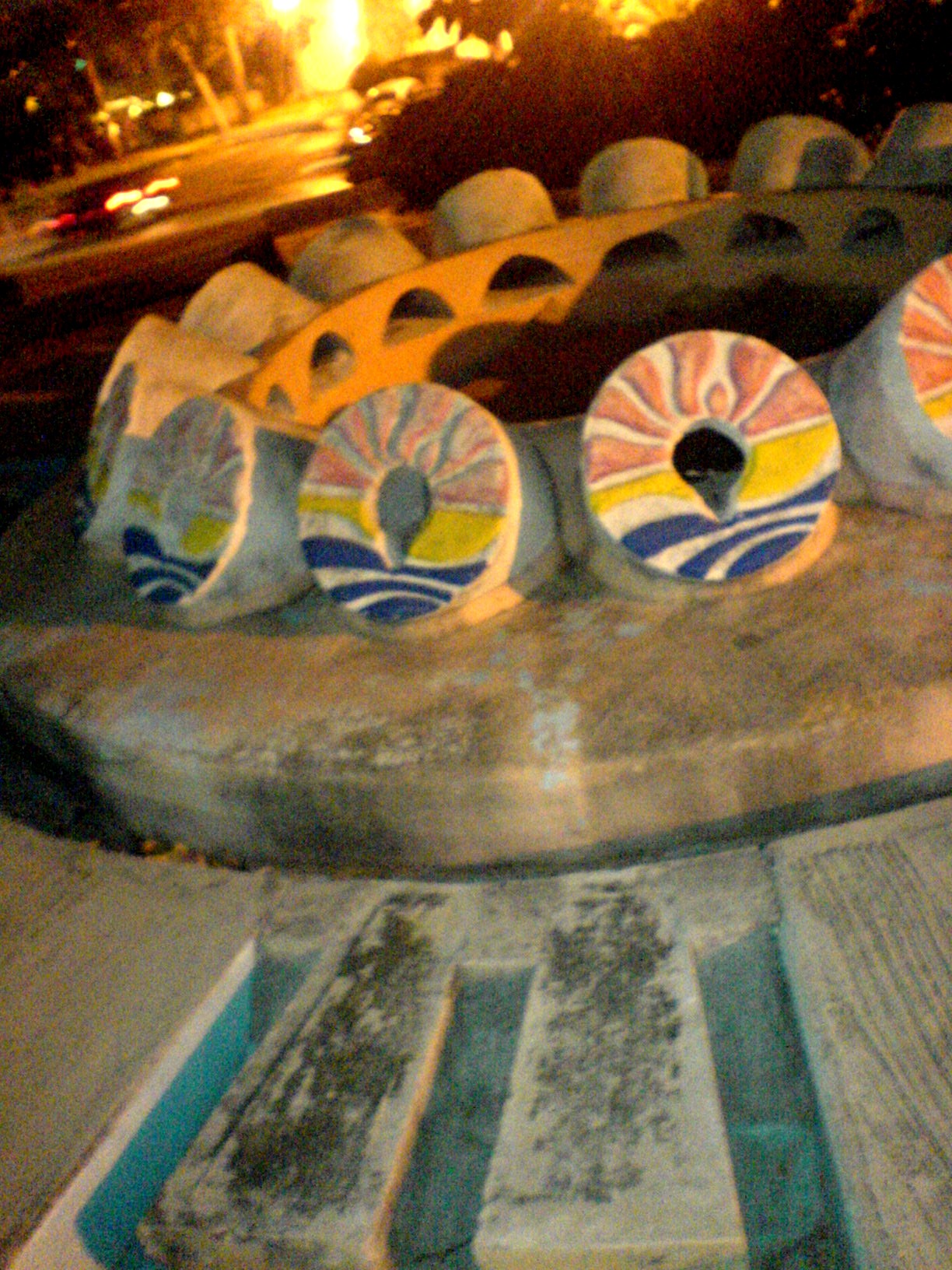
The real name of this monument is "Caribbean Fantasy", located in the heart of downtown Cancún, between the Coba and Tulum avenues intersection. It is the nerve center of the daily urban traffic of the city. It has witnessed multiple social and political events, undergoing constant repairs and remodeling for years.
Six years after Quintana Roo was recognized as the youngest state in the Mexican Republic and barely a decade after the city of Cancún was born, on October 22 and 23, 1981, the North-South Summit was held at the now defunct Sheraton Hotel. Two abstract pillars made of metal crossbeams gave the structure a stepped pyramidal appearance, with small masts displaying the flags of the countries attending the 1981 North-South Summit. The author, Lorraine Pinto, added details representing Quetzalcoatl on the sides, resembling the pyramid of Chichen-Itza, located in Yucatan.
In 1994, the municipal authorities of Cancún decided to demolish the commemorative structure because the city had been the scene of one of the most devastating climatic-environmental phenomena in the history of the Yucatan Peninsula, Hurricane Gilberto. The sculpture was irreversibly affected, leaving only the solid concrete base and the metal skeleton.
Due to its crosswise and bare appearance, the locals began to call it "Insectronic", a device manufactured by the Steren company to kill flies and mosquitoes. The municipal authorities decided to keep its base and the dynamics of the water fountain.
Once again, Lorraine Pinto was on call to create what locals began to call the Ceviche Fountain or the Ceviche Roundabout.
Mayan archeological sites

There are some small Mayan vestiges of the pre-Columbian Maya civilization in Cancún. El Rey (Las Ruinas del Rey) is located in the Hotel Zone. El Meco, a more substantial site, is found on the mainland just outside the city limits on the road north to Punta Sam.
Close by in the Riviera Maya and the Grand Costa Maya, there are sites such as Cobá and Muyil (Riviera) the small Polé (now Xcaret), and Kohunlich, Kinichná, Dzibanché, Ichkabal Oxtankah, Tulum, Noh Kah, Chacchoben, among others, in the south of the state. Chichén Itzá is in the neighboring state of Yucatán.
Sports
Football club Atlante F.C. was founded in 1916 in Mexico City and moved to Cancún in 2007 due to poor attendance in Mexico City. In June 2020, speculation began about a possible move of Atlante F.C. back Mexico City. On June 26, the relocation became official. The same day, the relocation of Cafetaleros de Chiapas to Cancún was announced, with the team renamed Cancún F.C. They play in the Liga de Expansión MX, the Mexican second division, at the Estadio Andrés Quintana Roo. The city is also home to the Pioneros de Cancún of the Liga Premier de México, the third tier of Mexican football.
The Tiburones de Cancún (Cancún Sharks) were a professional American football team who played in the Fútbol Americano de México (FAM) league until the league's dissolution in 2022.
The city is also home to the baseball team Tigres de Quintana Roo, who play in the Mexican League (LMB).
In October 2023, the WTA Finals (Women's Tennis Association) were held in Cancún, in a temporary, outdoor, hard court stadium in Plaza Quintana Roo with a capacity of 4,300. Aryna Sabalenka and Elena Rybakina criticized the facility, saying that it was unacceptable for high level tennis, not ready in time for practice, and there was no time to fix it.
Since February 2025, the Cancún Country Club Residencial & Golf in Cancún hosts the WTA 125 tennis tournament "Cancún Tennis Open", that takes place on outdoor hardcourts.
Transportation

Cancún is served by the Cancún International Airport with an added main runway that commenced operation as of October 2009. It has many flights to North America, Central America, South America, and Europe. It is located on the northeast of the Yucatán Peninsula serving an average of about fifteen million passengers per year. The airport is located around 20 km (12 mi) from the Hotel Zone, approximately a 20 minute trip by car. The island of Isla Mujeres is located off the coast and is accessible by ferry from Puerto Juárez and Playa Tortugas in the Hotel Zone. In 2020, the Quintana Roo government implemented a law that all international visitors arriving to the State of Quintana Roo are required to pay a fee called the VisiTAX. Visitors with a Mexican passport are exempted from the tax.
Bus service from Cancun Airport to Downtown Cancun is provided by bus company ADO.
Cancún is also served by five public transportation companies, who are granted concessions by the Quintana Roo Institute of Mobility (Imoveqroo) or the Municipality of Benito Juárez, depending on the type of vehicles operated.
These companies include:
- Autocar S.A. de C.V. (Autocar)
- Transportación Turística y Urbana de Cancún (Turicún)
- Sociedad Cooperativa de Autotransporte del Ejido de Alfredo Vladimir Bonfil (Bonfil)
- Sociedad Cooperativa de Transporte Maya Caribe (Maya Caribe)
- Transporte Terrestre Estatal (TTE)
Together, these companies operate 36 bus routes in Cancun and its surrounding areas. Autocar operates 18 routes, both Maya Caribe and Turican operate 28, and Bonfil operates 20. TTE only operates Microbuses and Minibuses known as "combis."
Most bus routes terminate near either Plaza Las Americas, the ADO Bus Terminal, Tulum Avenue, or the Hotel Zone.
In the Hotel Zone, the main routes are R-1 and R-2, which run up Kukulkan Avenue. Operated by SEA (a joint venture between Turicun, Autocar, and Maya Caribe), services run around every 5 minutes and go between Tulum Avenue and the Westin Resort.

In April 2024, SEA announced it had received 100 new air-conditioned buses, and were running them along the R-1 and R-2 routes. It was also announced that the two routes would be phased out in favor of a new corridor that ran between the Hotel Zone and Kabah Avenue, with other inner-city routes being considered.
In August 2024, it was reported that a subsidiary of ADO, which already operates buses in Merida, was interested in operating 184 units in Cancun.
ADO AEROPUERTO (Airport) already operates long distance bus services from its Cancun Bus Terminal, with destinations including Playa del Carmen, Tulum, Merida and the Airport.
The Tren Maya, under construction since June 2020, will connect Cancún to Palenque, Chiapas with intermediate stops on the Yucatán peninsula and operations started on December 15, 2023. Passengers can take a free electric shuttle from Cancun Airport to the Tren Maya Station.
Sister cities
- USA Wichita, Kansas, USA – November 25, 1975
- China Hangzhou, China – October 17, 2008
- ROU Timișoara, Romania – March 5, 2019
- USA Naperville, Illinois, USA – February 5, 2021
Notes
References
References
- "Cancun Population 2022 (Demographics, Maps, Graphs)". World Population Review.
- (2020). "INEGI. Censo de Población y Vivienda 2020. Tabulados del Cuestionario Básico – Quintana Roo". [[INEGI]].
- "TelluBase—Mexico Fact Sheet (Tellusant Public Service Series)". Tellusant.
- {{MerriamWebsterDictionary. Cancún
- (February 3, 2007). "OMT concede premio excelencia a la promoción turística de Cancún (México)". [[El Economista (Spain).
- (2020-01-24). "How Cancún Grew into a Major Resort".
- "Government of Mexico, Cancún 2014".
- (1976). "Transportation, improving mobility for older Americans: hearings before the Subcommittee on Federal, State, and Community Services of the Select Committee on Aging, House of Representatives, Ninety-fourth Congress, second session". U.S. Government Printing Office.
- (1998). "A Dictionary of the Maya Language: As Spoken in Hocabá, Yucatán". University of Utah Press.
- "Fast Facts".
- Andrews, Anthony P.. "Historic Notes and Observations on Isla Cancún, Quintana Roo".
- (19 August 2013). "Centro de Cancún, tan mexicano como cosmopolita".
- (2012-01-08). "MEXICO: Quintana Roo". Citypopulation.de.
- (April 22, 2021). "Disappearance of Mayans inhabiting Cancun". Cancun Airport Transportations.
- Dunphy, Robert. (5 March 1972). "Why the Computer Chose Cancun". [[New York Times]].
- Ojeda, Antonio B.. (2024). "Análisis geohistórico de la turistificación de Quintana Roo en México, en los últimos cien años (1920-2020)". [[Norte Grande Geography Journal]].
- (December 21, 2023). "Prevén cierre de año con 21 millones de turistas en Q. Roo".
- Booth, William. (May 27, 2010). "Mayor of Cancun, Mexico, charged with drug trafficking, money laundering". Washington Post.
- Hawley, Chris. (May 26, 2010). "Drugs cast cloud over Mexican paradise". USA Today.
- (February 11, 2017). "Se disparan 162% los homicidios en Cancún". [[Milenio]].
- "Abaten a tiros a mujer en Cancún, llegan a 193 asesinatos este año". Yucatan a la Mano.
- (August 26, 2017). "En 2017, crimen organizado mató a 111 en Cancún". [[Milenio]].
- (January 9, 2018). "Quintana Roo, por arriba de la media nacional en homicidios". Noticaribe.
- (February 1, 2018). "Se disparan 300% los homicidios en Cancún". La Palabra del Caribe - Journalism with ethics - Quintana Roo News.
- (October 29, 2015). "Mexico's holiday beaches buried as mystery seaweed invasion hits Cancun". The Independent.
- (March 27, 2021). "Brown tide of sargassum threatens Caribbean tourist beaches". Nola.com.
- (2006). "La arquitectura norteamericana, motor y espejo de la arquitectura española en el arranque de la modernidad (1940-1965)". Servicio Publicaciones ETSA.
- "Location". Puerto Cancun.
- Mendez, Xavier. (18 July 2011). "Todo Incluido acabó hasta con las propinas".
- "Cancun Weather".
- "Cancún Weather".
- "Cancun weather – water temperature". Cancunmap.com.
- "Cancun Climate and Weather Averages, Cancun and Riviera Maya". Weather to Travel.
- (August 16, 2007). "Hurricane Dean On Course for Cancún".
- Benigono Aguirre. "Cancun under Gilbert: Preliminary Observations". International Journal of Mass Emergencies and Disasters March 1989, Vol. 7, No.1, pp. 69–82.
- "Novedades de Quintana Roo".
- (August 21, 2007). "Huge hurricane roils Yucatan". San Francisco Chronicle.
- Kachroo-Levine, Maya. "50 Years of Cancún: How the Beachfront Haven Became a Favorite Tropical Retreat".
- (February 7, 2021). "Cancun airport's old control tower memorial". "Mexican Routes" [mexicanroutes.com].
- (April 8, 2013). "La antigua torre de control, símbolo de la fundación de Cancún".
- (21 June 2024). "Te damos horarios y ubicación del Museo Maya de Cancún para que vayas y veas su nueva exposición Máscaras". Tus Buenas Noticias.
- "Atlante Futbol Club".
- (3 February 2021). "Atlante regresa a la CDMX y jugará en el Estadio Azul".
- (3 February 2021). "Cafetaleros se muda a Quintana Roo y nace Cancún FC".
- [https://www.abc.net.au/news/2023-10-31/aryna-sabalenka-labels-wta-finals-court-disrespectful/103042304 Aryna Sabalenka labels WTA Finals court in Cancún unacceptable for high-level tennis], [[Associated Press]]/[[ABC News Online]], 2023-10-31
- "2025 WTA Calendar".
- "México suma torneos de tenis para el 2025, uno de WTA 125 y dos Challengers de la ATP".
- (January 14, 2025). "Presentan el Cancun Tennis Open WTA 125".
- [http://www.cancuncare.com/Cancun_Airport/cancun_airport_map.htm] {{Webarchive. link. (October 13, 2010 CANCUN AIRPORT MAP (CUN) ICAO CODE (MMUN) LATITUDE 21.0° LONGITUDE 86.9°)
- (21 June 2024). "¿Dónde se localiza Isla Mujeres y cómo llegar?". Tus Buenas Noticias.
- "VisiTAX Frequently Asked Questions".
- "VisiTAX, what is it? Official Information and latest update 2023".
- "Cancun Airport Public Bus Service".
- Roo, Redacción Quintana. (2017-02-20). "Opera TTE de forma irregular".
- Esto, Redacción Por. (2024-10-17). "Usuarios reprueban el transporte público de Cancún, "el servicio es muy malo, inseguro y tardado"".
- "Transporte Cancún {{!}} PDF".
- Blanco, Stephani. (2024-04-03). "Estrenan trabajadores de Cancún transporte de lujo hacia la zona hotelera".
- "Public Transportation".
- Maidana, Victoria García. (2024-04-03). "Nuevas rutas con destino a Cancún.".
- Hoy, Redacción Quintana Roo. (2024-08-29). "Posible nueva entrada de concesionaria de Autobuses en Cancún, mismas que ofrecen el servicio en Mérida, Yucatán".
- (2017-01-18). "Cancun to Merida Bus Schedule".
- (13 January 2021). "Todo lo que sabemos hasta ahora sobre el Tren Maya". Diario de Yucatán.
- (October 6, 2023). "El 15 de diciembre inicia ruta Palenque-Cancún; todos los tramos, para febrero: AMLO".
- (December 16, 2023). "Mexico's Tren Maya officially begins first stage passenger service". Riveiera Maya News.
- "How to get to Cancún Train Station?".
- "Wichita Sister Cities". City of Wichita.
- "Cancun".
- (March 5, 2019). "Timişoara s-a înfrăţit cu oraşul mexican Cancun. Ambasadorul a făcut cadou filmul care a câştigat Premiul Oscar 2019 pentru cel mai bun film străin". Adevarul.
- (June 4, 2021). "Naperville Welcomes Cancun México as Third Sister City". Positively Naperville.
This article was imported from Wikipedia and is available under the Creative Commons Attribution-ShareAlike 4.0 License. Content has been adapted to SurfDoc format. Original contributors can be found on the article history page.
Ask Mako anything about Cancún — get instant answers, deeper analysis, and related topics.
Research with MakoFree with your Surf account
Create a free account to save articles, ask Mako questions, and organize your research.
Sign up freeThis content may have been generated or modified by AI. CloudSurf Software LLC is not responsible for the accuracy, completeness, or reliability of AI-generated content. Always verify important information from primary sources.
Report