From Surf Wiki (app.surf) — the open knowledge base
Blandford–Znajek process
Explanation for how quasars are powered
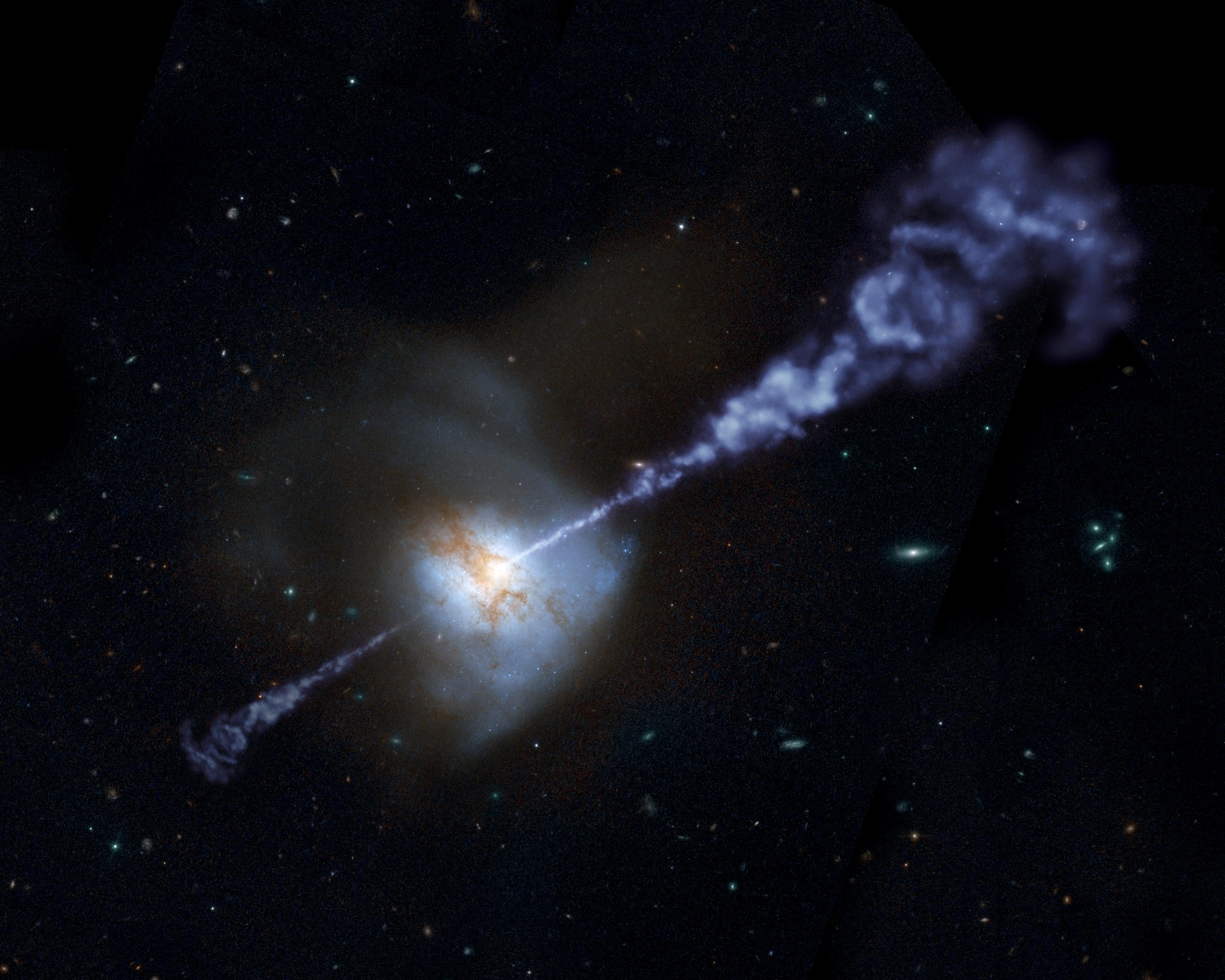
Explanation for how quasars are powered
The Blandford–Znajek process is a mechanism for the extraction of energy from a rotating black hole, introduced by Roger Blandford and Roman Znajek in 1977. This mechanism is the most preferred description of how astrophysical jets are formed around spinning supermassive black holes. This is one of the mechanisms that power quasars, or rapidly accreting supermassive black holes. Generally speaking, it was demonstrated that the power output of the accretion disk is significantly larger than the power output extracted directly from the hole, through its ergosphere. Hence, the presence (or not) of a poloidal magnetic field around the black hole is not determinant in its overall power output. It was also suggested that the mechanism plays a crucial role as a central engine for a gamma-ray burst.
Physics of the mechanism
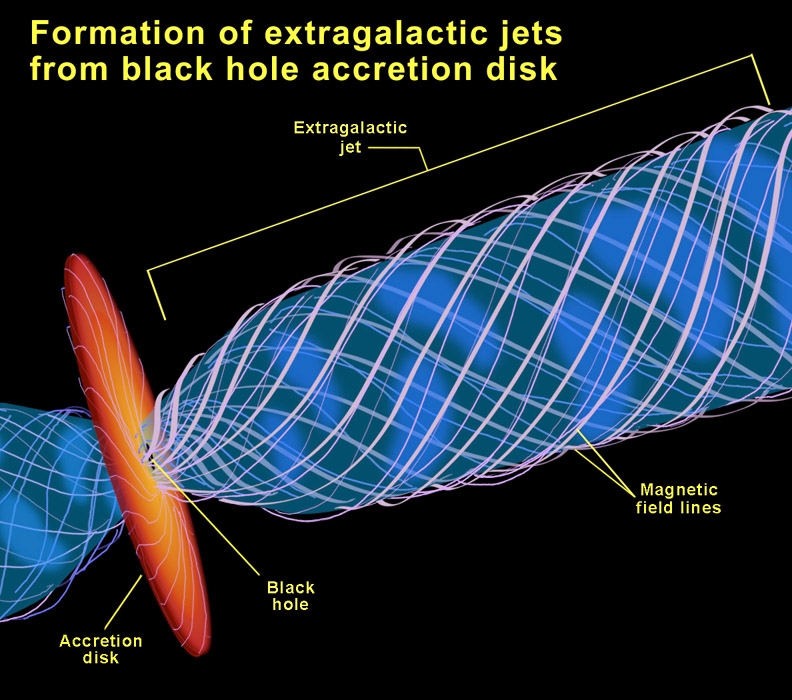
As in the Penrose process, the ergosphere plays an important role in the Blandford–Znajek process. In order to extract energy and angular momentum from the black hole, the electromagnetic field around the hole must be modified by magnetospheric currents. In order to drive such currents, the electric field needs to not be screened, and consequently the vacuum field created within the ergosphere by distant sources must have an unscreened component. The most favored way to provide this is an e± pair cascade in a strong electric and radiation field. As the ergosphere causes the magnetosphere inside it to rotate, the outgoing flux of angular momentum results in extraction of energy from the black hole.
The Blandford–Znajek process requires an accretion disc with a strong poloidal magnetic field around a spinning black hole. The magnetic field extracts spin energy, and the power can be estimated as the energy density at the speed of light cylinder times area:
: P = B^2\left(\frac{r}{r_c}\right)^4 r_c c = \frac{B^2 r^4 \omega^2}{c},
where B is the magnetic field strength, r_c is the Schwarzschild radius, and ω is the angular velocity.
References
References
- (2011). "Introduction to Black Hole Physics". [[Oxford University Press]].
- Lea, Robert. (2019-01-31). "How black holes power relativistic jets".
- (1977-07-01). "Electromagnetic extraction of energy from Kerr black holes". Monthly Notices of the Royal Astronomical Society.
- (February 2002). "Accretion Power in Astrophysics". Cambridge University Press.
- (1999-02-01). "Extracting Energy from Black Holes: The Relative Importance of the Blandford-Znajek Mechanism". The Astrophysical Journal.
- McKinney, Jonathan C.. (2005-09-01). "Total and Jet Blandford-Znajek Power in the Presence of an Accretion Disk". The Astrophysical Journal Letters.
- (2000). "The Blandford-Znajek process as a central engine for a gamma-ray burst". Physics Reports.
- Camenzind, M.: "Compact objects in Astrophysics" (Springer 2007, {{ISBN. 978-3-540-25770-7), p. 500, 505.
This article was imported from Wikipedia and is available under the Creative Commons Attribution-ShareAlike 4.0 License. Content has been adapted to SurfDoc format. Original contributors can be found on the article history page.
Ask Mako anything about Blandford–Znajek process — get instant answers, deeper analysis, and related topics.
Research with MakoFree with your Surf account
Create a free account to save articles, ask Mako questions, and organize your research.
Sign up freeThis content may have been generated or modified by AI. CloudSurf Software LLC is not responsible for the accuracy, completeness, or reliability of AI-generated content. Always verify important information from primary sources.
Report