From Surf Wiki (app.surf) — the open knowledge base
Bakezōri
Yōkai in Japanese folklore
Yōkai in Japanese folklore
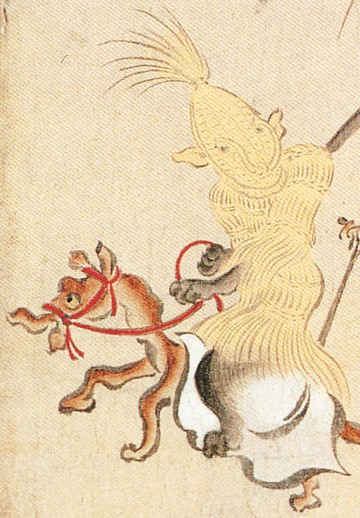
A Bakezōri is a being from Japanese folklore belonging to the group of Yōkai.
Description
The Bakezōri is described as a wandering sandal with two arms and two legs, but only one eye. He is said to spook inhabited households during the night, running around and continuously chanting: "Kararin, kororin, kankororin, managu mittsu ni ha ninmai!" (カラリン、コロリン、カンコロリン、まなぐ三つに歯二ん枚; "Kararin, kororin, kankororin! They have three eyes and two teeth!"). Most possibly he's mocking his "more noble cousins", the famous Geta.
Background
Design model of the Bakezōri may have been Zōri, traditional sandals made of braided rice straw.
The being Bakezōri belongs to a special group of Yōkai, called Tsukumogami (付喪神; "artifact-demons"): According to Japanese folklore, households are like repair tools, kitchen appliances and even clothes of any kind which eventually come to life and receive their own consciousness when ignored or neglected for a long time (mostly after 100 years). Bakezōri are said to be normally harmless to humans, but they can start to rip or pester them. Their motivation is boredom and frustration, or simply revenge and jealousy. Most Bakezōri group up with other animated household stuff or clothes, or they simply leave home and run away.
Sources
References
- Masaharu Takemura: {{lang. ja. ろくろ首考:妖怪の生物学. Bungei-sha, Tokyo 2002, {{ISBN. 4835546350, p. 89-91.
- Michaela Haustein: ''Mythologien der Welt: Japan, Ainu, Korea''. ePubli, Berlin 2011, {{ISBN. 3844214070, p. 9.
This article was imported from Wikipedia and is available under the Creative Commons Attribution-ShareAlike 4.0 License. Content has been adapted to SurfDoc format. Original contributors can be found on the article history page.
Ask Mako anything about Bakezōri — get instant answers, deeper analysis, and related topics.
Research with MakoFree with your Surf account
Create a free account to save articles, ask Mako questions, and organize your research.
Sign up freeThis content may have been generated or modified by AI. CloudSurf Software LLC is not responsible for the accuracy, completeness, or reliability of AI-generated content. Always verify important information from primary sources.
Report