From Surf Wiki (app.surf) — the open knowledge base
Arab Socialist Ba'ath Party – Syria Region
Neo-Ba'athist political party

Neo-Ba'athist political party
| Field | Value | |||||||||||||
|---|---|---|---|---|---|---|---|---|---|---|---|---|---|---|
| name | Arab Socialist Ba'ath Party – Syria Region | |||||||||||||
| native_name | ||||||||||||||
| native_name_lang | ar | |||||||||||||
| logo | Logo of the Syrian Ba'ath.png | |||||||||||||
| colorcode | ||||||||||||||
| governing_body | Central Command | |||||||||||||
| (2018–2024) | ||||||||||||||
| leader2_title | Assistant General Secretary | |||||||||||||
| leader2_name | ||||||||||||||
| general_secretary | ||||||||||||||
| founded | ||||||||||||||
| dissolved | ||||||||||||||
| newspaper | Al-Ba'ath and Al-Thawra (until 2024) | |||||||||||||
| student_wing | National Union of Students | |||||||||||||
| Ba'ath Vanguards | ||||||||||||||
| youth_wing | Revolutionary Youth Union | |||||||||||||
| wing1_title | Armed wing | |||||||||||||
| wing1 | Ba'ath Brigades | |||||||||||||
| (2012–2018) | ||||||||||||||
| membership | 1.2 million (2010 ) | |||||||||||||
| ideology | Neo-Ba'athism | |||||||||||||
| * Arab nationalism<ref>{{Cite book | last | Phillips | first =Christopher | url =https://books.google.com/books?id=cqIjEAAAQBAJ | title= The Battle for Syria: International Rivalry in the New Middle East | publisher =Yale University Press | year =2020 | isbn =978-0-300-21717-9 | location =London, UK | page =11 | quote =In 1963, Syria's most prominent Arab nationalists, the socialist Ba'ath Party, seized power.}} | |||
| * Arab socialism<ref>{{Cite book | last | Atassi | first =Karim | title = Syria, the Strength of an Idea: The Constitutional Architectures of Its Political Regimes | publisher =Cambridge University Press | year =2018 | isbn = 978-1-107-18360-5 | location =New York, NY | doi = 10.1017/9781316872017 | pages =262, 344 | quote=Within months, a cascade of nationalizations transformed the Syrian economy from a liberal to a socialist-style state economy. In May 1963, the new regime nationalized the private banks... The spirit of the text reflects the traditional themes dear to Ba'thist literature. In the talks among the delegations of the three countries to adopt the charter, the Founding Fathers of the Ba'th, Michel Aflaq anad Salah Bitar, sat among the representatives of the Syrian delegation. The two dominant themes of the charter were nationalism and Arab socialism.}} | |||
| * Authoritarian socialism{{refn | Sources:<ref>{{Cite book | last | Meininghaus | first =Esther | title =Creating Consent in Ba'thist Syria: Women and Welfare in a Totalitarian State | publisher =I. B. Tauris | year =2016 | isbn =978-1-78453-115-7 | pages =1–33 | chapter =Introduction}}{{Cite book | ||||
| editor-last1 | Hunter | |||||||||||||
| editor-first1 | Shireen T. | |||||||||||||
| editor-link1 | Shireen Hunter | |||||||||||||
| editor2 | Huma Malick | |||||||||||||
| title | Modernization, Democracy, and Islam | publisher =Praeger Publishers | ||||||||||||
| location | Westport, Connecticut | |||||||||||||
| year | 2005 | |||||||||||||
| url | https://books.google.com/books?id=fnzDEAAAQBAJ | |||||||||||||
| isbn | 0-275-98511-3 | page =106 | ||||||||||||
| quote | The region's political systems have been described as 'authoritarian-socialist' (Algeria, Iraq, Syria) [...]. | |||||||||||||
| {{Cite book | last | Lane, Redissi | first =Jan-Erik, Hamadi | title =Religion and Politics: Islam and Muslim Civilization | publisher =Ashgate | year =2009 | isbn =978-0-7546-7418-4 | edition =2nd | location =Surrey, England | pages =188 | chapter =13: Islam and Politics: Where the Principal Difficulty of Post-modernity Lies}}}} | |||
| * Left-wing nationalism<ref>{{Cite book | last | Solomon | first =Christopher | title =In Search of Greater Syria: The History and Politics of the Syrian Social Nationalist Party | publisher =I.B. Tauris | year =2022 | isbn =978-1-8386-0640-4 | location =New York, NY 10018, USA | page =43 | quote=It adopted a heightened anti-imperialist character and aligned itself with the left-wing nationalist Baath Party.}} | ||||
| * Militarism<ref>{{Cite book | last1 | Heydemann | first1 =Stevem | title =War, Institutions, and Social Change in the Middle East | last2 =Perthes | first2 =Volker | publisher =University of California Press | year =2000 | isbn =0-520-22421-3 | location =Berkeley and Los Angeles, California, USA | pages =151–156 | chapter =5: State Building, National Security and War Preparation in Syria | quote =Since 1970, parts of the regime structure itself have been reorganized along quasi-military, hierarchical lines. This applies in particular to the Ba‘th Party... Moreover, the dividing lines between the party as a political organization and the security apparatus have become blurred, as much of the party's energy is spent on the political control and so-called security evaluations of Syrian citizens.}} | |
| * Secularism<ref>{{cite web | title | Bashar's Syria: The Regime and its Strategic Worldview | url =http://www.herzliyaconference.org/_Uploads/2590Bashars.pdf | url-status=dead | archive-url =https://web.archive.org/web/20110723214138/http://www.herzliyaconference.org/_Uploads/2590Bashars.pdf | archive-date =23 July 2011 | accessdate =8 March 2013 | pages =364–365 | quote= "The secularism of the party is an important source of legitimacy. It is estimated that about 25 percent of the population of Syria are non-Sunni Muslims (Alawites, Druze, Isma'ilis), or non-Muslims (Christians)."}} | |||||
| * <ref>{{Cite book | title | The Israel Economist | publisher =Kollek & Son, Limited | year =1970 | volume =26-27 | location =University of Minnesota | page =61 | quote ="The ideology propounded by the Ba'ath changed completely. The accent on Arab nationalism was discarded as was moderate socialism. Their place was taken by Syrian nationalism and extreme left-wing ideas verging on communism."}} | ||||||
| * Syrian irredentism<ref>{{Cite book | last | Nisan | first =Mordechai | title =Politics and War in Lebanon: Unraveling the Enigma | publisher =Routledge | year =2017 | isbn =978-1-4128-5667-6 | location = New York, NY | pages =93–116 | chapter =5: Syria: The Occupation of Lebanon}} | ||||
| * Anti-imperialism<ref>{{cite encyclopedia | encyclopedia | Britannica | date= 2020 | url= https://www.britannica.com/topic/Bath-Party | title= Baʿath Party | quote= The Baʿath Party espoused nonalignment and opposition to imperialism and colonialism... | access-date= 8 June 2023 | archive-date= 7 January 2019 | archive-url= https://web.archive.org/web/20190107070213/https://www.britannica.com/topic/Bath-Party | url-status= live}} | ||||
| * Anti-Zionism<ref>{{cite journal | title | SYRIA'S CHALLENGES AFTER THE ELECTION YEAR IS BASHAR AL-ASAD PART OF THE PROBLEM OR PART OF THE SOLUTION IN THE MIDDLE EAST? | url =http://www.scielo.org.co/scielo.php?script=sci_arttext&pid=S0122-44092007000100009 | journal =Papel Politico | date =June 2007 | volume =12 | issue =1 | pages =209–236 | last1 =Wieland | first1 =Carsten | access-date =24 September 2023 | archive-date =25 April 2023 | archive-url =https://web.archive.org/web/20230425041312/http://www.scielo.org.co/scielo.php?script=sci_arttext&pid=S0122-44092007000100009 | url-status =live }} |
| * <ref>{{cite book | author | Walt, Stephen | title=The Origins of Alliances | publisher=Cornell University Press | year=1987 | pages=87–88 | chapter=3:From the Baghdad Pact to the Six Day War | isbn= 978-0-8014-9418-5 | quote="yet another coup d'etat in Syria in February 1966 ousted the old guard of the Ba'th Party... and gave a radical faction (subsequently dubbed the neo-Ba'th) undisputed power. Abandoning the traditional goal of Arab unity, the new leaders proclaimed a radical socialist platform at home and a commitment to violent revolutionary activity abroad.."}} | |||||
| * {{Cite book | last | El-attrache | first =Mohammed | url =https://hdl.handle.net/11244/3545 | title =The Political Philosophy of Michel Aflaq and the Ba'th Party in Syria | publisher =University of Oklahoma | year =1973 | location =Norman, Oklahoma, USA | pages =160–177 | hdl=11244/3545 }} | ||||
| * {{Cite book | last | Roberts | first =David | title =The Ba'ath and the creation of modern Syria | publisher =Routledge | year =2015 | isbn =978-0-415-83882-5 | edition =Routledge Library Editions: Syria | location =Abingdon, Oxon | pages =62–76 | chapter =7: Ba'athist Doctrine}} | |||
| * {{Cite book | last | Bar-Siman-Tov | first =Yaacov | title =Linkage Politics in the Middle East Syria Between Domestic and External Conflict, 1961–1970 | publisher =Westview Press | year =1983 | isbn =0-86531-945-6 | location =Boulder, CO | page =151 | chapter=7: The Neo-Ba'ath Regime}} | ||||
| * {{Cite book | editor-last1 | Wilber | editor-last2= Jameson | editor-first1 =Charles K. | editor-first2= Kenneth P. | title=Socialist Models of Development | last1 =Gottheil | first1 =Fred | publisher =Pergamon Press | year =1982 | isbn =0-08-027921-X | location =Oxford, England | pages =825–836 | chapter =Iraqi and Syrian Socialism: An Economic Appraisal}} |
| * {{Cite book | last | Heydemann | first =Steven | title =Authoritarianism in Syria: Institutions and Social Conflict | publisher =Cornell University Press | year =1999 | isbn =0-8014-2932-3 | location= New York | page =85 | chapter =4: Building the Institutions of Populist Authoritarian Rule}} | ||||
| (1966–1970) | ||||||||||||||
| * Pan-Arabism (until 1970)<ref>{{Cite book | last | Pipes | first =Daniel | url =https://books.google.com/books?id=NYLXJnsmgKQC&pg=PA5 | title =Syria Beyond the Peace Process | date =1996 | publisher =Daniel Pipes | isbn =978-0-944029-64-0 | pages =5 | language =en | quote= "Assad effectively abandoned pan-Arab nationalism in the early 1970s, looking instead to dominate a much smaller area in the Levant; with this, he changed the region's ideological climate."}} | |||
| position | Far-left | |||||||||||||
| * {{Cite book | last | Cavoški | first =Jovan | title =Non-Aligned Movement Summits: A History | publisher =Bloomsbury | |||||||||
| url | https://books.google.com/books?id=JFlqEAAAQBAJ | |||||||||||||
| year | 2022 | isbn=978-1-3500-3209-5 | location=UK | page=101 | quote ="Syria, headed by the radical leftist Baath Party overtly challenged Nasser's leadership credentials by highlighting his diminished revolutionary spirit."}} | |||||||||
| * {{Cite book | last | I. Dawisha | first =Adeed | title =Syria and the Lebanese Crisis | publisher =Macmillan Press Ltd | year =1980 | isbn =978-1-349-05373-5 | location =London, UK | page =45 | chapter =3: External and Internal Setting | quote ="The change has been particularly marked under Asad. He has created a fairly popular Presidential regime: radical left, the most advanced socialist regime in the Arab world, it is progressively widening the frame to include more peasants and labourers."}} | |||
| * {{Cite book | title | The Israel Economist | publisher =Kollek & Son, Limited | year =1970 | volume =26–27 | location =University of Minnesota | page =61 | quote ="The ideology propounded by the Ba'ath changed completely. The accent on Arab nationalism was discarded as was moderate socialism. Their place was taken by Syrian nationalism and extreme left-wing ideas verging on communism."}} | ||||||
| * {{Cite book | last | Abadi | first =Jacob | title =Israel's Quest for Recognition and Acceptance in Asia: Garrison State Diplomacy | publisher =Frank Class Publishers | year =2004 | isbn =0-7146-5576-7 | location =London, UK | page =22 | quote ="radical left-wing Ba'ath party in Syria."}} | ||||
| * {{Cite book | last | S. Abu Jaber | first =Kamel | title =The Arab Ba'th Socialist Party: History, Ideology and Organization | publisher =Syracuse University Press | year =1966 | location =Syracuse, New York, USA | pages =xii–xiii, 33–47, 75–97 | lccn =66-25181 | quote= "The leadership now in control of Syria does not represent the gamut of the Ba'th party. It is composed mainly of extreme leftists vesting almost exclusive authority in the military wing of the party."}} | ||||
| * {{Cite book | last | Hopwood | first =Derek | title =Syria 1945–1986: Politics and Society | publisher =Routledge | year =2013 | isbn =9781317818427 | pages =45–46, 73–75, 90 | doi =10.4324/9781315818955 | quote ="The period 1963 to 1970 when Asad finally succeeded was marked ideologically by uncertainty and even turbulence. It was a period of transition from the old nationalist politicians to the radical socialist Baathis... struggle between 'moderates' and radicals was centred on the dispute whether to impose a radical left wing government and a social revolution on Syria or to follow a more moderate Arab unionist course which would possibly appease opponents of the Baath. The radicals largely held the upper hand and worked to strengthen the control of the party over the state."}} | ||||
| * {{Cite book | last | Phillips | first =Christopher | url =https://books.google.com/books?id=cqIjEAAAQBAJ | title =The Battle for Syria: International Rivalry in the New Middle East | publisher =Yale University Press | year =2020 | isbn =978-0-300-21717-9 | location =London, UK | page =11 | quote ="In 1963... the socialist Ba'ath Party, seized power. The radical left wing of the party then launched an internal coup in 1966, initiating accelerated land reform"}} | |||
| * {{Cite book | last | Mikhaĭlovich Vasil'ev | first =Alekseĭ | title =Russian Policy in the Middle East: From Messianism to Pragmatism | publisher =Ithaca Press | year =1993 | isbn =978-0863721687 | location=University of Michigan, USA | pages =63, 76 | url =https://books.google.com/books?id=qtJoAAAAMAAJ | quote ="Syrian Baathist version of Arab nationalism and socialism offered plenty of points of contact with Soviet policy... when the left-wing Baathist faction led by Nureddin Atasi came to power, accelerated Syria's rapprochement with the Soviet Union... for the USSR Syria remained an uneasy ally whose actions were beyond control, often unpredictable and the cause of complications. The ultra-leftist slogans originating from Damascus (such as a 'people's war') were not received enthusiastically in Moscow. Mustafa Tlas, the new Syrian chief of staff, was a theoretician of guerrilla warfare and had even translated works by Che Guevara who was not particularly popular among the Soviet leaders."}} | |||
| * {{Cite book | last | Climent | first =James | url =https://books.google.com/books?id=dv8TBwAAQBAJ | title =World Terrorism: An Encyclopedia of Political Violence from Ancient Times to the Post-9/11 Era | publisher =Routledge | year =2015 | isbn =978-0-7656-8284-0 | edition =2nd | location =New York | page =383 | quote ="influence of different views, came from the more radical left-wing nationalist groups. These groups included... Syria's Ba'ath party which seized power in Damascus in 1963"}} | ||
| affiliation1_title | Popular front | |||||||||||||
| affiliation1 | National Progressive Front (1972–2024) | |||||||||||||
| affiliation2_title | Regional affiliation | |||||||||||||
| affiliation2 | Arab Socialist Ba'ath Party (1966–2024) | |||||||||||||
| PSOM (historical) | ||||||||||||||
| international | For the Freedom of Nations! (2024) | |||||||||||||
| colors | Black White Green | |||||||||||||
| Red (Pan-Arab colors) | ||||||||||||||
| slogan | Unity, Freedom, Socialism | |||||||||||||
| Long Live The Arabs | ||||||||||||||
| seats1_title | Seats in the | |||||||||||||
| People's Assembly | ||||||||||||||
| seats1 | ||||||||||||||
| seats2_title | Seats in the | |||||||||||||
| Council of Ministers | ||||||||||||||
| seats2 | ||||||||||||||
| flag | Flag of the Ba'ath Party.svg | |||||||||||||
| flag_title | Party flag | |||||||||||||
| website | ||||||||||||||
| country | Syria |
the branch that controlled Syria
(2018–2024) Ba'ath Vanguards (2012–2018)
- Assadism
- Arab nationalism
- Arab socialism
- Authoritarian socialism{{refn|Sources:{{Cite book |editor-last1 = Hunter |editor-first1 = Shireen T. |editor-link1 = Shireen Hunter
- Left-wing nationalism
- Militarism
- Secularism
- Syrian nationalism
- Syrian irredentism
- Anti-imperialism
- Anti-Zionism Historical:
- Revolutionary socialism
(1966–1970)
- Pan-Arabism (until 1970)
- {{Cite book |last =Cavoški |first =Jovan |title =Non-Aligned Movement Summits: A History |publisher =Bloomsbury
PSOM (historical) Red (Pan-Arab colors) Long Live The Arabs People's Assembly Council of Ministers (Now Defunct)
The Arab Socialist Ba'ath Party – Syria Region ( Ḥizb al-Ba'th al-'Arabī al-Ishtirākī – Quṭr Sūriyā), officially the Syrian Regional Branch (), was a neo-Ba'athist organisation founded on 7 April 1947 by Michel Aflaq, Salah al-Din al-Bitar and followers of Zaki al-Arsuzi. The party ruled Syria from the 1963 coup d'état, which brought the Ba'athists to power, until 8 December 2024, when Bashar al-Assad fled Damascus in the face of a rebel offensive during the Syrian civil war. It was formally disbanded in January 2025.
The party was founded on 7 April 1947 as the Arab Ba'ath Party through the merger of the Arab Ba'ath Movement led by Michel ʿAflaq and Salah al-Din al-Bitar and the Arab Ba'ath, led by Zaki al-Arsuzi. The party espoused Ba'athism, an ideology mixing Arab nationalist, pan-Arab, Arab socialist, and anti-imperialist interests. Ba'athism calls for the unification of the Arab world into a single state. It quickly established branches in other Arab countries, although it would only hold power in Syria and in Iraq. Following their ascent to power in 1963, neo-Ba'athist officers proceeded to stamp out the traditional civilian elites in order to construct a military dictatorship operating on totalitarian{{efn|Sources:
lines; wherein all state agencies, party organisations, public institutions, civil entities, media and health infrastructure were tightly dominated by the military establishment and the Mukhabarat (intelligence services).
The 1966 coup d'état carried out by the radical left-wing faction of Salah Jadid and Hafez al-Assad ousted the Old Guard of Ba'ath leadership consisting of Aflaq and Bitar; and dissolved the National Command of the united Ba'ath Party. The leftist faction of the Syrian Ba'ath advanced a strictly socialist economic programme, pursued a closer alliance with the Syrian communists, "progressive" Arab states and the Soviet Bloc, and prioritised the spread of socialist revolution in the neighbouring "reactionary" Arab states over pan-Arab unity. The official ideology preached by the Syrian Ba'ath is known as neo-Ba'athism, a school of Ba'athist thought that denounces Aflaq and Bitar and eulogizes Alawite philosopher Arsuzi as its leading theoretician.
In another coup in 1970, officially dubbed the "Corrective Revolution", Hafez al-Assad would overthrow the Jadid faction and tone down the revolutionary measures. The new regime emphasized building socialism in Syria first and was open to alliances with neighbouring countries. From this period, the party adopted Assadism as its official ideology, promoting a personality cult centred around the Assad dynasty.
Following the fall of the Assad regime on 8 December 2024, on 11 December, the party suspended all activities "until further notice" and transferred its assets to the Syrian caretaker government. On 29 January 2025, the party was formally dissolved by the Syrian caretaker government during the Syrian Revolution Victory Conference.
History
Main article: History of the Arab Socialist Ba'ath Party – Syria Region
Founding and early years: 1947–1963
The Ba'ath Party, and indirectly the Syrian Regional Branch, was established on 7 April 1947 by Michel Aflaq (a Christian), Salah al-Din al-Bitar (a Sunni Muslim) and Zaki al-Arsuzi (an Alawite). According to the congress, the party was "nationalist, populist, socialist, and revolutionary" and believed in the "unity and freedom of the Arab nation within its homeland." The party opposed the theory of class conflict, but supported the nationalisation of major industries, the unionisation of workers, land reform, and supported private inheritance and private property rights to some degree. The party merged with the Arab Socialist Party (ASP), led by Akram al-Hawrani, to establish the Arab Socialist Ba'ath Party in Lebanon following Adib Shishakli's rise to power. Most ASP members did not adhere to the merger and remained, according to George Alan, "passionately loyal to Hawrani's person." The merger was weak, and a lot of the ASP's original infrastructure remained intact. In 1955, the party decided to support Gamal Abdel Nasser and what they perceived as his pan-Arabist policies.
Syrian politics took a dramatic turn in 1954 when the military government of Adib al-Shishakli was overthrown and the democratic system restored. The Ba'ath, now a large and popular organisation, won 22 out of 142 parliamentary seats in the Syrian election that year, becoming the second-largest party in parliament. The Ba'ath Party was supported by the intelligentsia because of their pro-Egyptian and anti-imperialist stance and their support for social reform.
The assassination of Ba'athist colonel Adnan al-Malki by a member of the Syrian Social Nationalist Party (SSNP) in April 1955 allowed the Ba'ath Party and its allies to launch a crackdown, thus eliminating one rival. In 1957, the Ba'ath Party partnered with the Syrian Communist Party (SCP) to weaken the power of Syria's conservative parties. By the end of that year, the SCP weakened the Ba'ath Party to such an extent that in December the Ba'ath Party drafted a bill calling for a union with Egypt, a move that was very popular. The union between Egypt and Syria went ahead and the United Arab Republic (UAR) was created, and the Ba'ath Party was banned in the UAR because of Nasser's hostility to parties other than his own. The Ba'ath leadership dissolved the party in 1958, gambling that the legalisation against certain parties would hurt the SCP more than it would the Ba'ath. A military coup in Damascus in 1961 brought the UAR to an end. Sixteen prominent politicians, including al-Hawrani and Salah al-Din al-Bitarwho later retracted his signature, signed a statement supporting the coup. The Ba'athists won several seats during the 1961 parliamentary election.
Coup of 1963
Main article: 1963 Syrian coup d'état
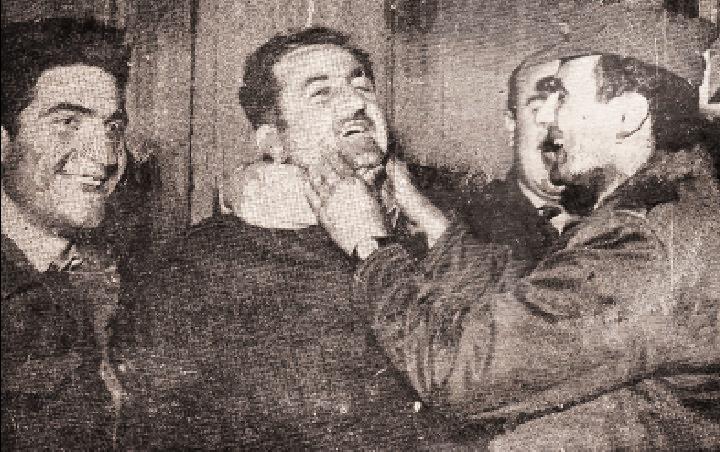
The military group preparing for the overthrow of the separatist regime in February 1963 was composed of independent Nasserite and other unionist, including Ba'athist officers. The re-emergence of the Ba'ath as a majority political force aided in the coup; without a political majority the coup would have remained a military take over . Ziyad al-Hariri controlled the sizable forces stationed at the Israeli Front, not far from Damascus, Muhammad as-Sufi commanded the key brigade stationes in Homs, and Ghassan Haddad, one of Hariri's independent partners, commanded the Desert Forces. Early in March it was decided the coup would be brought into action on 9 March. But on 5 March several of the officers wanted to delay the coup in hope of staging a bloodless coup. It was presumed that the Nasserites were preparing a coup of their own which effectively canceled the delay. The coup began at night and by the morning of 8 March it was evident that a new political era had begun in Syria.
Ruling party: 1963–1970

The secession from the UAR was a time of crisis for the party; several groups, including Hawrani, left the Ba'ath Party. In 1962, Aflaq convened a congress which re-established the Syrian Regional Branch. The division in the original Ba'ath Party between the National Command led by Michel Aflaq and the "regionalists" in the Syrian Regional Branch stemmed from the break-up of the UAR. Aflaq had sought to control the regionalist elementsan incoherent grouping led by Fa'iz al-Jasim, Yusuf Zuayyin, Munir al-Abdallah and Ibrahim Makhus. Aflaq retained the support of the majority of the non-Syrian National Command members (13 at the time).
Following the success of the February 1963 coup d'état in Iraq, led by the Ba'ath Party's Iraqi Regional Branch, the Military Committee hastily convened to plan a coup against Nazim al-Kudsi's presidency. The coupdubbed the 8 March Revolutionwas successful and a Ba'athist government was installed in Syria. The plotters' first order was to establish the National Council of the Revolutionary Command (NCRC), which consisted entirely of Ba'athists and Nasserists, and was controlled by military personnel rather than civilians. However, in its first years in power, the Syrian Regional Branch experienced an internal power struggle between traditional Ba'athists, radical socialists and the members of the Military Committee. The Nasserist and Muslim Brotherhood opposition joined forces to raise the spectre of communist takeover of Syria during the 1960s. They attacked the Ba'ath party as being anti-Sunni and condemned the state secularism of the regime as being anti-religious and atheist. Nasser himself proscribed the Syrian Ba'ath for its militant secularism and the radical Marxist proposals of its leaders. The first period of Ba'ath rule was put to an end with the 1966 Syrian coup d'état, which overthrew the traditional Ba'athists led by Aflaq and Bitar and brought Salah Jadid, the head of the Military Committee, to power (though not formally).

1970 Coup
Main article: Corrective movement (Syria)
After the 1967 Six-Day War, tensions between Jadid and Hafez al-Assad increased, and al-Assad and his associates were strengthened by their hold on the military. In late 1968, they began dismantling Jadid's support network, facing ineffectual resistance from the civilian branch of the party that remained under Jadid's control. This duality of power persisted until the Corrective Revolution of November 1970, when al-Assad ousted and imprisoned Atassi and Jadid. He then set upon a project of rapid institution-building, reopened parliament and adopted a permanent constitution for the country, which had been ruled by military fiat and a provisional constitutional documents since 1963. Assad significantly modified his predecessor's radical socialist economic policies, encouraged several wealthy urban families to increase their activities in the private sector, and allowed limited foreign investment from Arab countries in the Persian Gulf region States.
Reign of the Assads (1970–2024)
Hafez al-Assad (1970–2000)

Hafez Al-Assad's reign was marked by the virtual abandonment of Pan-Arab ideology; replacing it with the doctrine of socialist transformation and giving overriding priority in constructing socialist society within Syria. Political participation was limited to the National Progressive Front, the ruling coalition of Syrian Ba'ath and Marxist–Leninist parties; entrenching itself firmly within the Soviet Bloc. The Party also began building a personality cult around Assad and brought the elite of the armed forces under Assad's grip and the officer corps were installed with Alawite loyalists; further alienating the Sunni majority from the party.

By the late 1970s, the state apparatus of the Ba'ath regime under Assad had consolidated into an anti-Sunni orientation. Official propaganda incited Alawite farmers against rich Sunni landowners and regularly disseminated stereotypes of Sunni merchants and industrialists, casting them as enemies of nationalisation and socialist revolution. Bitterness towards the Assadist regime and the Alawite elite in the Ba'ath and armed forces became widespread amongst the Sunni majority, laying the beginnings of an Islamic resistance. Prominent leaders of Muslim Brotherhood like Issam al-Attar were imprisoned and exiled. A coalition of the traditional Syrian Sunni ulema, Muslim Brotherhood revolutionaries and Islamist activists formed the Syrian Islamic Front in 1980 with objective of overthrowing Assad through Jihad and establishing an Islamic state. In the same year, Hafez officially supported Iran in its war with Iraq and controversially began importing Iranian fighters and terror groups into Lebanon and Syria. This led to rising social tensions within the country which eventually became a full-fledged rebellion in 1982; led by the Islamic Front. The regime responded by slaughtering the Sunni inhabitants in Hama and Aleppo and bombarding numerous mosques, killing around 20,000–40,000 civilians. The uprising was brutally crushed and Assad regarded the Muslim Brotherhood as demolished.
Syria under Hafez al-Assad was a staunch Soviet ally and firmly aligned itself with Soviet Bloc during the height of the Cold War. Soviet Union saw Syria as the lynchpin of its Middle-East strategy and signed the Treaty of Friendship and Co-operation in 1980; directly committing itself to Syria's defense and incorporating the Syrian armed forces into Soviet standards. For his part, Hafez committed himself to socialist economic and foreign policies; and was one of the few autocrats to openly support the Soviet invasion of Afghanistan. The end of the Cold War and collapse of the Soviet Union dealt a deep blow to Assad, who retained the nostalgia for the old order. Assad continued to rule Syria until his death in 2000, by centralizing powers in the state presidency.
Bashar al-Assad (2000–2024)
.jpeg)
Hafez's son Bashar al-Assad succeeded him in office as President of Syria and Regional Secretary of the Syrian Regional Branch on 17 July and 24 June respectively. State propaganda portrayed the new president as the symbol of "modernity, youth, and openness". At the beginning, Bashar al-Assad's rule was met with high expectations, with many foreign commentators believing he would introduce reforms reminiscent of the Chinese economic reforms or the perestroika of Mikhail Gorbachev. A brief period of political and cultural opening known as Damascus Spring was stamped out during 2001–2002, when numerous intellectuals, activists and dissidents, were arrested or exiled, under the guise of "national unity". Image of Assad as a moderniser also vanished; when economic measures resulted in the concentration of wealth under loyalist oligarchs, heightened systematic corruption and increased poverty levels amongst the urban middle classes and villagers.
_06_(cropped).jpg)
Bashar al-Assad's rule was believed to be stable until the Arab Spring took place; the revolutions occurring in other parts of the Arab world acted as an inspiration for the Syrian opposition, leading to the 2011 Syrian revolution which escalated into a civil war. The Syrian Regional Branch has demonstrated absolute loyalty to Bashar al-Assad in its entirety throughout the civil war, from organising counter-demonstrations to forming paramilitary units focused on violently crushing peaceful demonstrators of the Syrian Revolution. It is generally believed that the plays a minor role in the conflict, having been reduced to a mass organization, and real decision-making taking place either in the military, the Assad family or Bashar al-Assad's inner circle. Despite this, the party remained loyal to the government almost in its entirety throughout the civil war, probably out of concerns that the overthrow of the Assad family's rule would result in its own demise as well. Several militias were formed by Ba'ath Party volunteers to fight against insurgents, with the most notable being the Ba'ath Brigades. The civil war also resulted in a referendum on a new constitution on 26 February 2012. The constitution was approved by the populace, and the article stating that Ba'ath Party was "the leading party of society and state" was removed and the constitution was ratified on 27 February.
Another aspect of Assad's tenure was the restoration of close alliance with Russia, the successor state of former Soviet Union. As protests erupted in 2011 as part of the Arab Spring and later proiliferated into a Civil War; Russia became the sole member to safeguard Assad in the UN Security Council. In September 2015; Vladimir Putin ordered a direct Russian military operation in Syria on behalf of Assad; providing the regime with training, volunteers, supplies and weaponry; and has since engaged in extensive aerial bombardment campaigns throughout the country targeting anti-Assad rebels.
Between 2018 and 2024, the government enacted an extensive Ba'athification campaign in its territories, amalgamating the state-party nexus and further entrenching its one-party rule. During the 2018 local elections and 2020 parliamentary elections, more hardline Ba'athist loyalists were appointed to commanding roles while other satellite parties in the National Progressive Front had been curtailed. Ba'athist candidates were fielded uncontested in many regions. The party itself was structurally overhauled, re-invigorating neo-Ba'athist ideology in organizational levels, and cadres accused of lacking ideological dedication were purged. The party portrayed itself as the vanguard of the Syrian nation and had tightened its monopoly on youth organisations, student activism, trade unions, agricultural organisations and other civil society groups.
On 8 December 2024, the Syrian Arab Republic under Assad collapsed amid major offensives by the Syrian opposition led by Hayat Tahrir al-Sham. The fall of Damascus marked the end of the regime of the al-Assad family. Assad fled Damascus by plane.
Post-Assad era
Following the fall of the Assad regime, the Ba'ath's Central Command published a statement on the party's newspaper Al-Ba'ath, announcing the party's intention to cooperate with the Syrian transitional government, which is currently being led by members of Hayat Tahrir al-Sham, in order to "defend the unity of the country, land, people, institutions and capabilities". It also called for reforms to provide for political pluralism and separation of powers. Two days later, an internal statement on December 11 was circulated among members and published on Al-Ba'ath which announced the suspension of all party activities "until further notice" and the handover of all vehicles and weapons belonging to the party to the Ministry of Interior as well as all party funds to the Ministry of Finance, with the property's proceeds going towards the Central Bank of Syria so as to be spent by the transitional government "according to the law"; the Al-Sham Private University was also announced to be placed under the supervision of the Ministry of Higher Education while all other party assets were to be transferred to the Ministry of Justice, including the former headquarters of the party, where it was turned into a settlement center for former members of the army and security forces who served under Assad.
On 20 January 2025, the building that housed the headquarters of a local branch of the party in Suwayda was transferred to a local branch of Damascus University by the Syrian transitional government.
On 29 January 2025, the party was formally dissolved by the newly declared president of the Syrian transitional government, Ahmed al-Sharaa, along with the 2012 constitution, the People's Assembly, the Syrian Arab Armed Forces, and the security services affiliated with the deposed regime.
Organization
General Congress
The General Congress was supposed to be held every fourth year to elect members of the Central Command. Since 1980, its functions have been eclipsed by the Central Committee, which was empowered to elect the Central Command. By 1985's 8th Regional Congress, the Command Secretary was empowered to elect the Central Committee. The 8th Regional Congress would be the last congress held under Hafez al-Assad's rule. The next Regional Congress was held in June 2000 and elected Bashar al-Assad as Command Secretary and elected him as a candidate for the next presidential election.
Delegates to the General Congress were elected beforehand by the Central Command leadership. While all delegates came from the party's local organisation, they was forced to elect members presented by the leadership. However, some criticism was allowed. At the 8th Regional Congress, several delegates openly criticised the growing political corruption and the economic stagnation in Syria. They could also discuss important problems to the Central Command, which in turn could deal with them. ;Regional Congresses before the Regional Branch's dissolution in 1958
- 1st Regional Congress (March 1954)
- 2nd Regional Congress (March 1955)
- 3rd Regional Congress (9–12 July 1957) ;Regional Congresses held after the Regional Branch's reestablishment
- 1st Regional Congress: 5 September 1963
- 2nd Regional Congress: 18 March – 4 April 1965
- 3rd Regional Congress: September 1966
- 4th Regional Congress: 26 September 1968
- 5th Regional Congress: 8–14 May 1971
- 6th Regional Congress: 5–15 April 1975
- 7th Regional Congress: 22 December – 7 January 1980
- 8th Regional Congress: 5–20 January 1985
- 9th Regional Congress: 17–21 June 2000
- 10th Regional Congress: 6–9 June 2005 ;Extraordinary Regional Congresses
- 1st Extraordinary Regional Congress: 1 February 1964
- 2nd Extraordinary Regional Congress: 1 August 1965
- 3rd Congress of the Regional Emergency: 10–13 and 20–27 March 1966
- 4th Congress of the Regional Emergency: September 1967
- 5th Regional Emergency Congress: 21–31 March 1969
- 6th Regional Congress of the Emergency: June 1974
Central Command
Main article: Central Command of the Arab Socialist Ba'ath Party – Syria Region

The Central Command, according to the Syrian Constitution, had the power to nominate a candidate for president. While the constitution did not state that the Secretary of the Central Command is the President of Syria, the charter of the National Progressive Front (NPF), of which the Ba'ath Party was a member, stated that the President and the Central Command Secretary is the NPF President, but this was not stated in any legal document. The 1st Extraordinary Regional Congress held in 1964 decided that the Secretary of the Central Command would also be head of state. The Central Command was officially responsible to the General Congress.
Central Committee
The Central Committee (), established in January 1980, was subordinate to the Central Command. It was established as a conduit for communication between the Ba'ath Party leadership and local party organs. At the 8th Regional Congress held in 1985, membership size increased from 75 to 95. Other changes was that its powers were enhanced; in theory, the Central Command became responsible to the Central Committee, the hitch was that the Central Command Secretary elected the members of the Central Committee. Another change was that the Central Committee was given the responsibilities of the Regional Congress when the congress was not in session. As with the Central Command, the Central Committee was in theory supposed to be elected every fourth year by the Regional Congress, but from 1985 until Hafez al-Assad's death in 2000, no Regional Congress was held.
Central-level organs
Military Bureau
Main article: Military Committee of the Ba'ath party
The Military Bureau, which succeeded the Military Committee, oversaw the Syrian Armed Forces. Shortly after the 8 March Coup, the Military Committee created National Council for the Revolutionary Command (NCRC) and became the supreme authority in military affairs. The party had a parallel structure within the Syrian armed forces. The military and civilian sectors only met at the regional level, as the military sector is represented in the Central Command and sends delegates to general congresses. The military sector was divided into branches, which operated at the battalion level. The head of a military party branch was called a tawjihi, or guide.

In 1963, the Military Committee established the Military Organisation, which consisted of 12 branches resembling their civilian counterparts. The Military Organisation was led by a Central Committee, which represented the Military Committee. These new institutions were established to stop the civilian faction meddling in the affairs of the Military Committee. The Military Organisation met with the other branches through the Military Committee, which was represented at the Regional and National Congresses and Commands. The Military Organisation was a very secretive body. Members were sworn not to divulge any information about the organisation to officers who were not members in order to strengthen the Military Committee's hold on the military. In June 1964, it was decided that no new members would be admitted to the organisation. The Military Committee was built on a democratic framework, and a Military Organization Congress was held to elect the members of the Military Committee. Only one congress was ever held.
The lack of a democratic framework led to internal divisions within the Military Organisation among the rank-and-file. Tension within the organisation increased, and became apparent when Muhammad Umran was dismissed from the Military Committee. Some rank-and-file members presented a petition to the Regional Congress which called for the democratisation of the Military Organisation. The National Command, represented by Munif al-Razzaz, did not realise the importance of this petition before Salah Jadid suppressed it. The Military Committee decided to reform, and the Regional Congress passed a resolution which made the Military Organisation responsible to the Military Bureau of the Central Command, which was only responsible for military affairs.
Central Party School
Ali Diab is the current head of the Ba'ath Party's Central Party School.
Lower-level organizations
The party had 19 branches in Syria: one in each of the thirteen provinces, one in Damascus, one in Aleppo and one at each of the country's four universities. In most cases the governor of a province, police chief, mayor and other local dignitaries comprised the Branch Command. The Branch Command Secretary and other executive positions were filled by full-time party employees.
Members
Michel Aflaq and Salah al-Din al-Bitar, the two principal fathers of Ba'athist thought, saw the Ba'ath Party as a vanguard party, comparable to the Soviet Union's Communist Party, while Assad saw it as a mass organisation. In 1970 he stated, "After this day the Ba'ath will not be the party of the elect, as some has envisaged ... Syria does not belong to the Ba'athists alone."
Since 1970, membership of the Ba'ath Party in Syria expanded dramatically. In 1971, the party had 65,938 members; ten years later it stood at 374,332 and by mid-1992 it was 1,008,243. By mid-1992, over 14 percent of Syrians aged over 14 were members of the party. In 2003, the party membership stood at 1.8 million people, which is 18 percent of the population. The increase in membership was not smooth. In 1985 a party organisational report stated that thousand of members had been expelled before the 7th Regional Congress held in 1980 because of indiscipline. The report also mentioned the increased tendency of opportunism among party members. Between 1980 and 1984, 133,850 supporter-members and 3,242 full members were expelled from the party.
The increase in members has led official propaganda, and leading members of the party and state, to say that the people and the party are inseparable. Michel Kilo, a Syrian Christian dissident and human rights activist, said, "The Ba'ath does not recognize society. It consider itself [to be] society." This idea led to Ba'athist slogans and tenets being included in the Syrian constitution. In 1979, the Ba'ath Party's position was further strengthened when dual party membership became a criminal offence.
Ideology

The original Ba'ath headed by Michel Aflaq had viewed Islam as a unique religion that shaped Arab history and society, calling for the incorporation of pan-Arabism with Islamic religious values. On other hand; the younger Neo-Ba'athists who came from minority communities like Alawites were highly influenced by communist ideals and incorporated Marxist anti-religious, economic ideas and downplayed efforts for pan-Arab unity. The Neo-Ba'athist faction that took official control of Syria following the 1966 coup were advocates of militant revolution, calling for immediate socialist transformation of society. The Soviet Union began supporting the group for its leftist programme and denounced its rival Iraqi Ba'ath as "reactionary" and "right-wing". The early years of neo-Ba'ath power was marked by militarism along with increasing sectarianism in the army and party elites. State propaganda regularly attacked religion and belief in God and young students were given compulsory military training. Big businesses, banks and large agricultural lands were all nationalised. These policies brought the Syrian Ba'athists into conflict with Arab nationalist ideologies like Nasserism, which was accused of betraying socialist ideals. Nasser, in turn, charged the Ba'ath with anti-religion and sectarianism.

Neo-Ba'athism advocates the creation of a "vanguard" of leftist revolutionaries committed to build an egalitarian, socialist state in Syria and other Arab countries before making steps to achieve pan-Arab unity. The vanguard organisation is the Ba'th party; which advocates class-struggle against the traditional Syrian economic elite classes; the big agriculturalists, industrialists, bourgeoisie and feudal landlords. By the 1970s, 85% of agricultural lands were distributed to landless peasant populations and tenant farmers. Banks, oil companies, power production and 90% of large-scale industries were nationalised. The neo-Ba'athists led by Salah Jadid who came to power in 1966 concentrated on improving the Syrian economy and exporting the doctrines of class-conflict and militant socialist revolution to the neighbouring countries.

This view was challenged by General Hafez al-Assad and his neo-Ba'ath faction; who were proponents of a military-centric approach and focused on a strategy of strengthening the Syrian military to defend the socialist government against imperialist forces and their alleged internal collaborators. Assad favoured reconciliation of various leftist factions and pursued better relations with other Arab states. Although majority of the party members favoured Salah, Hafez was able to gain the upperhand following the events of the 1970 coup dubbed the "Corrective Movement" in official Syrian Ba'ath history. Assad's victory also marked the supersedure of the military over the Ba'ath party structures; making the armed forces a central centre of political power.
Assadism

Since the end of the Cold War and fall of the Soviet Bloc in the 1990s, the official ideological paradigm of the Ba'athist dogma in Syria has been described as foundering. Despite decades of one-party rule that has lasted longer than the period of independent Syria (1946–1963); Ba'athist ideology itself has not gained popular legitimacy. The role of the party has become supplanted with the cult of personality surrounding the Assad dynasty and a consolidation of communal-based allegiances. Assad's government was a personalist system and his wisdom was portrayed as "beyond the comprehension of the average citizen". Assad deepened the Alawitization of the party and the military; reduced the role of the civilian wing of party and based his state governance structure on loyalty to the leader's family. State biography of Hafiz al-Assad describes this philosophy as "Asadiyah (Assadism)" defining it as: "the New Ba'th led by Hafiz al‑Asad, representing a new distinctive current in Syria which has been developed by him; it is a school of thought which has benefited from Nasserism, but has surpassed it, just as it has surpassed the traditional Ba'thist school, albeit that it does not contradict either of these schools of thought but has further developed them in line with contemporary needs."

Assad personality cult was portrayed as integral to the prosperity and security of the nation; with Hafez al-Assad being depicted as the father figure of the Syrian nation. Ceremonies and slogans of loyalty, praise and adulation of Assads were a daily part of schools, party centres, government offices, public spaces and the military. Official state propaganda attributed Assad with supernatural abilities combined by repetitive usage of symbolism that discouraged wider society from arenas for political activism. Upon the death of Hafez al-Assad in 2000, his successor Bashar al-Assad was depicted as a reformist and youthful hope. Hafez's inner circle elite was replaced by a far more restricted faction of elites closer to Bashar, often referred to as the "New Guard". Major posts in the armed forces were awarded to Alawite loyalists, family relatives and many non-Alawite elites that served under Hafez were expelled. Another important shift was the end of the Ba'th party's practical significance; with it being reduced to a formal structure for affirming fealty to Bashar and support for his revamped crackdowns on the newly established independent civil society groups, political activists and reformist voices that arose during the Damascus Spring in the 2000s.
Describing the nature of Assadist ideological propaganda in her work Ambiguities of Domination, Professor of political science Lisa Wedeen writes: "Asad's cult is a strategy of domination based on compliance rather than legitimacy. The regime produces compliance through enforced participation in rituals of obeisance that are transparently phony both to those who orchestrate them and to those who consume them. Asad's cult operates as a disciplinary device, generating a politics of public dissimulation in which citizens act as if they revere their leader... It produces guidelines for acceptable; it defines and generalizes a specific type of national membership; it occasions the enforcement of obedience; it induces complicity by creating practices in which citizens are themselves "accomplices", upholding the norms constitutive of Asad's domination; it isolates Syrians from one another; and it clutters public space with monotonous slogans and empty gestures, which tire the minds and bodies of producers and consumers alike... Asad is powerful because his regime can compel people to say the ridiculous and to avow the absurd."
Religion

Like Marxists, Syrian Ba'athist ideologues viewed religion as a tool used by traditional elites to oppress the weaker sections of the society and reinforce their conservative social order. Anti-religious propaganda has been a common ideological theme in the literature published by Syrian Ba'ath party. Militant secularism was emphasized in the "Declaration of Principles" manifesto published by the Ba'ath party in 1960; which declared that the party's "educational policy" was to build a "new generation of Arabs that believes in the unity of the nation and the eternity of its mission". The manifesto also stated that this envisaged Ba'athist generation would be "committed to scientific thought freed from the shackles of superstition and backward customs" and replace religion with Arab nationalism as their belief system. Syrian Ba'athist documents regularly depicted religion as a social institution that advanced "the values of feudalism and imperialism".
Neo-Ba'athism views religion as the "foremost symbol of reaction" preventing the birth of a modern socialist society, and advocate strict state supervision over religious activities for sustaining what its ideologues regard as a healthy, secularist society. During Salah Jadid's reign in power, the Ba'ath postured itself as a strongly anti-religious political entity; adhering to the Marxist–Leninist approach of top-down regimentation of the society through liquidation of what it regarded as "reactionary" classes such as the traditional ulema. The Grand Mufti's official status was downgraded by the Ba'athist government and the conventional role of religious clergy in state functioning was curtailed. While state ministers, officials, educators, etc. regularly preached about the "perils of religion"; party periodicals and magazines during the 1960s regularly made predictions about the "impending demise" of religion through the socialist revolution. In an article titled "The Path to Creation of the New Arab Man" published by the Syrian Arab Army magazine "People's Army" in 1967, party ideologue Ibrahim Khalas declared: "The New Man believes that God, religions, feudalism, capitalism, imperialism and all the values that govern the ancient society are mummies that are just worth being put away in the museum of History.... We don't need a man who prays and kneels, who bows his head with baseness and begs God for pity and mercy. The New Man is a socialist, a revolutionary."

During the rule of Salah Jadid, neo-Ba'athist ideologues openly denounced religion as a source of what they considered as the backwardness of the Arabs. Following popular revulsion at Jadid's blatant anti-religious policies, Hafez al-Assad began to tone down the secularisation programme during the 1970s, by co-opting some pro-government clerics like Ramadan al-Bouti to counter the Islamic opposition and granted them a degree of autonomy from the regime. Simultaneously, the regime began the "nationalization" of religious discourse through a loyal clerical network, and condemned anyone deviating from the state-promoted Ba'thist religious ideology as a threat to the society. The state-sponsored religious discourse during the rule of Hafez al-Assad promoted a left-wing nationalist worldview that sought to anathematize Islamists and re-inforce loyalty towards the Alawite president.
The era of d'tente between the religious establishment and the Ba'athists came to an end in 2008, when Bashar al-Assad appointed Muhammad al-Sayyid as Chief of the Ministry of Awqaf, which marked an era of harsh regulations in the religious landscape. Numerous private religious educational institutes, religious charities, independent preaching organisations, female religious centres, etc. were forcibly shut down as part of the revamped state -sponsored secularization drive. The state also tightened its grip over the official religious institutions and dissident Islamic voices were imprisoned, leading to open rift with the ulema. Private religious institutes were allowed donations only after official permission from the Ministry of Awqaf, which also controlled the expenditures. The state was also entrusted with a broad range of powers including the hiring and firing of its instructors as well as the standardisation of their religious curriculum with the Ba'thist religious policy advocated by the Assad government, effectively nationalising the private religious institutes.
In 2009, Ba'ath party activists launched ideological campaigns against the Niqab (Islamic face veils) and alleged "extremist trends" in the society, which was complemented by the regime's revamped clampdown on religious activists, independent religious scholars and private schools. Popular display of religious symbols of all sects was banned in 2010 and officials close to the ulema were suspended, under the pretext of preserving the "secular character" of the country. The regime also implemented nation-wide ban on the Niqab (face-covering) and imposed restrictions on female Islamic organisations like the Al-Qubaisiat, which ignited a region-wide controversy. By the onset of Arab Spring in late 2010, relationship between the ulema and the Assad regime had sunk to its lowest level, with even staunch Assad-loyalists like the Grand Mufti Ramadan al-Bouti expressing public discontent.
With the outbreak of the Syrian civil war, regime's crackdown on religious dissidents increased, particularly those of Sunni background over allegations of sympathies with Syrian opposition groups. In November 2021, Assad abolished the office of Grand Mufti of Syria. Describing Assadism as a quasi-religion fostered by the Ba'athist state for mobilising the fealty and adulation of Syrian citizens, Professor of Middle Eastern Studies at Bonn International Centre Dr. Esther Meininghaus wrote: "by drawing on religion, the Assad regime successfully sought to promote a value system ultimately rooted in the Baʿthist vision for Syrian society.... To this, we can indeed add the cult surrounding Presidents Hafiz and Bashar al-Asad, whose pictures are displayed not only in public buildings and schools but taxis and shops, or ceremonies such as mass parades and/or the playing of the national anthem during official celebrations. Also, official rhetoric has become increasingly infused with transcendental and metaphysical elements, in particular with regard to the President's personality cult. For instance, the President is addressed as the 'Eternal Leader who will guide his people to becoming the 'true' Arab nation. The recent slogan of Bashar, Allah, Suriyya wa-bas (Bashar, God, and Syria – that's it) possibly best epitomises how close the regime has come to creating a Syrian public religion in its own right. Whether the outward performance of 'regime rituals' was actually fully internalised or secretly mocked, it had to be practised and obeyed."
Status
At the time of Bashar al-Assad's election in the party's June 2000 Regional Congress, which was fifteen years after the last such congress, Subhi Hadidi, a Syrian dissident, commented "The Ba'ath is in complete disarray. ... It's like a dead body. It's no longer a party in any normal sense of the word." Hanna Batatu wrote, "Under Assad the character of the Ba'ath changed ... Whatever independence of opinion its members enjoyed in the past was now curtailed, a premium being placed on conformity and internal discipline. The party became in effect another instrument by which the regime sought to control the community at large or to rally it behind its policies. The party's cadres turned more and more into bureaucrats and careerists, and were no longer vibrantly alive ideologically as in the 1950s and 1960s, unconditional fidelity to Assad having ultimately overridden fidelity to old beliefs."
According to Volker Perthes, the Ba'ath Party was transformed under Assad; Perthes wrote, "It was further inflated such as to neutralise those who had supported the overthrown leftist leadership, it was de-ideologised; and it was restructured so as to fit into the authoritarian format of Assad's system, lose its avant-garde character and became an instrument for generating mass support and political control. It was also to become the regime's main patronage network."

The Ba'ath Party was turned into a patronage network closely intertwined with the bureaucracy, and soon became virtually indistinguishable from the state, while membership rules were liberalized. In 1987, the party had 50,000 members in Syria, with another 200,000 candidate members on probation. The party lost its independence from the state and was turned into a tool of the Assad government, which remained based essentially in the security forces. Other parties that accepted the basic orientation of the government were permitted to operate again. The National Progressive Front was established in 1972 as a coalition of these legal parties, which were only permitted to act as junior partners to the Ba'ath, with very little room for independent organisation.
Despite its social and political subservience to Assadism, the Ba'ath party apparatus and its working establishments were crucial components in daily governance. The party facilitated Assad family's tight control over the state, served to organize supporters and mobilize mass-rallies for social legitimacy. Despite affirmation of multiple parties in the 2012 constitution; no real opposition was allowed to operate in practice. All candidates to the People's Assembly and local councils were from the National Progressive Front (NPF), a Ba'athist-led alliance firmly committed to the government. After 2018, the Ba'ath party expanded its political dominance and fielded more candidates in regional and national electoral processes, at the expense of other parties in the NPF. Internally, the party was strictly monitored by the High Command and regional Ba'athist leaders suspected of insufficient loyalty were expelled as "grey members" (al-Ramadiyyin).
As of 2022, the Ba'athists continued to dominate the regional councils, civil services, parliament, army and Mukhabarat. Vast majority of legalized trade unions, students associations also belonged to the Ba'ath party. More than a third of government employees in rural regions were Baath members; whereas in urban areas about half the officers were Baathists. Baath party institutions were vital to establish bureaucratic functioning in the government-controlled regions. Other parties of the National Progressive Front were minority in size.
Anthem
| Arabic script | Arabic transliteration | English translation | ||
|---|---|---|---|---|
| {{lang | ar | يا شبـاب العرب هيـا وانطـلق يا موكبـي | yā šabāba l-ʕarbi hayyā wa-nṭaliq yā mawkibī | Arab youth, raise and march to fight your enemies, |
| Lyrics: Suleiman al-Issa |
Election results
Presidential elections
| Election | Party candidate | Votes | % | Result | 1971 | 1978 | 1985 | 1991 | 1999 | 2000 | 2007 | 2014 | 2021 |
|---|---|---|---|---|---|---|---|---|---|---|---|---|---|
| Hafez al-Assad | 1,919,609 | 99.2% | Elected | ||||||||||
| 3,975,729 | 99.9% | Elected | |||||||||||
| 6,200,428 | 100% | Elected | |||||||||||
| 6,726,843 | 99.99% | Elected | |||||||||||
| 8,960,011 | 100% | Elected | |||||||||||
| Bashar al-Assad | 8,689,871 | 99.7% | Elected | ||||||||||
| 11,199,445 | 99.82% | Elected | |||||||||||
| 10,319,723 | 88.7% | Elected | |||||||||||
| 13,540,860 | 95.1% | Elected |
Syrian People's Assembly elections
References
Notes
Bibliography
Journals and papers
Books
References
- [[Federal Research Division]] (2004). ''Syria: A Country Study''. [[Kessinger Publishing]]. p. 215. {{ISBN. 978-1-4191-5022-7.
- "السيرة الذاتية للرفاق أعضاء القيادة المركزية لحزب البعث العربي الاشتراكي07-05-2024".
- (9 May 2024). "هنأ بوتين بتنصيبه رئيساً لروسيا الاتحادية لولاية جديدة ... الرئيس الأسد للقيادة المركزية: الحوار أحد أهم آليات تعزيز حضور «البع". [[Al-Watan (Syria).
- (2013). "Historical Dictionary of Syria". Scarecrow Press.
- "Syria". Arab Press Network.
- (2008). "The Encyclopedia of the Arab-Israeli Conflict: A Political, Social, and Military History". [[ABC-CLIO]].
- (23 December 2015). "Syria's Conflicting Powers Develop Separate Education Curriculums".
- [http://ryu-sy.org/ أحدث أخبار وفعاليات منظمة اتحاد شبيبة الثورة] {{Webarchive. link. (18 November 2022 (The latest news and events of the Revolutionary Youth Union).)
- Edward Dark. (14 March 2014). "Pro-regime Sunni fighters in Aleppo defy sectarian narrative". [[Al Monitor]].
- (20 September 2018). "Source: The "Tiger" Cancels the Contracts of 6500 of Its Troops throughout Syria".
- (9 July 2012). "Profile: Syria's ruling Baath Party". [[BBC]].
- Korany, Baghat; Dessouki, Ali (2010). ''The Foreign Policies of Arab States: The Challenge of Globalization''. [[American University in Cairo Press]]. pp. 423–424. {{ISBN. 978-977-416-360-9. "Zisser similarly highlights the "clearly personal character" of the Syrian regime and how it revolves "completely around the personality and image of the man who created it"; Nicholas coins the term 'Assadism' to express how the "Assad [[cult of personality. leadership cult]]" dominates Syrian politics; and Cleveland stresses how this personalization, aimed at "raising the image of the president to the level of one whose wisdom was beyond the comprehension of the average citizen", is the most distinctive character of the Syrian regime."
- [[Viorst, Milton]] (1995). ''Sandcastles: The Arabs in Search of the Modern World''. [[Syracuse University Press]]. p. 146. {{ISBN. 978-0224033237.
- Phillips, Christopher. (2020). "The Battle for Syria: International Rivalry in the New Middle East". Yale University Press.
- Atassi, Karim. (2018). "Syria, the Strength of an Idea: The Constitutional Architectures of Its Political Regimes". Cambridge University Press.
- Atassi, Karim. (2018). "Syria, the Strength of an Idea: The Constitutional Architectures of Its Political Regimes". Cambridge University Press.
- C. Tucker, Spencer. (2015). "U.S. Conflicts in the 21st Century". ABC-CLIO.
- Meininghaus, Esther. (2016). "Creating Consent in Ba'thist Syria: Women and Welfare in a Totalitarian State". I. B. Tauris.
- (2008). "A Companion to the History of the Middle East". Wiley Blackwell.
- (1982). "Socialist Models of Development". Pergamon Press.
- Heydemann, Steven. (1999). "Authoritarianism in Syria: Institutions and Social Conflict". Cornell University Press.
- (2019). "Women's Work and Women's Lives: The Continuing Struggle Worldwide". Routledge.
- Moaddel, Mansoor. (2005). "Islamic Modernism, Nationalism, and Fundamentalism: Episode and Discourse". University of Chicago Press.
- Solomon, Christopher. (2022). "In Search of Greater Syria: The History and Politics of the Syrian Social Nationalist Party". I.B. Tauris.
- Awad, Ziad. (27 January 2023). "The 2022 Syrian Local Elections: A Leadership Rooted in Regime Networks". European University Institute.
- (2020). "Arab Lefts: Histories and Legacies, 1950s-1970s". Edinburgh University Press.
- (2000). "War, Institutions, and Social Change in the Middle East". University of California Press.
- Suerbaum, Magdalena. (2021). "Masculinities and Displacement in the Middle East: Syrian Refugees in Egypt". I.B Tauris.
- Umit Ungor, Ugur. (2020). "Paramilitarism: Mass Violence in the Shadow of the State". Oxford University Press.
- Fleischman, Luis. (2021). "The Middle East Riddle: A Study of the Middle East Peace Process and Israeli-Arab Relations in Current Times". New Academia Publishing.
- "Bashar's Syria: The Regime and its Strategic Worldview".
- (1970). "The Israel Economist". Kollek & Son, Limited.
- (13 December 2017). "Syrian nationalism is all about masculinity". The Conversation.
- Nisan, Mordechai. (2017). "Politics and War in Lebanon: Unraveling the Enigma". Routledge.
- (2020). "Baʿath Party".
- (June 2007). "SYRIA'S CHALLENGES AFTER THE ELECTION YEAR IS BASHAR AL-ASAD PART OF THE PROBLEM OR PART OF THE SOLUTION IN THE MIDDLE EAST?". Papel Politico.
- Walt, Stephen. (1987). "The Origins of Alliances". [[Cornell University Press]].
- Pipes, Daniel. (1996). "Syria Beyond the Peace Process". Daniel Pipes.
- Elizabeth O'Bagy. (7 June 2012). "Syria's Political Struggle: Spring 2012". ISW.
- Perthes, Volker (1997). The Political Economy of Syria Under Asad. I.B. Tauris. p. 156. {{ISBN. 1-86064-192-X.
- (2024-12-08). "Syrian President Bashar al-Assad has left Damascus to an unknown destination, say two senior army officers".
- "تعيين الشرع رئيسا لسوريا في المرحلة الانتقالية".
- Galvani, John. (February 1974). "Syria and the Baath Party". MERIP Reports.
- Roberts, David. (2015). "The Ba'ath and the creation of modern Syria". Routledge.
- (15 June 1997). "Syria Between Two Transitions".
- Roberts, David. (2015). "The Ba'ath and the creation of modern Syria". Routledge.
- Pipes, Daniel. (1996). "Syria Beyond the Peace Process". Daniel Pipes.
- Roberts, David. (2015). "The Ba'ath and the creation of modern Syria". Routledge.
- Roberts, David. (2015). "The Ba'ath and the creation of modern Syria". Routledge.
- Pipes, Daniel. (1995). "Syria Beyond the Peace Process". Washington Institute for Near East Policy.
- Rezaei, Farhad. (2019). "Iran's Foreign Policy After the Nuclear Agreement". Palgrave Macmillan.
- (9 June 2021). "Assad's 20-year rule, from Damascus Spring to pariah". France 24.
- Rabil, Robert. (2 June 2005). "Baath Party Congress in Damascus: How Much Change in Syria?". [[Washington Institute for Near East Policy]].
- (1 April 2012). "The Damascus Spring".
- al-Amin, Ibrahim. (9 July 2013). "Syria's Baath: A National Sideshow". [[Al Akhbar (Lebanon).
- (3 July 2020). "Al-Assad attempts to boost "Ba'ath" vigor to tighten control".
- Aron Lund. (13 January 2014). "The Baath Battalions Move into Damascus". [[Carnegie Endowment for International Peace]].
- (15 February 2012). "Syria to hold referendum on new constitution". [[BBC World News]]. [[BBC Online]].
- Chulov, Martin. (27 February 2012). "Syrian regime rockets bombard Homs". Guardian News and Media.
- (28 February 2012). "Presidential Decree on Syria's New Constitution". [[Syrian Arab News Agency]].
- Rezaei, Farhad. (2019). "Iran's Foreign Policy After the Nuclear Agreement". Palgrave Macmillan.
- (28 January 2021). "Inside Syria's Clapping Chamber: Dynamics of the 2020 Parliamentary Elections".
- Lucas, Scott. (25 February 2021). "How Assad Regime Tightened Syria's One-Party Rule". EA Worldview.
- (December 8, 2024). "Syrian rebels topple Assad who flees to Russia in Mideast shakeup".
- (9 December 2024). "Statement by the Central Leadership of the Arab Socialist Ba'ath Party in Syria".
- Hassoun, Ali. (11 December 2024). "Internal Statement".
- (11 December 2024). "Baath Party Of Syria's Assad Says Suspends Work Indefinitely".
- AFP, Daily Sabah with. (2024-12-13). "Jumping ship: Syrians abandon once-mighty Assad's Baath party".
- (2024-12-30). "Now Syria's long-ruling Baath party is collapsing, too".
- (2025-01-20). "مبروك للسويداء و أبناءها الجامعيين،... - لواء جبل الكرامة {{!}} Facebook".
- Nasr, Hassan. (2025-01-20). "وزير التعليم العالي يعلن من السويداء تحويل مقر فرع حزب البعث لصالح جامعة دمشق".
- (10 June 2000). "National leadership workshop Arab world in the Heart of Regional and International Conflict". Arab Socialist Ba'ath Party – Syria Region.
- Roberts, David. (2015). "The Ba'ath and the creation of modern Syria". Routledge.
- S. Abu Jaber, Kamel. (1966). "The Arab Ba'th Socialist Party: History, Ideology and Organization". Syracuse University Press.
- Roberts, David. (2015). "The Ba'ath and the creation of modern Syria". Routledge.
- Walt, Stephen. (1987). "The Origins of Alliances". [[Cornell University Press]].
- F. Devlin, John. (1976). "The Baath Party: A History From its Origins to 1966". Hoover Institution Press.
- Galvani, John. (February 1974). "Syria and the Baath Party". MERIP Reports.
- (2010). "The Foreign Policies of Arab States: The Challenge of Globalization". [[American University in Cairo Press]].
- Van Dam, Nikolaos. (2011). "The Struggle for Power in Syria: Politics and Society Under Asad and the Ba'th Party". I. B Tauris.
- Van Dam, Nikolaos. (2011). "The Struggle for Power in Syria: Politics and Society Under Asad and the Ba'th Party". I. B Tauris.
- Phillips, Christopher. (2020). "The Battle for Syria: International Rivalry in the New Middle East". Yale University Press.
- Aslan Ozgul, Billur. (2019). "Leading Protests in the Digital Age: Youth Activism in Egypt and Syria". Palgrave Macmillan.
- A. Reilly, James. (2018). "Fragile Nation, Shattered Land: The Modern History of Syria". I. B Tauris.
- (2017). "Change and Continuity in North Korean Politics". Routledge.
- Wedeen, Lisa. (2015). "Ambiguities of Domination: Politics, Rhetoric, and Symbols in Contemporary Syria". University of Chicago Press.
- Rubin, Barry. (2007). "The Truth About Syria". Palgrave Macmillan.
- "Bashar's Syria: The Regime and its Strategic Worldview".
- (2013). "Middle East Authoritarianisms: Governance, Contestation and regime resilience in Syria and Iran". Stanford University Press.
- "Bashar's Syria: The Regime and its Strategic Worldview".
- (2013). "Middle East Authoritarianisms: Governance, Contestation and regime resilience in Syria and Iran". Stanford University Press.
- (2013). "Middle East Authoritarianisms: Governance, Contestation and regime resilience in Syria and Iran". Stanford University Press.
- "Bashar's Syria: The Regime and its Strategic Worldview".
- (2013). "Middle East Authoritarianisms: Governance, Contestation and regime resilience in Syria and Iran". Stanford University Press.
- (2013). "Middle East Authoritarianisms: Governance, Contestation and regime resilience in Syria and Iran". Stanford University Press.
- (2013). "Middle East Authoritarianisms: Governance, Contestation and regime resilience in Syria and Iran". Stanford University Press.
- (16 November 2021). "Syrian president abolishes position of Grand Mufti". Al Jazeera.
- Meininghaus, Esther. (2016). "Creating Consent in Ba'thist Syria: Women and Welfare in a Totalitarian State". I. B. Tauris.
- "The Banality of Authoritarian Control: Syria's Ba'ath Party Marches On".
- "Al-Assad: The Presidency That Never Ends".
- Awad, Ziad. (27 January 2023). "The 2022 Syrian Local Elections: A Leadership Rooted in Regime Networks". European University Institute.
- البعث. (2023-08-14). "نشيد حزب البعث - حزب البعث العربي الاشتراكي {{!}} فلسطين".
This article was imported from Wikipedia and is available under the Creative Commons Attribution-ShareAlike 4.0 License. Content has been adapted to SurfDoc format. Original contributors can be found on the article history page.
Ask Mako anything about Arab Socialist Ba'ath Party – Syria Region — get instant answers, deeper analysis, and related topics.
Research with MakoFree with your Surf account
Create a free account to save articles, ask Mako questions, and organize your research.
Sign up freeThis content may have been generated or modified by AI. CloudSurf Software LLC is not responsible for the accuracy, completeness, or reliability of AI-generated content. Always verify important information from primary sources.
Report