From Surf Wiki (app.surf) — the open knowledge base
Almería
.jpg)
| Field | Value |
|---|---|
| official_name | Almería |
| settlement_type | Municipality |
| motto | "Muy noble, muy leal y decidida por la libertad: ciudad de Almería" |
| (Very noble, very loyal and determined towards freedom: city of Almería) | |
| image_flag | Bandera_de_Almería.svg |
| image_shield | Escudo_ciudad_de_Almería.svg |
| flag_size | 150 |
| seal_size | 75 |
| image_skyline | {{Multiple image |
| perrow | 2/1/2 |
| border | infobox |
| total_width | 280 |
| caption_align | center |
| image1 | Alcazaba 1, Almeria, Spain.jpg |
| caption1 | Alcazaba |
| image2 | 20220813 Cable Inglés de Almería.jpg |
| caption2 | Cable Inglés |
| image3 | 2007-12-18-04706 Spain Almeria edited.jpg |
| caption3 | Panoramic view |
| image4 | Fachada ayuntamiento almeria.jpg |
| caption4 | City Hall |
| image5 | Almeria Capital - 003 (30398287310).jpg |
| caption5 | Cathedral |
| mapframe | yes |
| mapframe-zoom | 4 |
| map_caption | Location of Almería |
| subdivision_type | Country |
| subdivision_name | Spain |
| subdivision_type1 | Region |
| subdivision_name1 | Andalusia |
| subdivision_type2 | Province |
| subdivision_name2 | Almería |
| subdivision_type3 | Comarca |
| subdivision_name3 | Comarca Metropolitana de Almería |
| governing_body | Ayuntamiento de Almería |
| leader_title | Mayor |
| leader_name | Ramón Fernández-Pacheco (PP) |
| established_title | Founded |
| established_date | 955 |
| founder | Abd-ar-Rahman III |
| area_footnotes | |
| area_total_km2 | 296 |
| population_as_of | 2024 |
| population_footnotes | |
| population_total | 201946 |
| population_density_km2 | auto |
| population_demonyms | almerienses, urcitanos |
| timezone | CET |
| utc_offset | +1 |
| timezone_DST | CEST |
| utc_offset_DST | +2 |
| coordinates | |
| elevation_m | 24 |
| elevation_ft | 79 |
| elevation_min_ft | 0 |
| elevation_min_point | Mediterranean Sea |
| elevation_max_m | 1387 |
| elevation_max_ft | 4551 |
| elevation_max_point | Peak |
| postal_code_type | Postal code |
| postal_code | 04001-04090 |
| area_code | (+34) 950 |
| registration_plate | AL |
| website | http://www.aytoalmeria.es |
(Very noble, very loyal and determined towards freedom: city of Almería) | mapframe-zoom = 4 Almería (, , ) is a city and municipality of Spain, located in Andalusia. It is the capital of the province of the same name. The city lies in southeastern Iberia, extending primarily in between the eastern fringes of the Sierra de Gádor and the Andarax riverbed along the coastline of the Gulf of Almería, a large inlet of the Mediterranean Sea. The municipality has a population of 201,946.
Caliph Abd al-Rahman III founded the city in 955. The city grew wealthy during the Islamic era, becoming a world city throughout the 11th and 12th centuries. It enjoyed an active port that traded silk, oil, and raisins. This period was brought to an end with the 1147 conquest of the city by a Christian coalition. Control over Almería switched hands over the rest of the middle ages. In the early modern period, with the onset of Barbary piracy, the ethnic cleansing of moriscos in the Kingdom of Granada, and several natural calamities, urban decay accrued. The 19th-century reactivation of mining activity (lead) in the hinterland fostered commercial activity and demographic growth.
Key road routes include the A-7 connecting Almería to the rest of the Spanish Mediterranean coast and the A-92 connecting the city to Granada and inner Andalusia. Almería is served by a medium-sized airport and a port with a growing specialization in passenger and ro-ro transport with the North of Africa (Algeria and Morocco).
Being adjacent to a small desert, Almería has an exceptionally dry climate by European standards.
Etymology
The name "Almería" comes from the city's former Arabic name, مدينة المرية : Madīnat al-Mariyya, meaning "city of the watchtower". As the settlement was originally the port or coastal suburb of Pechina, it was initially known as مريّة البجّانة : Mariyyat al-Bajjāna (Bajjāna being the Arabic name for Pechina).
History
The origin of Almería is connected to the 9th-century establishment of the so-called Republic of Pechina (Bajjana) some kilometres to the north, which was for a time autonomous from the Cordobese central authority: the settlement of current-day Almería initially developed as a humble trading port of Pechina known as Al-Mariyya Bajjana. Pechina and its maritime port experienced divergent fortunes, and while the former progressively depopulated, the latter became the base of the Caliphal navy after 933, during the rule of Abd-ar-Rahman III. The port suffered a devastating Fatimid naval attack in 955 that exposed the Caliphate's defensive shortcomings. Also in 955, Abd-ar-Rahman III decided to erect the walls. A silk industry consisting of hundreds of looms and feeding itself from the mulberry trees planted in the region, fostered Almería's economy. Almería also became an important slave trade hub during the caliphal period.
In the wake of the collapse of the Caliphate of Córdoba in the early 11th century, Almería detached from Cordobese authority towards 1014 and became ruled as an independent taifa under Slavic kinglets. It submitted to the Taifa of Valencia in 1038, yet it soon became independent as a new taifa, ruled by the Arab Banu Sumadih until 1091, when it fell to Almoravid control. This allowed the city's economy to insert itself into the trade networks of the Almoravid empire. Building upon the previous development during the caliphal period, Almería reached a degree of historical relevance unmatched in the rest of its history throughout the 11th and 12th centuries, becoming the third-largest city of Al-Andalus. Almería imported indigo dye and wool from the Maghreb and linen from Egypt, while it exported copper to Fez and Tlemcen as well as its highly sought textiles. Contested by the emirs of Granada and Valencia, Almería experienced many sieges, including one especially fierce siege when Christians, called to the Second Crusade by Pope Eugene III, were also encouraged to counter the Muslim forces on a more familiar coast. On that occasion Alfonso VII, starting on 11 July 1147, at the head of mixed armies of Catalans, Genoese, Pisans and Franks, led a crusade against the rich city, and Almería was captured on 17 October 1147, marking the breakup of the city's period of splendor in the Middle Ages.
Within a decade, in 1157, Almería had passed to the control of Muslim Almohad rulers. Almería soon passed by the temporary overarching control of rebel Murcian emir Ibn Mardanish (1165–1169), hindering the early efforts of recovery in the city, that under the decade of Christian occupation reportedly had been left depopulated and, by and large, quite destroyed. During Almohad rule, the city did not return to its previous splendor, although the port remained trading with the Crown of Aragon and the Italian republics.
Following the rebellion against Almohad rule heralded by the likes of the Banu Hud and the Banu Mardanis, Almería submitted to the authority of Ibn Hud, who had raised the black banner and pledged nominal allegiance to Abbasid authorities by 1228. After Ibn Hud's assassination in Almería in 1238, the bulk of the remaining Muslim-controlled territories in the Iberian Peninsula passed to the control of rival ruler Ibn al-Aḥmar (sultan since 1232), who had set the capital of his emirate in Granada by 1238, constituting the Emirate of Granada, to which Almería belonged from then on. While relatively languishing throughout the Nasrid period, Almería still remained a key strategic port of the emirate together with Málaga, as well as a haven for pirates and political dissidents. It sustained intense trading relations with Aragon and the African port of Honaine. Almería endured a brutal siege by Aragonese forces in 1309 that, while eventually unsuccessful, left the city battered.
The city submitted to the sovereignty of the Catholic Monarchs on 22 December 1489. Relatively isolated and within the range of attacks from Barbary pirates, the hitherto mercantile city entered modernity by undergoing a process of heavy ruralization that imperiled its very same continued existence as a city.
Historically, there was a Jewish community in Almería dating to the 10th century, where members of the community mostly engaged in maritime trade. When the Jews were expelled in 1492, many living in Almería fled to North Africa.
The 16th century was for Almería a century of natural and human catastrophes; for there were at least four earthquakes, of which the one in 1522 was especially violent, devastating the city. The people who had remained Muslim were expelled from Almería after the War of Las Alpujarras in 1568 and scattered across the Crown of Castile. Landings and attacks by Barbary pirates were also frequent in the 16th century, and continued until the early 18th century. At that time, huge iron mines were discovered and French and British companies set up business in the area, bringing renewed prosperity and returning Almería to a position of relative importance within Spain.
During the Spanish Civil War the city was shelled by the German Navy, with news reaching the London and Parisian press about the "criminal bombardment of Almería by German planes". Almería surrendered in 1939, being the last Andalusian main city to fall to Francoist forces.
In the second half of the 20th century, Almería witnessed spectacular economic growth due to tourism and intensive agriculture, with crops grown year-round in massive invernaderos – plastic-covered "greenhouses" – for intensive vegetable production.
After Franco's death and popular approval of the new Spanish Constitution, the people of southern Spain were called on to approve an autonomous status for Andalusia region in a referendum. The referendum were approved with 118,186 votes for and 11,092 votes against in Almería province, which represented 42% of all registered voters.
Geography
_Greenhouses_of_Almería,_Spain_(cropped).jpg)
Due to its arid landscape, numerous Spaghetti Westerns were filmed in Almería and some of the sets still remain as a tourist attraction. These sets are located in the desert of Tabernas. The town and region were also used by David Lean in Lawrence of Arabia (1962), John Milius in The Wind and the Lion (1975) and others.
One of Almería's most famous natural spots is the Cabo de Gata-Níjar Natural Park. This park is of volcanic origin, and is the largest and most ecologically significant marine-terrestrial space in the European Western Mediterranean Sea. The Cabo de Gata-Níjar Natural Park runs through the municipal areas of Níjar, Almerimar and Carboneras. Its villages, previously dedicated to fishing, have become tourism spots. The beaches of Cabo de Gata-Níjar Natural Park are also an attraction.
Almería has one islet that it administers as a part of its territory in the Alboran Sea, Alboran Island. The island has a small cemetery, a harbor, and a lighthouse, built in the 19th century.
Crystal cave
In 2000, a team of geologists found a cave filled with giant gypsum crystals in an abandoned silver mine near Almería. The cavity, which measures 8 x, may be the largest geode ever found. The entrance of the cave was blocked by five tons of rocks, and was under police protection (to prevent looters from entering). According to geological models, the cave was formed during the Messinian salinity crisis 6 million years ago, when the Mediterranean sea evaporated and left thick layers of salt sediments (evaporites). The site is currently open for tourists under guided tours.
Climate
According to the Köppen climate classification, Almería has a hot desert climate (Köppen BWh; Trewartha: BWal). Almería is the driest city in Europe and it is the only one with a hot desert climate, starting in the south-eastern outskirts of the city (still inside the municipality of Almería) until the Cabo de Gata-Níjar Natural Park located east of the city.
The BWh climate is present in the city of Almería, in nearby areas of Almería province (such as the Cabo de Gata-Níjar Natural Park, the Andarax/Almanzora river valleys), the only region in Europe to have this climate. This arid climatic region spreads along the coastline around Almería to Torrevieja, in the northeast. The nearby Faro del Cabo in the Cabo de Gata-Níjar Natural Park, has the lowest annual precipitation on the European continent (156 mm) in the period 1961-1990 and around 140 mm since 2010. Almería enjoys about 3,000 hours of sunshine with over 320 sunny days per year on average (6 hours of sunshine in January and 12 in July) so it is one of the sunniest cities in Europe.
Almería is the only city in Continental Europe that has never registered any temperature below freezing in its recorded weather history. The coldest temperature recorded was 0.1 C at the airport in January 2005. Before that, the previous record was 0.2 C on 9 February 1935. Settled snow is unknown since 1935, although during the 20th century, light flurries (without settling) occurred on few occasions. The most important settled snowfall event occurred in 1926 and the snow arrived even at the coastline of the city. The last event with settled snowfall happened on 9 February 1935.
During the winter, daily maximum temperatures tend to stay around 17 -. At night, the minimum temperature is usually around 8 –. This makes the city of Almería one of the warmest in winter in Spain. The city only receives yearly precipitation of just 200 mm and 26 days of precipitation annually; so while no month could be described as truly wet, there are strong seasonal differences in terms of precipitation and temperature, with coastal parts of the city (such as the Cabo de Gata-Níjar Natural Park) receiving a precipitation amount of 156 mm, and an annual temperature of 19.1 C, while mountainous areas (such as the Tabernas Desert) receive a precipitation amount of 220 mm per year, and an average temperature of 17.9 C, so it would be classified as a cold desert climate (BWk) bordering a cold semi-arid climate (BSk).
Inland areas of the Almería province are believed to have reached temperatures above 45 C in summer. Though temperatures above 40 C are very rare in the city of Almería.
During the summer, the skies are usually sunny and almost no rainfall occurs. The typical daily temperatures are around 30 C during the day while the minimum temperatures stay around 22 °C during July and August. As is the case for most of coastal Iberia, heatwaves in Almería are much less common than in the interior because of its coastal location; The hottest temperature recorded was 42.0 °C in August 2022. The highest minimum temperature ever recorded was 33.2 C on 31 July 2001, which is also the highest ever recorded in peninsular Spain and Iberian Peninsula.{{cite web |access-date = 25 December 2024 |archive-url = https://web.archive.org/web/20241225073050/https://opendata.aemet.es/opendata/sh/772767fc |archive-date = 2024-12-25}}
WMO ID: 08487; coordinates ; elevation: 21 m; (1991–2020) extremes (1933–present){{cite web |url = https://opendata.aemet.es/opendata/sh/4a2f221b|title = Weather station data|website = opendata.aemet.es|publisher = AEMET OpenData |language = es |access-date = 13 November 2024|archive-url = https://web.archive.org/web/20241113115453/https://opendata.aemet.es/opendata/sh/4a2f221b |archive-date = 2024-11-13}} |Jan record high C = 25.7 |Feb record high C = 27.0 |Mar record high C = 32.4 |Apr record high C = 32.1 |May record high C = 36.3 |Jun record high C = 40.9 |Jul record high C = 41.6 |Aug record high C = 42.0 |Sep record high C = 38.4 |Oct record high C = 34.5 |Nov record high C = 29.0 |Dec record high C = 27.7 |year record high C = 42.0 |Jan avg record high C = 20.8 |Feb avg record high C = 21.7 |Mar avg record high C = 24.4 |Apr avg record high C = 27.4 |May avg record high C = 31.4 |Jun avg record high C = 35.7 |Jul avg record high C = 37.4 |Aug avg record high C = 37.4 |Sep avg record high C = 33.2 |Oct avg record high C = 29.6 |Nov avg record high C = 24.9 |Dec avg record high C = 22.1 |year avg record high C = 38.6 |Jan avg record low C = 5.2 |Feb avg record low C = 5.9 |Mar avg record low C = 7.0 |Apr avg record low C = 9.4 |May avg record low C = 11.9 |Jun avg record low C = 15.7 |Jul avg record low C = 18.9 |Aug avg record low C = 19.5 |Sep avg record low C = 16.1 |Oct avg record low C = 12.5 |Nov avg record low C = 8.2 |Dec avg record low C = 6.0 |year avg record low C = 4.2 |Jan record low C = 0.1 |Feb record low C = 1.0 |Mar record low C = 1.0 |Apr record low C = 6.0 |May record low C = 8.4 |Jun record low C = 10.4 |Jul record low C = 12.0 |Aug record low C = 14.8 |Sep record low C = 10.1 |Oct record low C = 3.4 |Nov record low C = 3.1 |Dec record low C = 2.0 |year record low C = 0.1 |Jan dew point C = 7.0 |Feb dew point C = 7.0 |Mar dew point C = 9.0 |Apr dew point C = 10.0 |May dew point C = 13.0 |Jun dew point C = 16.0 |Jul dew point C = 18.0 |Aug dew point C = 20.0 |Sep dew point C = 18.0 |Oct dew point C = 15.0 |Nov dew point C = 10.0 |Dec dew point C = 8.0 |year dew point C =
|access-date = 4 July 2012 |archive-date = 10 January 2020 |archive-url = https://web.archive.org/web/20200110033621/http://www.aemet.es/es/serviciosclimaticos/datosclimatologicos/valoresclimatologicos?l=6325O |url-status=live }}{{Cite web |access-date = 15 June 2020 |archive-date = 9 April 2016 |archive-url = https://web.archive.org/web/20160409044838/http://www.aemet.es/es/conocermas/recursos_en_linea/publicaciones_y_estudios/publicaciones/detalles/guia_resumida_2010 |url-status = live}}}}
Demographics
Culture
.jpg)
Famous natives of Almería include Nicolás Salmerón y Alonso, who in 1873 was the third president of the First Spanish Republic, as well as several musicians, including the composer José Padilla Sánchez, whose music was declared of "universal interest" by Unesco in 1989, the popular folk singer Manolo Escobar, renowned Flamenco guitar player José Tomás "Tomatito" and Grammy Award winner David Bisbal; the champion motorcyclist Antonio Maeso moved to Almería as a child.
The Irish folk-rock group The Pogues paid tribute to Almería in "Fiesta", a song on the band's third album, If I Should Fall from Grace with God.
In 1989, English electronic band Depeche Mode filmed the video for their song "Personal Jesus" in Almería.
Tourism increased and hotels were all occupied from January to February during the filming of the sixth season of the TV series Game of Thrones.
Festivities
The festive events that occur in the municipality are listed below:
- Carnival
- Holy Week
- Cruces de mayo
- Saint Joan's Eve
Sports
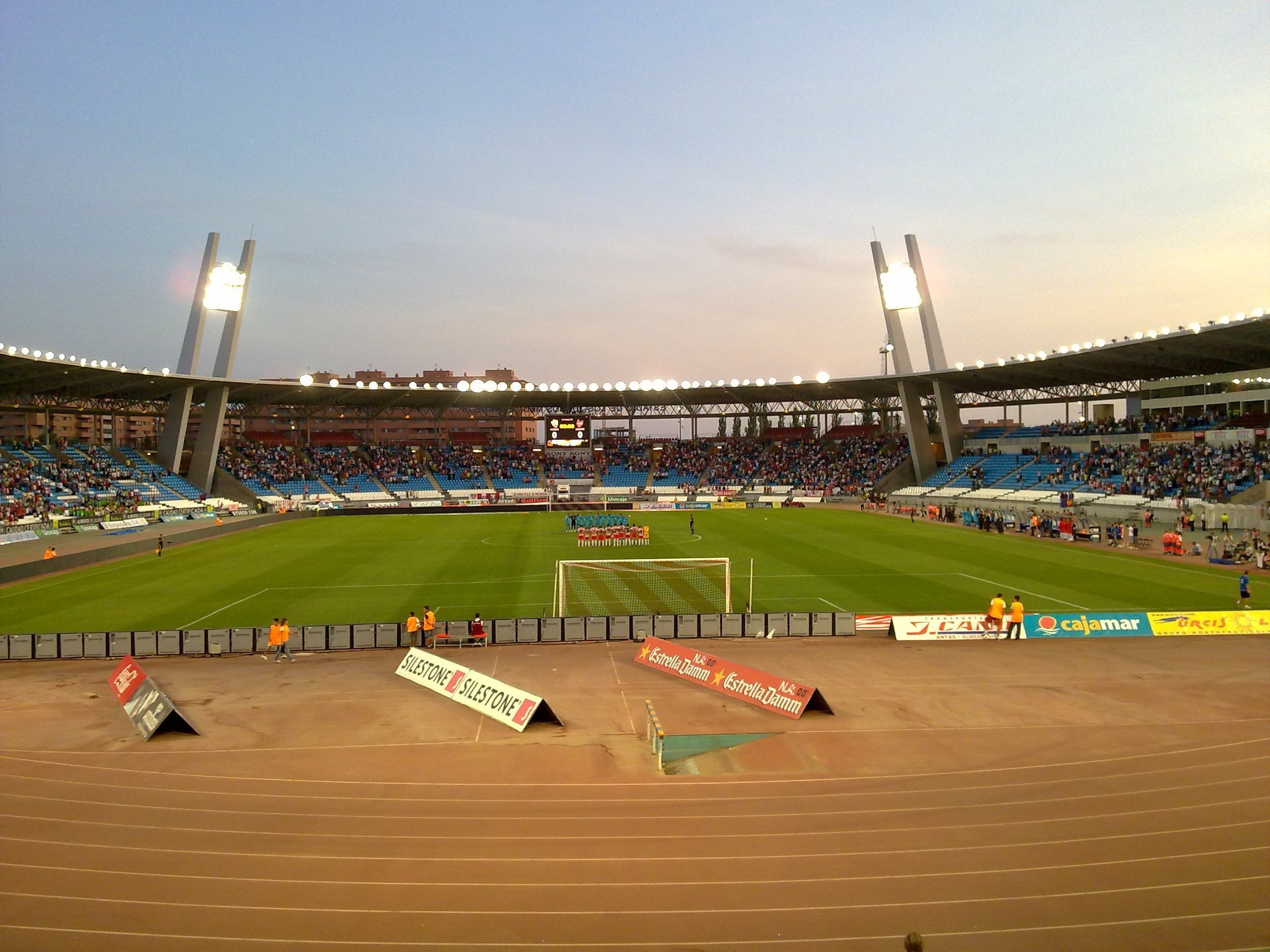
Almería hosted the Mediterranean Games in 2005. The city has two football teams: UD Almería, which was promoted to La Liga, the top tier of Spanish football, in 2022, and CP Almería, which plays in the División de Honor, the sixth tier.
The Plaza de toros de Almería is the main bullring in Almería. It has a capacity of 10,000 and it opened in 1882.
Films
Main article: List of films shot in Almería
Main sights
- The Alcazaba, a medieval fortress that was begun in the 10th century but destroyed by an earthquake in 1522. It includes a triple line of walls, a majestic keep and large gardens. It commands a city quarter with buildings dressed in pastel colors, of Muslim-age aspect. It is the second largest among the Muslim fortresses of Andalusia, after the Alhambra.
- Almería air raid shelters, underground galleries for civilian protection during the Spanish Civil War, currently the longest in Europe open for tourists.
- The Cathedral has a fortress-like appearance due to its towers, merlons and protected paths, created to defend it from Mediterranean pirates. Originally designated as a mosque, it was later converted into a Christian church, before being destroyed in the 1522 earthquake. In the 16th century it was rebuilt in the Renaissance style, whilst keeping some of its defensive features.
- Renaissance church of Santiago, built in 1533, with tower and portal decorated with reliefs.
- Chanca, a group of houses carved into rocks.
- Castle of San Cristobal, now in ruins. It is connected to the Alcazaba by a line of walls.
- Museum of Almería. Includes findings from Prehistoric, Iberic, Roman, Greek ages and Muslim objects, mostly from the Alcazaba.
- Paseo de Coches, a modern seaside promenade with gardens and palms.
- Cable Inglés (English Pier), 1904 iron railway pier built to transfer iron ore, copper, and silver produced by British- and French-run mines in Granada from trains to waiting cargo ships. File:Cable inglés noches.JPG|Cable Inglés, at night File:Almeria Alcazaba fcm.jpg|Alcazaba of Almería File:Almeria Muralla de Jayran fcm.jpg|The ancient walls of Jayrán File:San Cristóbal detrás Almería noche.JPG|The statue of San Cristóbal File:Estacion-de-almeria-01.jpg|The former train station
Economy
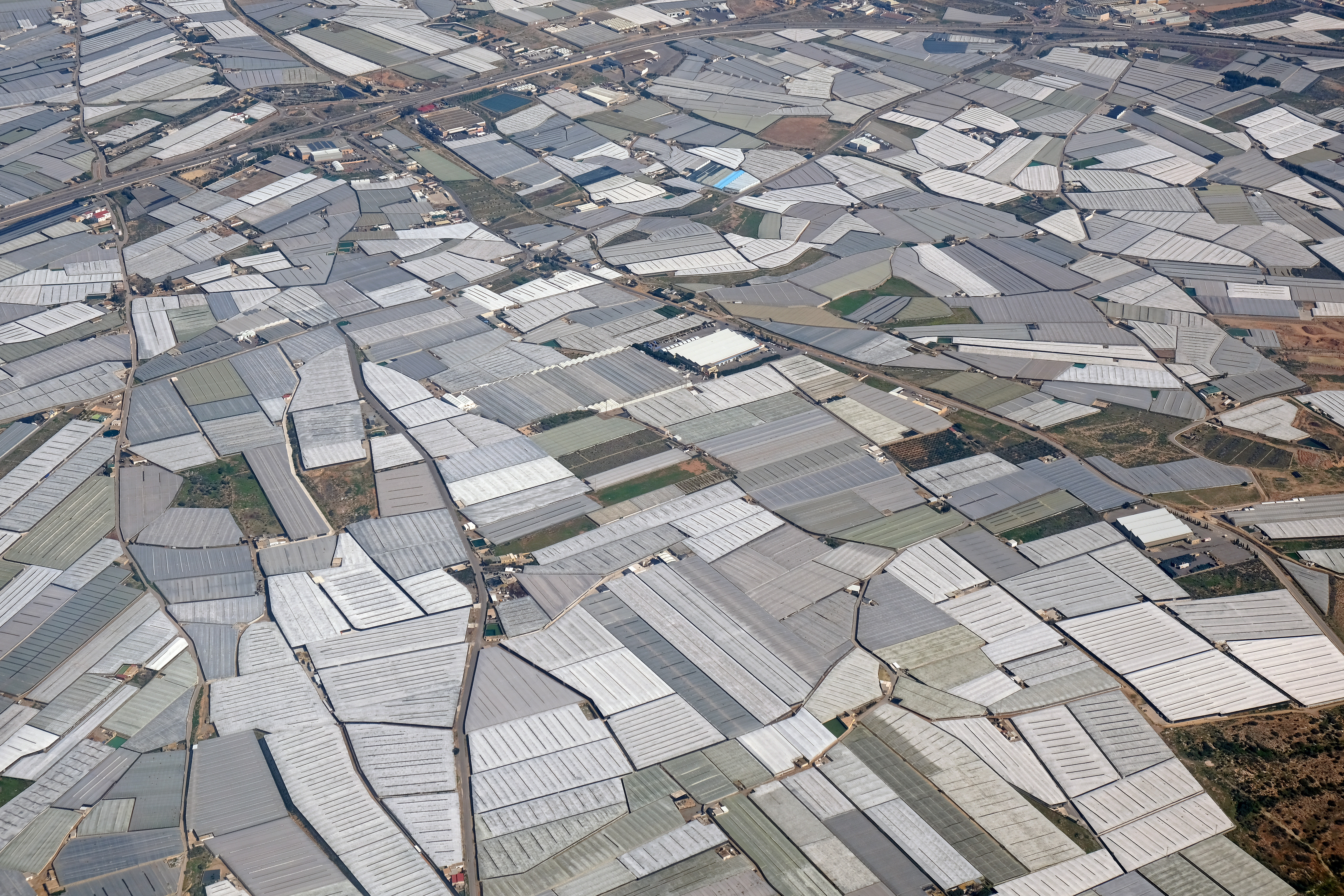
Intensive agriculture has been the most important economic sector of Almería for the last 50 years. Nowadays, greenhouse production, handling and commercialisation of vegetables, and the supply industry of the sector, represent almost 40% of Almería's GDP. Directly, agricultural production accounts for 18.2% of the provincial GDP. In Andalusia, the average contribution is 6.6% and in Spain it is only 2.9%.
This situation is the result of a great dynamic model, which can continually incorporate new technologies: using soil sanding, plastic covers, drip irrigation systems, hybrid seeds, soil-less cultivation, irrigation programs, new greenhouse structures, and so on. They all allowed to improve production and increase commercialisation calendars, assuring the profitability and quality of the crops and the competitiveness of the markets. Moreover, Almería's economy has an important exporting function: 75% of production was sold abroad in 2018, with a value of 2,400 million euros.
This development is explained by familiar investment, as subsidies have been limited or non-existent. In this sense, the horticultural sector receives the least European aid from the Common Agricultural Policy: 1.9% of total income. This figure is much lower than that received by other sectors such as olive groves (33%) or cereals (53%).
The production of this area is based on fair competition with officially a just remuneration of employees, with similar salaries than the ones in the same sector in Europe: 8% higher than Italy and 11% than Belgium. This avoids the social dumping exerted by non-EU countries, like Morocco, with salaries up to 90% lower than those of Almería. However, there is well-documented widespread exploitation of workers from North Africa who work and live in terrible conditions, earning much lower than the minimum wage.
From a social point of view, Almería and Granada are an example of family-owned and smallholder agriculture, with small farms and little concentration of land. This social nature generates high equity in the level of income and welfare: social cohesion is produced, and inequality is reduced. Concretely, Almería is made up of 12,500 farms with an average of 2.5 hectares and 30% of familiar labour. The high education levels of the farmers are also significant, which demonstrates an innovative and receptive character towards continuing education: 81.2% of farmers have some type of formal academic training.
At the same time, a commercial system based on social economy enterprises has been developed, e.g. as cooperative societies. These companies represent 62% of production and sales. They assure the access to the market in optimal conditions, because they increase its position inside the agri-food supply chain, facilitate financing, technical advice, and incorporation of technology. Moreover, local ties increase environmental sustainability.
Transport
By land, Almería can be reached by the A-7 Mediterranean Highway, which connects the Mediterranean area with the Spanish A-92 that unites it with the rest of Andalusia. Almería railway station is served by Renfe Operadora with direct rail services to Granada, and Madrid Atocha using a branch off the Alcázar de San Juan–Cádiz railway; the Linares Baeza–Almería railway. In the future, high-speed rail AVE services will link Almería to Madrid via Murcia. The central railway station has been closed for several months and it is not known exactly when it will re-open. Passengers currently start their journey by being bussed a few kilometres to Huercal de Almería station.
By sea, the port of Almería has connections to Melilla, Algeria, Morocco, and tourist cruises in the Mediterranean. It also has a marina with moorings for pleasure boats. Currently the port of Almería is being expanded with new docks and transformed into a container port to take large-scale international shipping and thereby increase its freight traffic. It normally connects with the following destinations:
- Acciona: Ghazaouet (Algeria), Oran (Algeria), Nador (Morocco) and Melilla.
- Comarit: Nador.
- Comanav: Nador.
By air, Almería is served by Almería Airport, the fourth largest in Andalusia. The winter timetable includes flights to Madrid, Barcelona, Melilla, London, and Seville, with international connections to Manchester, Birmingham, Brussels, Dublin and Swiss, German and other EU airports being added during the summer. File:Estación de Almería pixabay 212243.jpg|Almería rail station File:Puerto de Almería 100.jpg|Harbour of Almería
Notable people
- Said al-Andalusi (b 1029 - d 1070), mathematician, astronomer and philosopher
- Francisco Losada (b 1612 – d 1667), composer
- Luis de Soria Iribarne (b 1851 – d 1935), guitarist and composer
- Jimena Quirós (b 1899 – d 1983), Spanish scientist, considered the first female oceanographer in the country and the first female staff scientist of the Spanish Institute for Oceanography (IEO)
- Lita Baron (b 1923 - d 2015), actress, singer and dancer
- Chus Lampreave (b 1930 – d 2016), actress
- Nieves Navarro (b 1938), actress
- Manuel Lao Hernández (b 1944), founder of Cirsa, Spain's largest casino operator
- José Torres "Tomatito" (b 1958), flamenco guitar player
- Juan Martínez Oliver (b 1964), road bicycle racer
- Mar Abad (b 1972), journalist, writer and businesswoman
- David Bisbal (b 1979), Grammy Award winner
- Rosa García-Malea López (b 1981), first female fighter pilot in the Spanish Air Force
- Eduardo del Pino Vicente, journalist and writer
References
Bibliography
References
- "Datos geográficos y toponimia". [[Instituto Geográfico Nacional (Spain).
- "Annual population census 2021-2024". [[National Statistics Institute (Spain).
- "Mapa topográfico de España del Instituto Geográfico Nacional".
- "Almería". [[Oxford University Press]].
- {{Cite American Heritage Dictionary. Almería
- "Almería". [[HarperCollins]].
- (2014). "Actuar en la ciudad consolidada. Resumen de un curso en Almería. Cartagena, Universidad Politécnica". Cuadernos de introducción a la urbanística-CIURB.
- Valera Escobar, Ginés. (6 February 2014). "La Almería musulmana".
- Moraitis, Ioannes. (2020). "Almería 1147-Tesalónica 1185:estudio comparativo de dos conquistas a través de las fuentes escritas". [[University of Córdoba (Spain).
- Sánchez Picón, Andrés. (1991). "El siglo minero. Imágenes de una Almería del siglo XIX". Instituto de Estudios Almerienses.
- Bayo, Antonio. (2007). "El estrecho de Gibraltar como lugar de nuevas oportunidades". RETE.
- (27 April 2024). "Why visit Tabernas, home to Europe's only desert".
- García-Pulido, Luis José. (2019). "Encyclopaedia of Islam, Three". Brill.
- Bosch-Vilá, J.. (1960–2007). "Encyclopaedia of Islam, Second Edition". Brill.
- Torremocha Silva, Antonio. (2022). "Le détroit de Gibraltar (Antiquité - Moyen Âge). II Espaces et figures de pouvoir". [[Casa de Velázquez]].
- (1990). "Almería entre culturas: (siglos XIII-XVI)". Instituto de Estudios Almerienses de la Diputación de Almería.
- O'Callaghan, Joseph F.. (2014). "The Last Crusade in the West: Castile and the Conquest of Granada". University of Pennsylvania Press.
- Villanueva Muñoz, Emilio Ángel. (1981). "La actuación en el casco antiguo de Almería durante el siglo XIX". Boletín del Instituto de Estudios Almerienses. Letras.
- "Almeria, Spain".
- Abella, Rafael(1975). ''La vida cotidiana durante la guerra civil: la España republicana'', p. 254. Editorial Planeta.
- "Referéndum de ratificación de la iniciativa autonómica de Andalucía - Constitución española". Congreso.es.
- "Referéndum del Estatuto de Andalucía - La Voz Digital". Servicios.lavozdigital.es.
- "Poblados del Oeste. Desierto de Tabernas". Parque Natural Cabo de Gata.
- Frayling, Christopher. (1 August 2005). "'Once Upon A Time in Italy': The Films of Sergio Leone". [[NPR]] Books.
- "Cabo de Gata-Níjar Nature Reserve in Spain {{!}} spain.info in english".
- "Cabo de Gata-Níjar - Web oficial de turismo de Andalucía".
- Amos, Jonathan. (12 June 2000). "Giant crystal cave discovered". [[BBC News]].
- "Evolucion de los climas de Köppen en España en el periodo 1951-2020".
- (7 December 2015). "Desertification could soon make southern Spain more like West Africa".
- "Valores climatológicos normales. Clasificación climática de Köppen.". [[AEMET]].
- Rushby, Kevin. (29 April 2017). "Cabo de Gata, Spain: exploring Europe's only desert". The Guardian.
- Capel Molina, José Jaime. (1995). "Mapa pluviométrico de España peninsular y Baleares (en el período internacional 1961-1990)". Investigaciones Geográficas.
- (21 May 2022). "Cabo de Gata-Níjar Natural Park".
- "AEMET OpenData". Agencia Estatal de Meteorologia.
- "Viaje por un sueño: Acariciando el revólver justiciero de Clint Eastwood".
- "We're heating up, and not only in Almeria (In Spanish)".
- Agencia Estatal de Meteorología. "Almería: Almería Aeropuerto - Valores extremos absolutos - Selector - Agencia Estatal de Meteorología - AEMET. Gobierno de España".
- Agencia Estatal de Meteorología. "Almería: Almería - Valores extremos absolutos - Selector - Agencia Estatal de Meteorología - AEMET. Gobierno de España".
- "Observaciones meteorológicas de Almería (1922-1991)".
- "Almeria - Extreme Values".
- "NEVADA". Real Asociación Española de cronistas oficiales.
- (19 November 2019). "El día que Almería se vistió de blanco".
- (2017). "15 lugares de España para huir del invierno". [[Skyscanner]].
- "Extreme temperature records since 1850".
- "Almería Aeropuerto: Almería Aeropuerto - Valores extremos absolutos - Selector - Agencia Estatal de Meteorología - AEMET. Gobierno de España".
- (27 June 2019). "Highest minimum temperatures in Spain".
- "AEMET OpeenData". [[Agencia Estatal de Meteorologia]].
- "Valores extremos. Almería Almería Aeropuerto". Ministerio de Medio Ambiente y Medio Rural y Marino. [[Gobierno de España]].
- "Extremes". AEMET OpenData.
- "Normal". AEMET OpenData.
- "Climate & Weather Averages at Almería Airport weather station".
- "INEbase. Alterations to the municipalities in the Population Censuses since 1842". [[National Institute of Statistics (Spain).
- (31 January 2016). "La industria del cine llena los hoteles de la capital". [[La Voz de Almería]].
- "Fiestas Almería Ciudad".
- (2013). ""Sustainability dimensions related to agricultural based-development: the experience of 50 years of intensive farming in Almería (Spain)"". International Journal of Agricultural Sustainability.
- INE, Instituto Nacional de Estadística. (2018). "Contabilidad regional de España".
- (1999). "El papel de la agricultura intensiva en la economía almeriense". Vida Rural.
- Aznar Sánchez, J. A.; Galdeano Gómez, E.; Godoy Durán, A.; Tapia León, J. J. (2013): "Caracterización y desafíos del sector de la comercialización"; en J. A. Aznar Sánchez (coord.) ''El sector de la comercialización hortícola en Almería'' (pp. 17-46). Ed. Caja Rural Intermediterránea, Cajamar. Almería.
- Cajamar (2018): "''Análisis de la campaña hortofrutícola de Almería. Campaña 2016-2017''". Almería: Fundación Cajamar.
- European Union (2017): "''Operating subsidies (both direct payments and rural development except investment support)''". En red: https://ec.europa.eu/agriculture/sites/agriculture/files/statistics/facts-figures/cap-operating-subsidies.pdf[Consultado {{Webarchive. link. (23 January 2024 : abril 2018])
- Livre Blanc (2017): "''Les Producteurs de Légumes de France''" En red: http://www.legumesdefrance.fr/sites/fnplegweb/livre_blanc_2017.pdf{{Dead link. (March 2024)
- Pablo, Ofelia de; and Javier Zurita in Almería, Annie Kelly and Clare Carlile (2020). [https://www.theguardian.com/global-development/2020/sep/20/we-pick-your-food-migrant-workers-speak-out-from-spains-plastic-sea "We pick your food: migrant workers speak out from Spain's 'Plastic Sea'".] {{Webarchive. link. (6 September 2022 ''The Guardian''. Retrieved 19 June 2023.)
- [http://www.juntadeandalucia.es/agriculturaypesca/ifapa ''El sistema de producción hortícola protegido de la provincia de Almería'', 2016.] {{Webarchive. link. (21 November 2010 Instituto de Investigación y Formación Agraria y Pesquera de Andalucía (IFAPA).)
- Galdeano-Gómez, E.; Aznar-Sánchez, J. A.; Pérez-Mesa, J. C. (2016). ''Contribuciones económicas, sociales y medioambientales de la agricultura intensiva de Almería''. Almería: Cajamar Caja Rural.
- COEXPHAL, Asociación de Organizaciones de Productores de Frutas y Hortalizas de Almería (2016): "''Memoria 2015/16''". Online http://www.coexphal.es/descargas/ {{Webarchive. link. (31 July 2021)
- Galdeano-Gómez, E.; Aznar-Sánchez, J. A.; Pérez-Mesa, J. C. (2016): ''Contribuciones económicas, sociales y medioambientales de la agricultura intensiva de Almería''. Almería: Cajamar Caja Rural.
- (16 August 2020). "Jimena Quirós: the first Spanish oceanographer".
- "Lita Baron (1923–2015)". [[IMDb]].
- Martínez, Evaristo. (4 April 2016). "Fallece en Almería Chus Lampreave". [[La Voz de Almería]].
- Pita, Helena. (20 June 2017). "La guitarra de Tomatito". [[Radiotelevisión Española]].
- Delgado, Pedro. (14 April 2016). "Las escapadas de Perico: Rutas en bici por España". [[Penguin Random House]] Grupo Editorial España.
- Agencias. (4 September 2003). "David Bisbal, premio al "mejor nuevo artista" en los Grammy Latino". [[ABC (Spain).
- (16 March 2018). "Primer Concurso de micro guiones de cine". [[La Voz de Almería]].
This article was imported from Wikipedia and is available under the Creative Commons Attribution-ShareAlike 4.0 License. Content has been adapted to SurfDoc format. Original contributors can be found on the article history page.
Ask Mako anything about Almería — get instant answers, deeper analysis, and related topics.
Research with MakoFree with your Surf account
Create a free account to save articles, ask Mako questions, and organize your research.
Sign up freeThis content may have been generated or modified by AI. CloudSurf Software LLC is not responsible for the accuracy, completeness, or reliability of AI-generated content. Always verify important information from primary sources.
Report