From Surf Wiki (app.surf) — the open knowledge base
86th Street station (IRT Broadway–Seventh Avenue Line)
New York City Subway station in Manhattan

New York City Subway station in Manhattan
| Field | Value | ||||
|---|---|---|---|---|---|
| name | 86 Street | ||||
| image | 86th Street Southbound IRT Broadway-7th Avenue Line Platform, November 2024.jpg | ||||
| image_caption | R62A train arriving at the southbound platform | ||||
| address | West 86th Street & Broadway | ||||
| New York, New York | |||||
| borough | Manhattan | ||||
| locale | Upper West Side | ||||
| coordinates | |||||
| division | IRT | ||||
| line | IRT Broadway–Seventh Avenue Line | ||||
| service | Broadway-Seventh local | ||||
| service_header | Broadway-Seventh local header | ||||
| other | NYCT Bus: | ||||
| platforms | 2 side platforms | ||||
| tracks | 4 | ||||
| structure | Underground | ||||
| opened | |||||
| services | {{Adjacent stations | system=New York City Subway | |||
| line1 | Broadway-Seventh local | left1=96th Street | right1=79th Street | note-left1= | note-right1= |
| note-row2 | does not stop here}} | ||||
| other_services | {{Adjacent stations | system=New York City Subway | |||
| line | none | left=91st Street | note-left=closed | right=blank}} | |
| footnotes | |||||
| route_map | {{NYCS 4-tracked local station | inline=y | |||
| 1 | 96th Street | ||||
| 2 | 79th Street | ||||
| code | IRT Broadway–Seventh Avenue Line | ||||
| deg | 330 |
New York, New York |note-row2= does not stop here}} The 86th Street station is a local station on the IRT Broadway–Seventh Avenue Line of the New York City Subway. Located at the intersection of West 86th Street and Broadway on the Upper West Side of Manhattan, it is served by the 1 train at all times and the 2 train during late nights.
The 86th Street station was constructed for the Interborough Rapid Transit Company (IRT) as part of the city's first subway line, which was approved in 1900. Construction of the line segment that includes the 86th Street station began on August 22 of the same year. The station opened on October 27, 1904, as one of the original 28 stations of the New York City Subway. The station's platforms have been lengthened since opening.
The 86th Street station contains two side platforms and four tracks; express trains use the inner two tracks to bypass the station. The station was built with tile and mosaic decorations, although the platform extensions contain a cinder block design. The platforms contain exits to 86th Street and Broadway and are not connected to each other within fare control.
History
Construction and opening
Planning for a subway line in New York City dates to 1864, but development of what became the city's first subway line did not start until 1894, when the New York State Legislature passed the Rapid Transit Act. The subway plans were drawn up by a team of engineers led by William Barclay Parsons, the Rapid Transit Commission's chief engineer. It called for a subway line from New York City Hall in lower Manhattan to the Upper West Side, where two branches would lead north into the Bronx. A plan was formally adopted in 1897, and all legal conflicts over the route alignment were resolved near the end of 1899.
The Rapid Transit Construction Company, organized by John B. McDonald and funded by August Belmont Jr., signed the initial Contract 1 with the Rapid Transit Commission in February 1900, under which it would construct the subway and maintain a 50-year operating lease from the opening of the line. In 1901, the firm of Heins & LaFarge was hired to design the underground stations. Belmont incorporated the Interborough Rapid Transit Company (IRT) in April 1902 to operate the subway.
The 86th Street station was constructed as part of the IRT's West Side Line (now the Broadway–Seventh Avenue Line) from 82nd Street to 104th Street, for which work had begun on August 22, 1900. Work for that section had been awarded to William Bradley. By late 1903, the subway was nearly complete, but the IRT Powerhouse and the system's electrical substations were still under construction, delaying the system's opening. The 86th Street station opened on October 27, 1904, as one of the original 28 stations of the New York City Subway from City Hall to 145th Street on the West Side Branch.
Service changes and station renovations
1910s to 1930s
After the first subway line was completed in 1908, the station was served by local trains along both the West Side (now the Broadway–Seventh Avenue Line to Van Cortlandt Park–242nd Street) and East Side (now the Lenox Avenue Line). West Side local trains had their southern terminus at City Hall during rush hours and South Ferry at other times, and had their northern terminus at 242nd Street. East Side local trains ran from City Hall to Lenox Avenue (145th Street).
To address overcrowding, in 1909, the New York Public Service Commission proposed lengthening the platforms at stations along the original IRT subway. As part of a modification to the IRT's construction contracts made on January 18, 1910, the company was to lengthen station platforms to accommodate ten-car express and six-car local trains. In addition to $1.5 million (equivalent to $ million in ) spent on platform lengthening, $500,000 (equivalent to $ million in ) was spent on building additional entrances and exits. It was anticipated that these improvements would increase capacity by 25 percent. Platforms at local stations, such as the 86th Street station, were lengthened by between 20 and. Both platforms were extended to the north and south. Six-car local trains began operating in October 1910. The Broadway–Seventh Avenue Line opened south of Times Square–42nd Street in 1918, and the original line was divided into an H-shaped system. The original subway north of Times Square thus became part of the Broadway–Seventh Avenue Line, and all local trains were sent to South Ferry.
In December 1922, the Transit Commission approved a $3 million project to lengthen platforms at 14 local stations along the original IRT line, including 86th Street and five other stations on the Broadway–Seventh Avenue Line. Platform lengths at these stations would be increased from 225 to. The commission postponed the platform-lengthening project in September 1923, at which point the cost had risen to $5.6 million. In 1927, an additional staircase was constructed from the uptown platform to the northeastern corner of 86th Street and Broadway by Patteli & Wilson for $25,300. In 1932, the entrance at the southeastern corner of 86th Street and Broadway was relocated from the easterly curb of Broadway to the southern building line of 86th Street. The new entrance did not have a kiosk.
1940s to 1960s
The city government took over the IRT's operations on June 12, 1940. The IRT routes were given numbered designations in 1948 with the introduction of "R-type" rolling stock, which contained rollsigns with numbered designations for each service. The Broadway route to 242nd Street became known as the 1 and the Lenox Avenue route as the 3.
The original IRT stations north of Times Square could barely fit local trains of five or six cars depending on the configuration of the trains. Stations on the line from 50th Street to 96th Street, including this station but excluding the 91st Street station, had their platforms extended in the 1950s to accommodate ten-car trains as part of a $100 million rebuilding program. The contract to extend the platforms at 79th Street and 86th Street was awarded to Delma Engineering Corporation for $1,867,705 in 1957 (). The platform extensions at the local stations were completed by early 1958. As part of the contract to extend the platform at this station, additional entrances were constructed.
Once the project was completed, all 1 trains became local and all 2 and 3 trains became express, and eight-car local trains began operation. Increased and lengthened service was implemented during peak hours on the 1 train on February 6, 1959. Due to the lengthening of the platforms at 86th Street and 96th Street, the intermediate 91st Street station was closed on February 2, 1959, because it was too close to the other two stations.
1970s to present
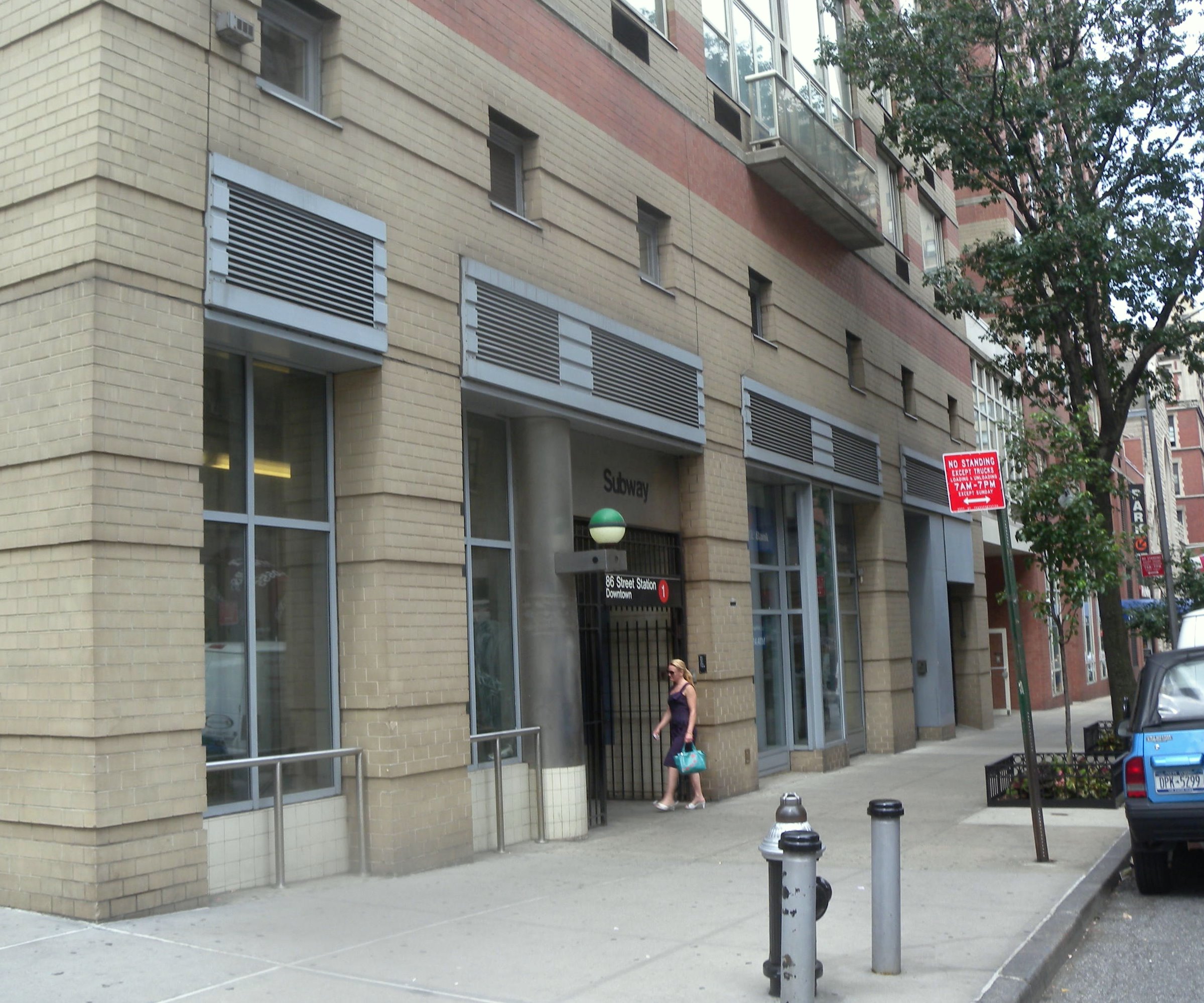
In 1985, art and mosaics were installed in the station for $200,000 (). The cost was covered by Haines, and was done as part of the construction of The Bromely at 85th Street and Broadway. The following year, the entrance to the southwestern corner of 87th Street and Broadway was relocated into a building, The Boulevard at 246 West 87th Street. The $1,270,000 cost of the project () was borne by the developer, Ian Bruce Eichner. The entrance was constructed to supplant public infrastructure improvements required by the New York City Housing Quality Program for the construction of The Boulevard, which in turn allowed the developer to increase the height of the development.
In April 1988, the New York City Transit Authority unveiled plans to speed up service on the Broadway–Seventh Avenue Line through the implementation of a skip-stop service: the 9 train. When skip-stop service started in 1989, it was only implemented north of 137th Street–City College on weekdays, and 86th Street was served by both the 1 and the 9. Skip-stop service ended on May 27, 2005, as a result of a decrease in the number of riders who benefited.
Station layout
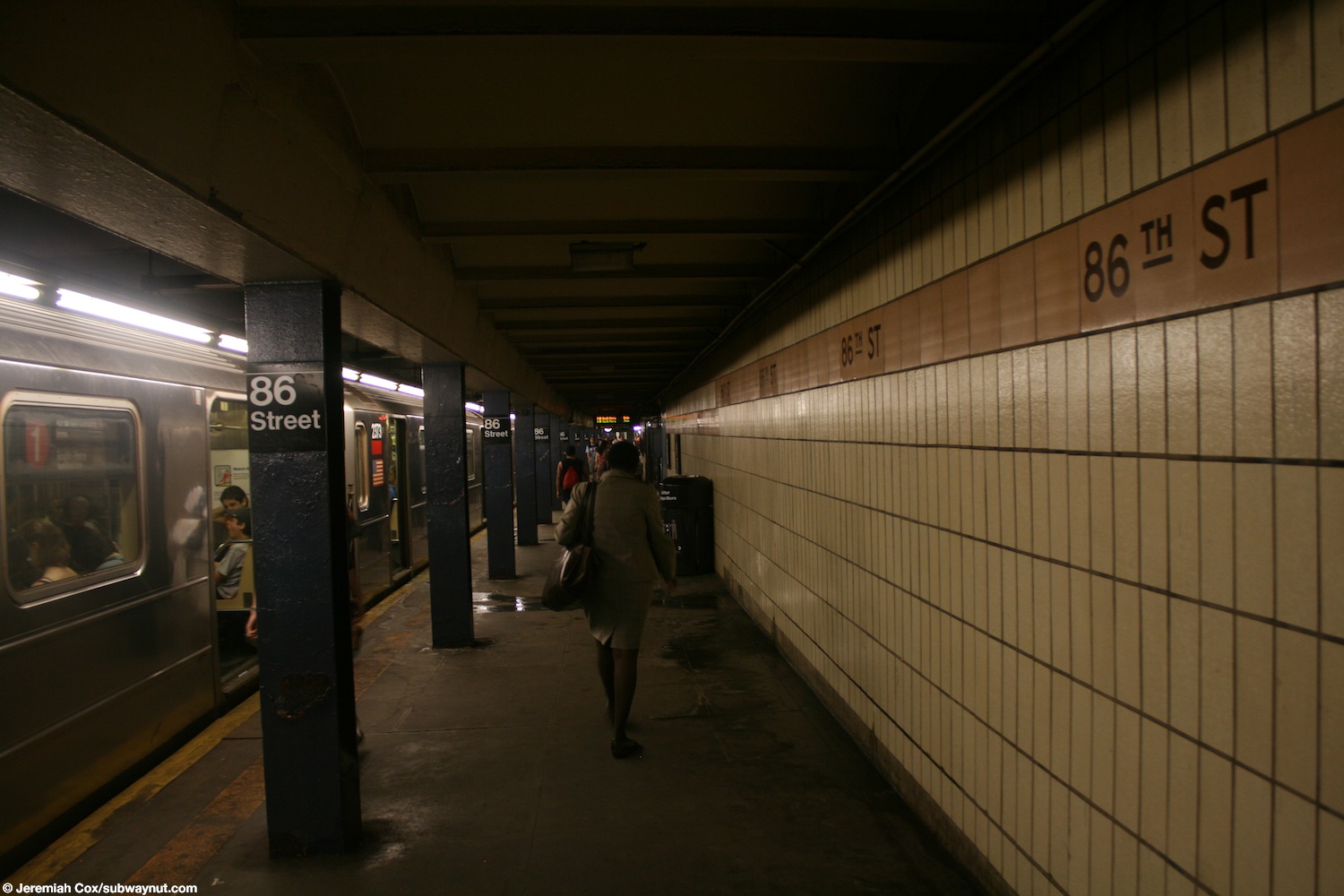
Like other local stations, 86th Street has four tracks and two side platforms. The station is served by the 1 at all times and by the 2 during late nights; the center express tracks are used by the 2 train during daytime hours and the 3 train at all times. The station is between 96th Street to the north and 79th Street to the south. The platforms were originally 200 ft long, like at other local stations on the original IRT, but as a result of the 1958–1959 platform extension, became 520 ft long.
Design
As with other stations built as part of the original IRT, the station was constructed using a cut-and-cover method. The tunnel is covered by a U-shaped trough that contains utility pipes and wires. This trough contains a foundation of concrete no less than 4 in thick. Each platform consists of 3 in concrete slabs, beneath which are drainage basins. The original platforms contain circular, cast-iron Doric-style columns spaced every 15 ft, while the platform extensions contain I-beam columns. Additional columns between the tracks, spaced every 5 ft, support the jack-arched concrete station roofs. There is a 1 in gap between the trough wall and the platform walls, which are made of 4 in-thick brick covered over by a tiled finish.
This station retains original mosaic and terracotta wall reliefs, consisting of purple characters surrounded by yellow and blue tiles. The tiled pilasters on the side walls are interrupted by tiled rectangles, as well as motifs of little squares and semicircles. The decorations also include cornucopia designs with the number "86". There are also a few "Men" and "Women" relief signs for now-defunct restrooms. The mosaic tiles at all original IRT stations were manufactured by the American Encaustic Tile Company, which subcontracted the installations at each station. The decorative work was performed by tile contractor Alfred Boote Company and faience contractor Rookwood Pottery Company. The ceilings of the original platforms and fare control areas contain plaster molding. At the northern part of the station, where the platforms have been extended, the walls have cream-colored tiles with a pink trim line and black "86th ST" written on them at regular intervals.
The 86th Street station has artwork installed in 1989 entitled Westside Views by Nitza Tufiño. The artists are students of Manhattan Community Board 7 and the Grosvernor House. Scenes include the 72nd Street station, medians on Broadway, New York City Fire Department, children at play, Ida Straus memorial in Straus Park, boats at the 79th Street Boat Basin, Buddhist vendors on Church Street, and a New York City Bus. The station also has a poem entitled West Side Views by student Pedro Pieti. Westside Views is one of two works Tufiño made for MTA Arts & Design; the other, Neo-Boriken – a solo effort – can be found at 103rd Street on the IRT Lexington Avenue Line.
Exits

All fare control areas are on platform level and there are no crossovers or crossunders. The centers of the northbound and southbound platforms each have a fare control area with a turnstile bank and token booth, although the northbound token booth is closed to the public. The northbound platform's fare control area contains stairs to the northeast and southeast corners of West 86th Street and Broadway, while the southbound platform's fare control area here contains stairs to the northwest and southwest corners of the same intersection.
The southbound platform has another fare control near the north end. A bank of three turnstiles lead to a token booth that is only staffed during rush hours. A staircase goes up to an alcove inside 246 West 87th Street, on the southwest corner of West 87th Street and Broadway.
References
References
- {{cite NYC bus map. M
- (October 28, 1904). "Our Subway Open: 150,000 Try It; Mayor McClellan Runs the First Official Train.". The New York Times.
- (1918). "Fifty Years of Rapid Transit — 1864 to 1917". Law Printing.
- (October 23, 1979). "Interborough Rapid Transit System, Underground Interior". [[New York City Landmarks Preservation Commission]].
- (1905). "Report of the Board of Rapid Transit Railroad Commissioners for the City of New York For The Year Ending December 31, 1904 Accompanied By Reports of the Chief Engineer and of the Auditor". Board of Rapid Transit Railroad Commissioners.
- (1903-11-14). "First of Subway Tests; West Side Experimental Trains to be Run by Jan. 1 Broadway Tunnel Tracks Laid, Except on Three Little Sections, to 104th Street -- Power House Delays.". The New York Times.
- (August 2, 1908). "Our First Subway Completed At Last — Opening of the Van Cortlandt Extension Finishes System Begun in 1900 — The Job Cost $60,000,000 — A Twenty-Mile Ride from Brooklyn to 242d Street for a Nickel Is Possible Now". The New York Times.
- (1916). "Brooklyn Daily Eagle Almanac". Brooklyn Daily Eagle.
- Hood, Clifton. (1978). "The Impact of the IRT in New York City". Historic American Engineering Record.
- (1911). "Report of the Public Service Commission for the First District of the State of New York For The Year Ending December 31, 1910". Public Service Commission.
- (August 2, 1918). "Open New Subway Lines to Traffic; Called a Triumph". The New York Times.
- (December 17, 1922). "33d Street to Be I.R.T. Express Stop; Reconstruction One of Many Station Improvements Ordered by Commission.". The New York Times.
- (December 18, 1922). "$4,000,000 in Construction on I. R. T. Ordered: 33d St. on East Side Subway Will Be Express Stop; Local Stations to Have 10-Car Train Capacity Aim to Speed Service Improvements Will Relieve Congestion Along Both Routes. Board Believes". New-York Tribune.
- (1923-09-07). "Express Stop Plan Opposed by I.R.T.; Officials Say Money Is Not Available for Change at 33d Street Station.". The New York Times.
- (7 Sep 1923). "I. R. T. Wins Delay At Subway Platform Extension Hearing: Transit Commission Head Tells Meeting Widening West Side Stations Would Increase Capacity 25 P. C". New-York Tribune.
- (1930). "Proceedings of the Board of Transportation of the City of New York". New York City Board of Transportation.
- (1927). "Proceedings of the Board of Transportation of the City of New York". New York City Board of Transportation.
- (1932). "Proceedings of the New York City Board of Transportation". New York City Board of Transportation.
- (1940-06-13). "City Transit Unity Is Now a Reality; Title to I.R.T. Lines Passes to Municipality, Ending 19-Year Campaign". The New York Times.
- (June 13, 1940). "Transit Unification Completed As City Takes Over I. R. T. Lines: Systems Come Under Single Control After Efforts Begun in 1921; Mayor Is Jubilant at City Hall Ceremony Recalling 1904 Celebration". New York Herald Tribune.
- Brown, Nicole. (May 17, 2019). "How did the MTA subway lines get their letter or number? NYCurious".
- (April 1960). "A Summary of Services on the IRT Division, NYCTA". Electric Railroaders' Association.
- Association, General Contractors. (1957). "Bulletin".
- (February 2009). "High-Speed Broadway Local Service Began in 1959". New York Division, Electric Railroaders' Association.
- (1964). "Proceedings of the New York City Transit Authority Relating to Matters Other Than Operation". New York City Transit Authority.
- (February 7, 1959). "Wagner Praises Modernized IRT — Mayor and Transit Authority Are Hailed as West Side Changes Take Effect". The New York Times.
- Aciman, Andre. (January 8, 1999). "My Manhattan — Next Stop: Subway's Past". The New York Times.
- (1990). "Transit Joint Development in the United States". University of California at Berkeley Institute of Urban and Regional Development.
- (1990). "The Portable Lower East Side". Portable Lower East Side.
- Brozan, Nadine. (June 4, 1989). "'Skip-Stop' Subway Plan Annoys No. 1 Riders". The New York Times.
- Moore, Keith. (June 10, 1988). "TA's skip-stop plan hit". New York Daily News.
- (August 20, 1989). "#1 Riders: Your Service is Changing". New York Daily News.
- (August 1989). "Announcing 1 and 9 Skip-Stop Service on the Broadway-Seventh Avenue Line". New York City Transit Authority.
- Lorch, Donatella. (August 22, 1989). "New Service For Subways On West Side". The New York Times.
- Chan, Sewell. (May 25, 2005). "On Its Last Wheels, No. 9 Line Is Vanishing on Signs". The New York Times.
- (May 7, 2005). "Noteworthy – 9 discontinued". Metropolitan Transportation Authority.
- {{NYCS const. trackref. trackbook3
- {{NYCS const. timetable. 1
- {{NYCS const. timetable. 2
- {{NYCS const. timetable. 3
- {{NYCS const. map
- Scott, Charles. (1978). "Design and Construction of the IRT: Civil Engineering". Historic American Engineering Record.
- Framberger, David J.. (1978). "Architectural Designs for New York's First Subway". Historic American Engineering Record.
- (5 Nov 1903). "By Colors: Subway Stations Will Be Recognized Need Not Look for Names New York's Transit Way Nearing Completion Still Much Is to Be Done". Courier-Journal.
- Cox, Jeremiah. (June 11, 2011). "Looking down the downtown platform at 86 Street".
- "86th Street – Nitza Tufiño – Westside Views, 1989". Metropolitan Transportation Authority.
- "103rd Street – Nitza Tufiño – Neo-Boriken, 1990". Metropolitan Transportation Authority.
- Cox, Jeremiah. (June 11, 2011). "The closed Customer Assistant Booth, on the uptown platform at 86 Street, yet to be removed, notice the decorative molding".
- (April 2018). "86th Street Neighborhood Map". Metropolitan Transportation Authority.

This article was imported from Wikipedia and is available under the Creative Commons Attribution-ShareAlike 4.0 License. Content has been adapted to SurfDoc format. Original contributors can be found on the article history page.
Ask Mako anything about 86th Street station (IRT Broadway–Seventh Avenue Line) — get instant answers, deeper analysis, and related topics.
Research with MakoFree with your Surf account
Create a free account to save articles, ask Mako questions, and organize your research.
Sign up freeThis content may have been generated or modified by AI. CloudSurf Software LLC is not responsible for the accuracy, completeness, or reliability of AI-generated content. Always verify important information from primary sources.
Report