From Surf Wiki (app.surf) — the open knowledge base
68th Street–Hunter College station
New York City Subway station in Manhattan

New York City Subway station in Manhattan
| Field | Value | ||||
|---|---|---|---|---|---|
| name | 68 Street–Hunter College | ||||
| image | IRT Lexington 68th Street-Hunter College Southbound Platform.jpg | ||||
| image_caption | R62A train arriving at the southbound platform | ||||
| address | East 68th Street & Lexington Avenue | ||||
| New York, New York | |||||
| borough | Manhattan | ||||
| locale | Upper East Side | ||||
| coordinates | |||||
| division | IRT | ||||
| line | IRT Lexington Avenue Line | ||||
| service | Lexington local | ||||
| service_header | Lexington local header | ||||
| other | NYCT Bus: | ||||
| MTA Bus: | |||||
| platforms | 2 side platforms | ||||
| tracks | 2 | ||||
| structure | Underground | ||||
| opened | |||||
| accessible | yes | ||||
| services | {{Adjacent stations | system=New York City Subway | |||
| line1 | Lexington local | left1=77th Street | right1=59th Street | note-left1= | note-right1= |
| note-row2 | does not stop here}} | ||||
| footnotes | |||||
| route_map | {{NYCS 2-tracked side platform station | inline=y | |||
| 1 | 77th Street | ||||
| 2 | 59th Street | ||||
| code | IRT Lexington Avenue Line | ||||
| deg | 330 |
New York, New York MTA Bus: |note-row2= does not stop here}} The 68th Street–Hunter College station is a local station on the IRT Lexington Avenue Line of the New York City Subway, located at the intersection of Lexington Avenue and 68th Street on the Upper East Side of Manhattan. It is served by the train at all times, the train during weekdays in the peak direction, and the train during late nights.
This station was constructed as part of the Dual Contracts by the Interborough Rapid Transit Company and opened in 1918, and was renovated in the 1980s. A further renovation between 2021 and 2024 made the station compliant with the Americans with Disabilities Act of 1990 and provided additional entry points.
History
Planning and construction
Following the completion of the original subway, there were plans to construct a line along Manhattan's east side north of 42nd Street. The original plan for what became the extension north of 42nd Street was to continue it south through Irving Place and into what is now the BMT Broadway Line at Ninth Street and Broadway. In July 1911, the IRT had withdrawn from the talks, and the Brooklyn Rapid Transit Company (BRT) was to operate on Lexington Avenue. The IRT submitted an offer for what became its portion of the Dual Contracts on February 27, 1912.
In 1913, as part of the Dual Contracts, which were signed on March 19, 1913, the Public Service Commission planned to split the original Interborough Rapid Transit Company (IRT) system from looking like a "Z" system (as seen on a map) to an H-shaped system. The original system would be split into three segments: two north–south lines, carrying through trains over the Lexington Avenue and Broadway–Seventh Avenue Lines, and a west–east shuttle under 42nd Street. This would form a roughly H-shaped system. It was predicted that the subway extension would lead to the growth of the Upper East Side and the Bronx.
On February 15, 1917, the Public Service Commission agreed to change the name of the under-construction station from 68th Street to 68th Street–Hunter College at the request of officials of Hunter College.
Opening
The 68th Street–Hunter College station opened on July 17, 1918, with service initially running between Grand Central–42nd Street and 167th Street via the line's local tracks. On August 1, the "H system" was put into place, with through service beginning on the new east and west side trunk lines, and the institution of the 42nd Street Shuttle along the old connection between the sides. The cost of the extension from Grand Central was $58 million.
Station renovations

The city government took over the IRT's operations on June 12, 1940.
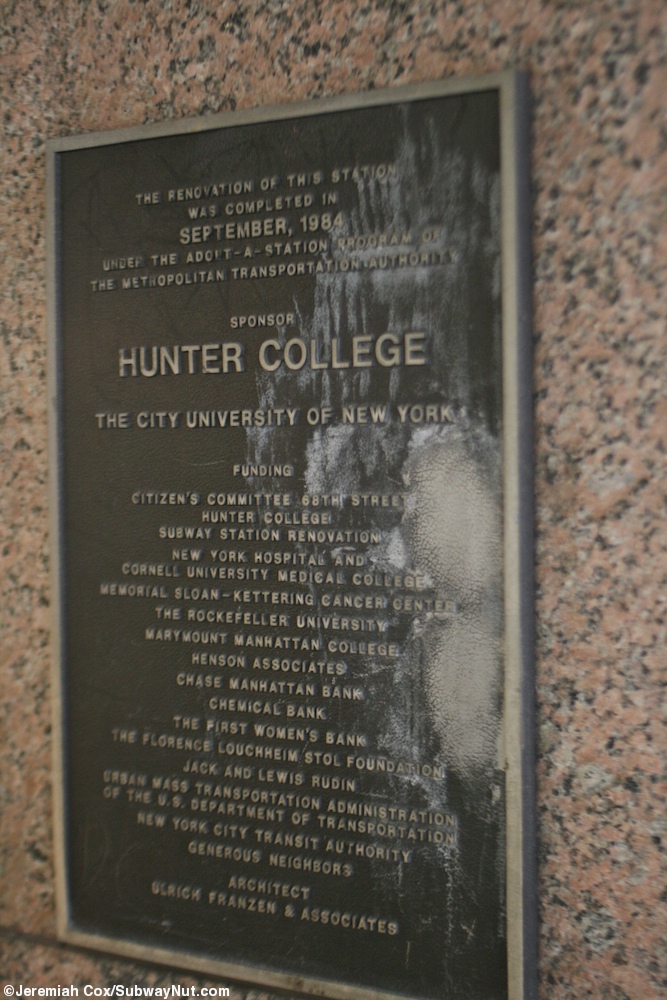
In 1981, the Metropolitan Transportation Authority (MTA) listed the station among the 69 most deteriorated stations in the subway system. This station was renovated in September 1984 as part of the MTA's Adopt-A-Station Program in conjunction with a renovation of Hunter College.
Elevator installation
As early as 2008, the MTA had wanted to install elevators at the 68th Street station. The MTA proposed to build elevators here under the 2010–2014 MTA Capital Program, as part of the MTA's 100 Key ADA-accessible stations program. The project scope included include building elevators at 68th Street and new street stair entrances at 69th Street and Lexington Avenue. In late 2011 and early 2012, the project faced local opposition; opponents claimed the new staircases would ruin the character of 69th Street. The MTA insisted the new entrances were necessary to reduce congestion at the station's current entrances. The 69th Street Tenants Corporation suggested building new entrances at 67th Street or 70th Street instead, although the station does not reach under either of those streets. These proposals would have required construction of new passageways connecting the platforms to 67th Street and 70th Street, which would be more expensive and take longer to construct.
The MTA originally hoped to award a construction contract by November 2013, but the project stalled for several years. In 2016, the MTA released an environmental assessment for the project, proposing to build a new southbound-only entrance at the southwest corner of 69th Street and Lexington Avenue, and a new northbound-only entrance on the east side of Lexington Avenue midblock between 68th and 69th Streets, at the suggestion of the 69th Street Tenants Corporation. , project design was still delayed, due to unresolved conflicts regarding real estate and infrastructure relocation work. The MTA hoped to award a contract by August 2018, with construction starting in December 2018, and completed in April 2021. By early 2019, the cost of the project had increased to $116 million. , a contract for the elevators' construction was projected to be awarded in July 2020 and be completed by 2023. The street-to-mezzanine elevator was originally supposed to be installed at the southeast corner of Lexington Avenue and 69th Street. The elevator was relocated to the northeast corner after engineers determined that the elevator would have been too complicated to install at the original location.
In December 2021, a contract for the renovations was awarded to Forte/Citnalta JV. The latest design moved the street elevator next to a relocated stair at the northeast corner of 68th Street and Lexington Avenue; an engineering analysis confirmed the original location of the proposed elevator, at the southeast corner of the intersection under the overhang of Hunter College East, was structurally infeasible. A relocated street stair on the west side of Lexington Avenue opened in October 2022, and the midblock entrance to the northbound platform opened in March 2023. The elevators were finally opened in December 2024, having cost $177 million.
Station layout
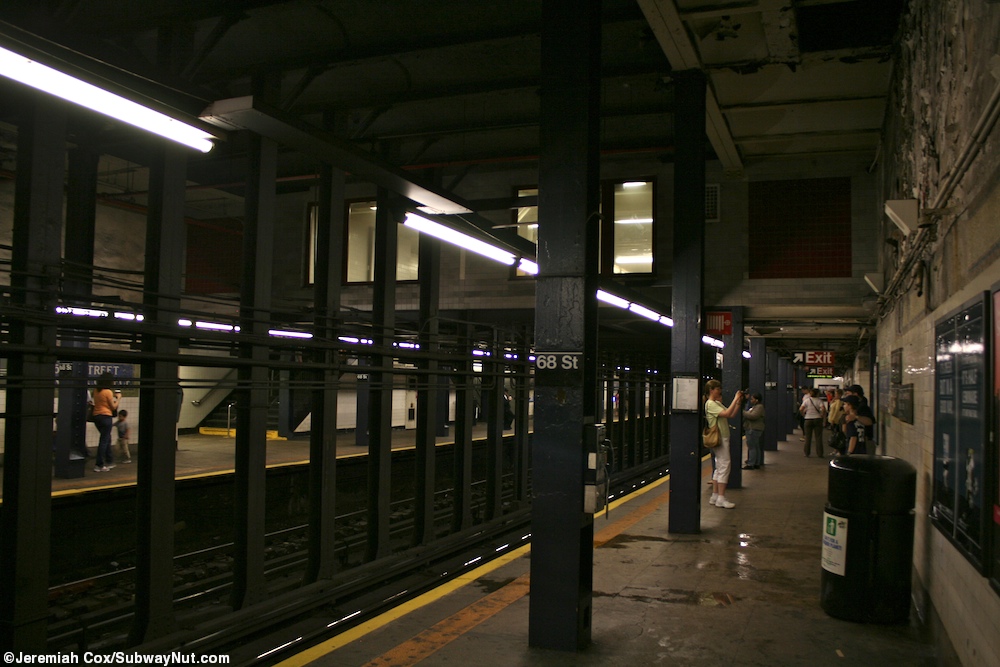
This underground station has two local tracks and two side platforms. The express tracks of the Lexington Avenue Line, used by the 4 and trains during daytime hours, pass beneath the station and are not visible from the platforms. The 6 stops here at all times, and the 4 stops here during late nights. The station is between to the north and to the south. Automated announcements on the R142 fleet refer to the station as 68th Street.
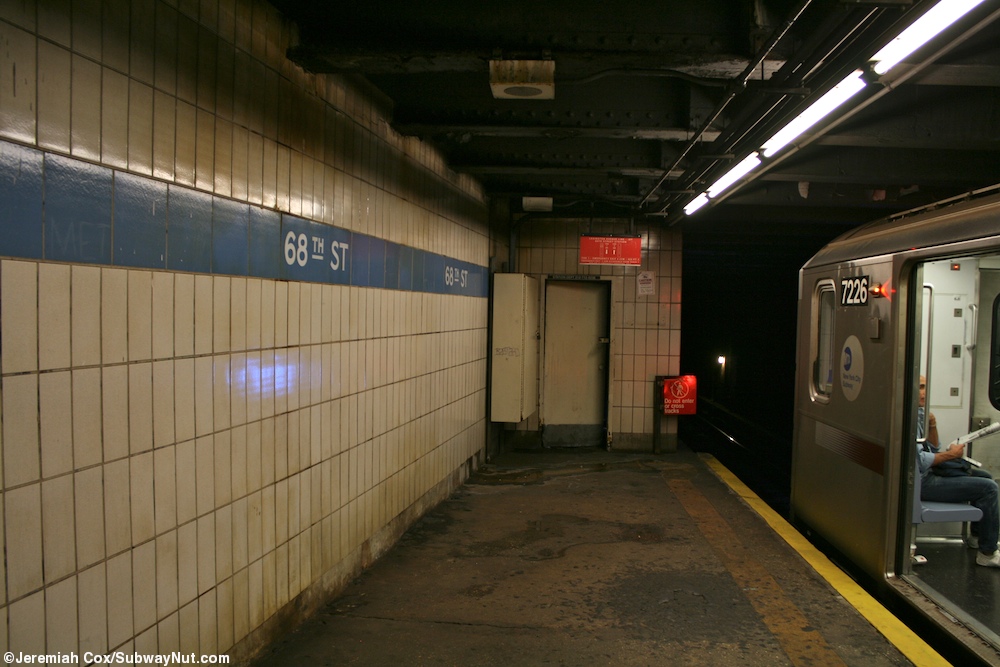
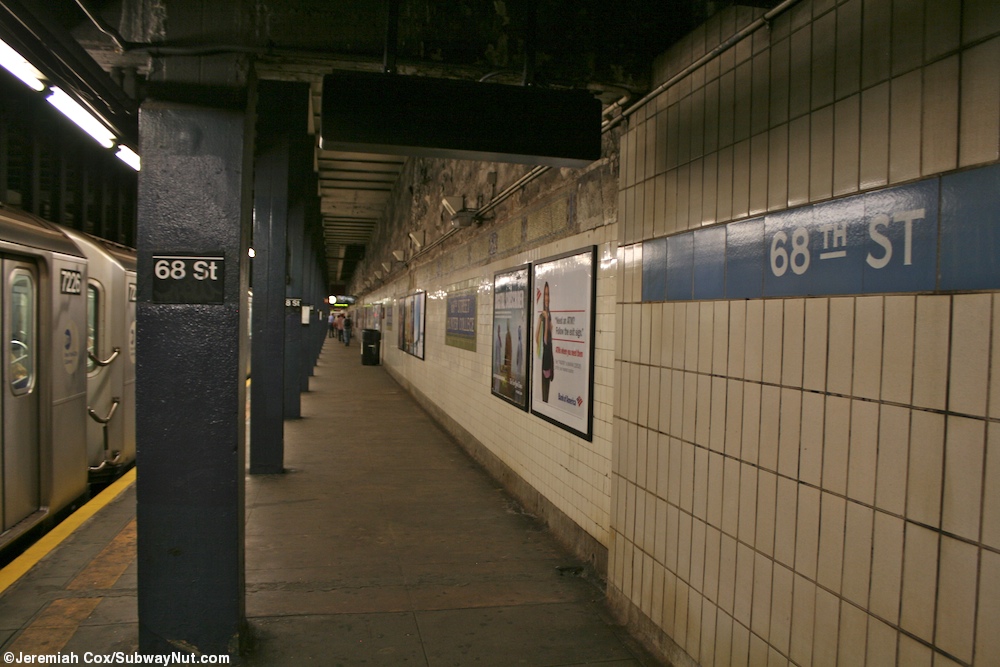
Both platforms have their original brown and yellow mosaic trim line with "68" friezes on it at regular intervals. Where some tiles have degraded and fallen off, the wall is painted in matching colors. Below the trim line are mosaic name tablets reading "68TH STREET-HUNTER COLLEGE" broken onto two lines in white seriffed lettering on blue with a gold and green border. On small sections of the platforms on either ends, where they were extended in the 1950s, there are blue trim lines with "68TH ST" white lettering printed on them. Midnight blue I-beam columns run along both platforms at regular intervals with alternating ones having the standard black station name plate in white lettering. Fixed platform barriers, which are intended to prevent commuters falling to the tracks, are positioned near the platform edges. Both platforms have emergency exits from the lower level express tracks.
Toward the south end of the platforms are two stairs leading to the only mezzanine in the station. It has been renovated with stainless steel fare control rails and features red accent stripes in the IND style. Old wall lights exist but are not functional. The waiting area inside fare control has windows that allow a full view of the platforms and tracks. The northern half of the station without the mezzanine has very high ceilings.
Two glass mosaic artworks, Tempestuous Terrain and Liminal Location by Hunter College professor Lisa Corinne Davis, are installed at the station as part of the MTA Arts & Design program. The Liminal Location mural is split into two sections. Both artworks consist of painted and engraved pieces of glass, which depict lines winding through a multicolored field. These decorations were intended to resemble a map.
Exits


Outside of the large turnstile bank that provides access to and from the station through the mezzanine, there is a token booth and a passageway on each side separated from the waiting area by a steel fence. Each passageway leads to a small staircase going up to either northern corner of 68th Street and Lexington Avenue, as well as an elevator to the northeast corner. On the east side of the mezzanine is a short staircase going up to a landing, where a larger staircase goes up to the southeast corner of 68th Street and Lexington Avenue underneath Hunter College's East Building. The west side of the mezzanine has a direct entrance to the West Building of Hunter College and a double-wide marble staircase going up to the plaza on the southwest corner of 68th Street and Lexington Avenue.
An additional entrance for the northbound platform is located on the east side of Lexington Avenue between 68th and 69th Streets. It is flush with the retail facade of the Imperial House apartment building and leads down to an intermediate landing with a small turnstile bank. An additional entrance for the southbound platform is located on the southwestern corner of Lexington Avenue and 69th Street.
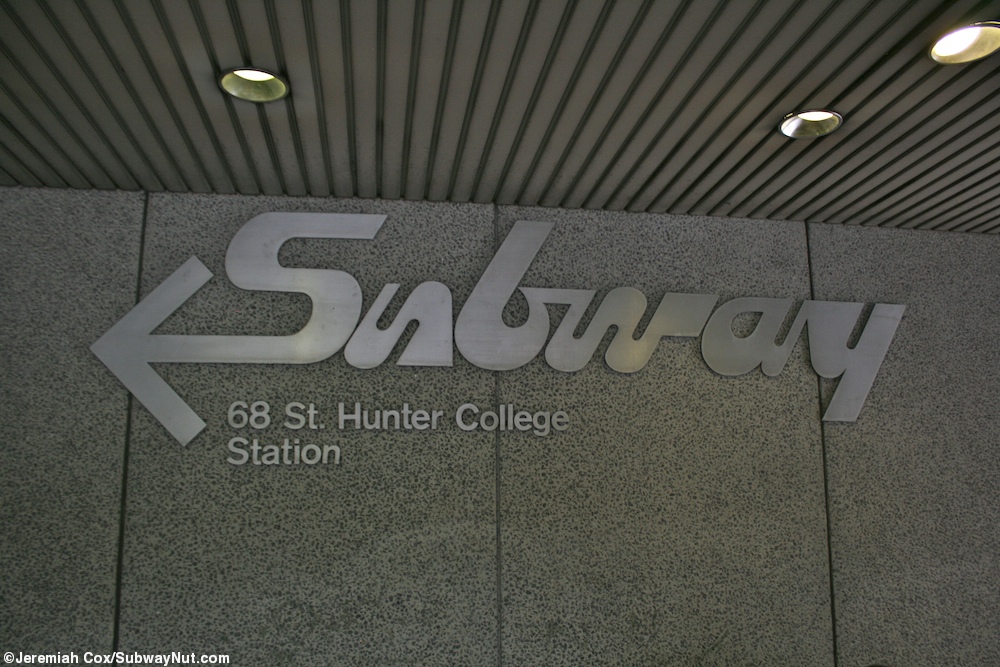
The entrance at the southeast corner contains a sign with the word "Subway" in a unique typeface seen only on the Hunter campus. This sign, and other signs around the college campus that are set in the same typeface, was created by Barbara Stauffacher Solomon as part of Ulrich Franzen's 1984 expansion of the campus.
References
References
- {{cite NYC bus map. M
- (1918). "Fifty Years of Rapid Transit — 1864 to 1917". Law Printing.
- (May 22, 1912). "Petition for Subway in Lexington Ave.". The New York Times.
- (March 20, 1913). "Subway Contracts Solemnly Signed; Cheers at the Ceremonial Function When McCall Gets Willcox to Attest.". The New York Times.
- (March 19, 1913). "Money Set Aside For New Subways; Board of Estimate Approves City Contracts to be Signed To-day with Interboro and B.R.T.". The New York Times.
- (1916). "Engineering News-record". McGraw-Hill Publishing Company.
- (March 10, 1918). "The Seventh and Lexington Avenue Subways Will Revive Dormant Sections — Change in Operation That Will Transform Original Four-Tracked Subway Into Two Four-Tracked Systems and Double Present Capacity of the Interborough". The New York Times.
- (May 19, 1918). "Public Service Commission Fixes July 15 For Opening of The New Seventh and Lexington Avenue Subway Lines — Will Afford Better Service and Less Crowding — Shuttle Service for Forty-Second Street — How the Various Lines of the Dual System Are Grouped for Operation and List of Stations on All Lines". The New York Times.
- (February 16, 1917). "Station Named for Hunter College.". The New York Times.
- (July 17, 1918). "Lexington Av. Line to be Opened Today". The New York Times.
- (1918-07-17). "Lexington Subway to Operate To-day". New York Herald.
- (August 2, 1918). "Open New Subway Lines to Traffic; Called a Triumph — Great H System Put in Operation Marks an Era in Railroad Construction — No Hitch in the Plans — But Public Gropes Blindly to Find the Way in Maze of New Stations — Thousands Go Astray — Leaders in City's Life Hail Accomplishment of Great Task at Meeting at the Astor". The New York Times.
- (1918-08-02). "New "H" System Brings Worst Subway Jam". New-York Tribune.
- (July 11, 1918). "Finish a New Link of the Dual Subway; Lexington Avenue Line North of Forty-second Street to Begin Local Service Wednesday. Branch Extends to Bronx Through service, with Times SquareGrand Central Shuttle Connections, to Open Soon. Changes in the Bronx.". The New York Times.
- (June 13, 1940). "City Transit Unity Is Now a Reality; Title to I.R.T. Lines Passes to Municipality, Ending 19-Year Campaign". The New York Times.
- (June 13, 1940). "Transit Unification Completed As City Takes Over I. R. T. Lines: Systems Come Under Single Control After Efforts Begun in 1921; Mayor Is Jubilant at City Hall Ceremony Recalling 1904 Celebration". New York Herald Tribune.
- (June 11, 1981). "Agency Lists Its 69 Most Deteriorated Subway Stations". The New York Times.
- Cox, Jeremiah. (August 15, 2008). "Plaque for the station's renovations under the 'Adapt-a-Station' program".
- Levingston, Miranda. (December 23, 2024). "Inside This UES Subway Station's $177 Million Accessibility Upgrade".
- (September 26, 2016). "Capital Program Oversight Committee Meeting". Metropolitan Transportation Authority.
- Williams, Keith. (June 13, 2013). "The MTA's Key Station Plan for subway accessibility". The Weekly Nabe.
- Zimmer, Amy. (October 6, 2011). "UES Residents Blast Subway Entrance Plans for Landmarked Blocks". dnainfo.com.
- Buckley, Cara. (February 25, 2012). "Subway Entrances? Not on Our Block".
- (February 2016). "68th Street/Hunter College Subway Station Improvement Project Manhattan, New York Environmental Assessment And Proposed Section 4(f) De Minimis Impact Finding". [[Metropolitan Transportation Authority]].
- (July 24, 2017). "Capital Program Oversight Committee Meeting". [[Metropolitan Transportation Authority]].
- (February 20, 2018). "Transit and Bus Committee Meeting February 2018". [[Metropolitan Transportation Authority]].
- "T6041307 ADA Accessibility at 68 St-Hunter College Station on the Lexington Av Line". Metropolitan Transportation Authority.
- Martinez, Jose. (April 22, 2019). "The tab for the access project at the 68th St.-Hunter College station has risen to more than $116 million over a decade of delay-inducing opposition.".
- Wright, Colin. (May 2, 2019). "Building accessible subways, affordably: How to help people in wheelchairs navigate the system without breaking the bank".
- "Project Details".
- Martinez, Jose. (October 6, 2020). "More than a dozen years after the transit agency first proposed making the 68th Street subway entrance ADA compliant, the MTA has now altered the $100 million-plus plan.".
- (February 21, 2023). "Capital Program Committee Meeting - February 2023".
- (2020). "Proposed Changes to the 68 St-Hunter College Station Improvement Project".
- Senzamici, Peter. (March 2, 2023). "New UES Subway Entrance At 68th Street/Hunter College Nearly Open".
- (December 20, 2024). "MTA Announces 68 St-Hunter College Station Now Fully Accessible".
- {{NYCS const. trackref. trackbook3
- {{NYCS const. timetable. 4
- {{NYCS const. timetable. 6
- {{NYCS const. map
- Whitehorne, Wayne. (January 31, 1998). "Name tablet".
- Cox, Jeremiah. (June 11, 2011). "1950s era trimline is at an extreme end of the platforms of eight streetstairs".
- Cox, Jeremiah. (June 11, 2011). "Looking down the downtown platform has the 1950s era wall gives way to more conventional wall tiling".
- Wassef, Mira. (July 18, 2025). "Platform barriers installed at 56 subway stations in NYC".
- Russo-Lennon, Barbara. (July 20, 2025). "These are the NYC subway stations that now have protective platform barriers".
- Harris, David. (November 16, 2007). "68th Street Mezzanine".
- Cox, Jeremiah. (June 11, 2011). "Approaching the entrance area almost suspended inside the station ceiling the platform roof gets lower".
- Culgan, Rossilynne Skena. (January 29, 2025). "Abstract mosaics are bringing a powerful message to this Upper East Side subway station".
- Spielman, Ralph. (December 26, 2024). "MTA Holiday Presents: Completes Nearly $500M in Renovations at E. 68th St. and W. 14th St. Subway Stations".
- (April 2018). "68th Street—Hunter College Neighborhood Map". Metropolitan Transportation Authority.
- Metropolitan Transportation Authority. (March 1, 2023). "ADA Accessibility Upgrade and Station Improvements 68th Street Hunter College Station".
- Cox, Jeremiah. (June 11, 2011). "An artsy Subway sign for the 68 St-Hunter College Station entrance".
- Plitt, Amy. (July 14, 2017). "The forgotten history of a retro NYC subway entrance".
This article was imported from Wikipedia and is available under the Creative Commons Attribution-ShareAlike 4.0 License. Content has been adapted to SurfDoc format. Original contributors can be found on the article history page.
Ask Mako anything about 68th Street–Hunter College station — get instant answers, deeper analysis, and related topics.
Research with MakoFree with your Surf account
Create a free account to save articles, ask Mako questions, and organize your research.
Sign up freeThis content may have been generated or modified by AI. CloudSurf Software LLC is not responsible for the accuracy, completeness, or reliability of AI-generated content. Always verify important information from primary sources.
Report