From Surf Wiki (app.surf) — the open knowledge base
28th Street station (IRT Broadway–Seventh Avenue Line)
New York City Subway station in Manhattan
New York City Subway station in Manhattan
| Field | Value | ||||
|---|---|---|---|---|---|
| name | 28 Street | ||||
| image | IRT Broadway-Seventh 28th Street Northbound Platform.jpg | ||||
| image_caption | Northbound 1 train departs | ||||
| address | West 28th Street & Seventh Avenue | ||||
| New York, New York | |||||
| borough | Manhattan | ||||
| locale | Chelsea, Flower District, Midtown | ||||
| coordinates | |||||
| division | IRT | ||||
| line | IRT Broadway–Seventh Avenue Line | ||||
| service | Broadway-Seventh center south local | ||||
| service_header | Broadway-Seventh local header | ||||
| other | NYCT Bus: | ||||
| platforms | 2 side platforms | ||||
| tracks | 4 | ||||
| structure | Underground | ||||
| opened | |||||
| services | {{Adjacent stations | system=New York City Subway | |||
| line1 | Broadway-Seventh local | left1=34th Street–Penn Station | right1=23rd Street | note-left1= | note-right1= |
| note-row2 | does not stop here}} | ||||
| footnotes | |||||
| route_map | {{NYCS 4-tracked local station | inline=y | |||
| 1 | 34th Street–Penn Station | ||||
| 2 | 23rd Street | ||||
| code | IRT Broadway–Seventh Avenue Line | ||||
| deg | 330 | ||||
| embedded | {{Infobox NRHP | ||||
| embed | yes | ||||
| name | West 28th Street Subway Station (Dual System IRT) | ||||
| added | March 30, 2005 | ||||
| mpsub | New York City Subway System MPS | ||||
| refnum | 05000235 |
New York, New York |note-row2= does not stop here}}
The 28th Street station is a local station on the IRT Broadway–Seventh Avenue Line of the New York City Subway. Located at the intersection of 28th Street and Seventh Avenue in the Chelsea neighborhood of Manhattan, it is served by the 1 train at all times and by the 2 train during late nights.
The station was built by the Interborough Rapid Transit Company (IRT) as part of the Dual Contracts with New York City, and opened on July 1, 1918. The station had its platforms extended in the 1960s.
History
Construction and opening
The Dual Contracts, which were signed on March 19, 1913, were contracts for the construction, rehabilitation and operation of rapid transit lines in the City of New York. The contracts were "dual" in that they were signed between the City and two separate private companies, the Interborough Rapid Transit Company (IRT) and the Brooklyn Rapid Transit Company (BRT), all working together to make the construction of the Dual Contracts possible. The Dual Contracts promised the construction of several lines in Brooklyn. As part of Contract 4, the IRT agreed to build a branch of the original subway line south down Seventh Avenue, Varick Street, and West Broadway to serve the West Side of Manhattan.
The construction of this line, in conjunction with the construction of the Lexington Avenue Line, would change the operations of the IRT system. Instead of having trains go via Broadway, turning onto 42nd Street, before finally turning onto Park Avenue, there would be two trunk lines connected by the 42nd Street Shuttle. The system would be changed from looking like a "Z" system on a map to an "H" system. One trunk would run via the new Lexington Avenue Line down Park Avenue, and the other trunk would run via the new Seventh Avenue Line up Broadway. In order for the line to continue down Varick Street and West Broadway, these streets needed to be widened, and two new streets were built, the Seventh Avenue Extension and the Varick Street Extension. It was predicted that the subway extension would lead to the growth of the Lower West Side, and to neighborhoods such as Chelsea and Greenwich Village.
28th Street opened as part of an extension of the line from 34th Street–Penn Station to South Ferry on July 1, 1918. Initially, the station was served by a shuttle running from Times Square to South Ferry. The new "H" system was implemented on August 1, 1918, joining the two halves of the Broadway–Seventh Avenue Line and sending all West Side trains south from Times Square. An immediate result of the switch was the need to transfer using the 42nd Street Shuttle in order to retrace the original layout. The completion of the "H" system doubled the capacity of the IRT system.
Later years
The city government took over the IRT's operations on June 12, 1940. On August 9, 1964, the New York City Transit Authority (NYCTA) announced the letting of a $7.6 million contract to lengthen platforms at stations on the Broadway—Seventh Avenue Line from Rector Street to 34th Street–Penn Station, including 28th Street, and stations from Central Park North–110th Street to 145th Street on the Lenox Avenue Line to allow express trains to be lengthened from nine-car trains to ten-car trains, and to lengthen locals from eight-car trains to ten-car trains. With the completion of this project, the NYCTA project to lengthen IRT stations to accommodate ten-car trains would be complete.
The station was listed on the National Register of Historic Places on March 30, 2005. The southbound platform's Customer Assistance Booth was removed in 2010.
A small bar called La Noxe is next to one of the street staircases from the northbound platform. The bar first opened in October 2020, shuttered for three months due to the COVID-19 pandemic in New York City, and reopened in February 2021.
Station layout

This underground station has four tracks and two side platforms. The station is served by the 1 at all times and by the 2 during late nights; the center express tracks are used by the 2 and 3 trains during daytime hours. It is between 34th Street–Penn Station to the north and 23rd Street to the south.
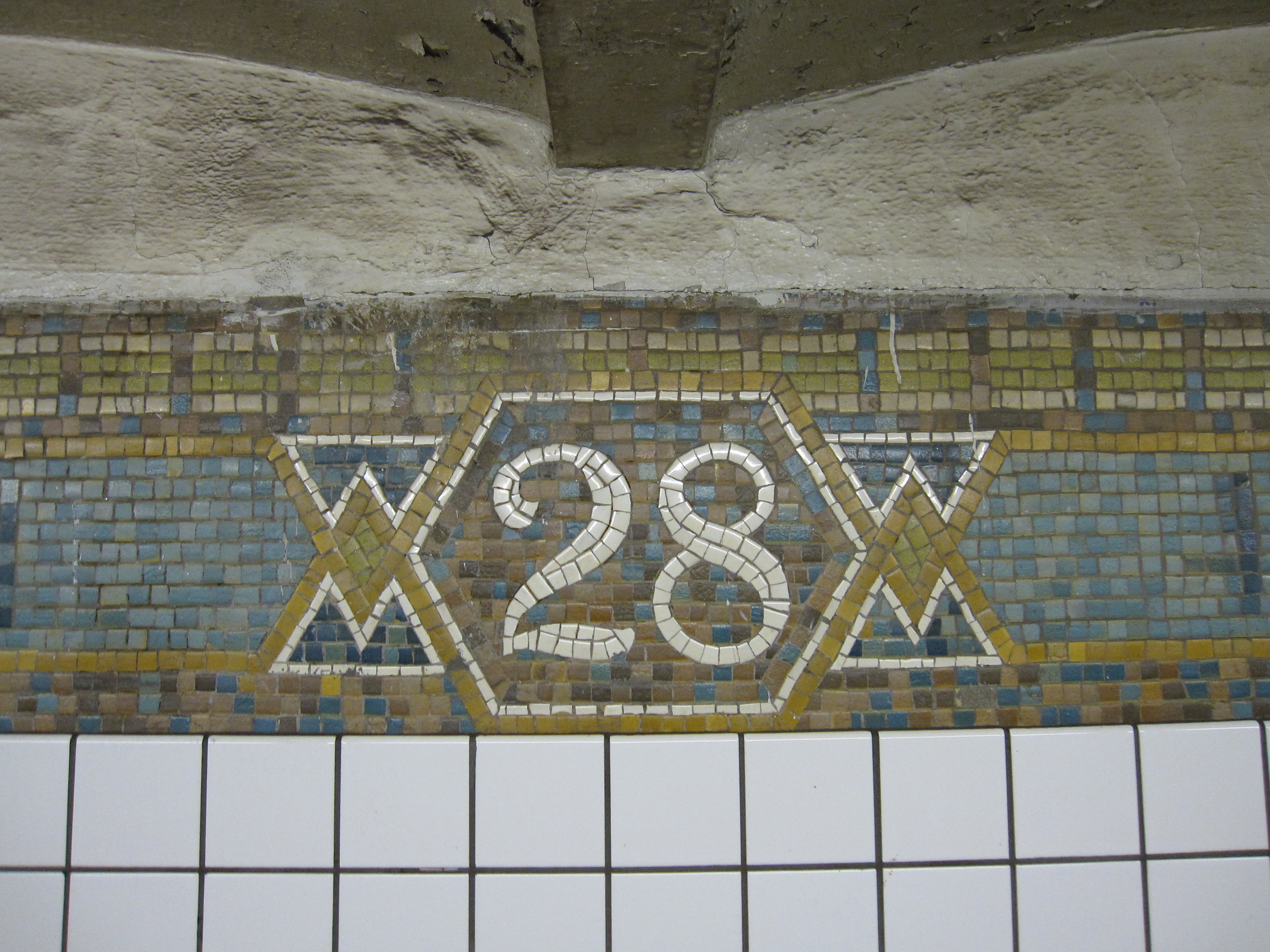
Both platforms have their original mosaic trim line, name tablets, and directional signs. Vent chambers are present and there is a closed newsstand on the northbound platform as evidenced by sealed windows on the walls. Slate blue I-beam columns run along both platforms at regular intervals, alternating ones having the standard black station name plate with white lettering.
The station is built on a former wetland, making it especially vulnerable to flooding during heavy rains.
Exits

All fare control areas are on platform level and there are no crossovers or crossunders. The main ones are at the centers of the platforms, at 28th Street. On the Bronx-bound platform, a turnstile bank leads to a mezzanine with a token booth and two staircases going up to either eastern corners of 28th Street and Seventh Avenue. On the southbound platform, a turnstile bank leads to an unstaffed mezzanine. Two staircases go up to either western corners of 28th Street and Seventh Avenue.
Both platforms have an exit-only at their extreme south ends, at 27th Street. A single exit-only turnstile from each platform leads to one staircase each going up to either northern corner of Seventh Avenue and 27th Street. The northwest-corner exit, from the southbound platform, is outside Fashion Institute of Technology. The northeast-corner exit is from the northbound platform.
References
References
- {{Cite archive
- (March 19, 1913). "Terms and Conditions of Dual System Contracts". Public Service Commission.
- (September 1912). "The Dual System of Rapid Transit (1912)". Public Service Commission.
- (September 9, 1917). "Most Recent Map of the Dual Subway System Which Shows How Brooklyn Borough Is Favored In New Transit Lines". The Brooklyn Daily Eagle.
- Sealey, D.A.. (1916). "Rapid Transit Work in New York City, 1915". McGraw-Hill Publishing Company.
- (March 10, 1918). "The Seventh and Lexington Avenue Subways Will Revive Dormant Sections". [[The New York Times]].
- (May 19, 1918). "Public Service Commission Fixes July 15 For Opening of The New Seventh and Lexington Avenue Subway Lines". [[The New York Times]].
- (1 Jul 1918). "7th Avenue Subway System Is Opened To Public To-day: First Train Will Start at 2 O'Clock This Afternoon". New-York Tribune.
- (July 2, 1918). "Open New Subway to Regular Traffic". The New York Times.
- (1917-07-01). "Times Sq. Grows as Subway Centre: New Seventh Avenue Line, Open Today, Marks Great Transportation Advance". The New York Times.
- (August 2, 1918). "Open New Subway Lines to Traffic; Called a Triumph". The New York Times.
- (1940-06-13). "City Transit Unity Is Now a Reality; Title to I.R.T. Lines Passes to Municipality, Ending 19-Year Campaign". The New York Times.
- (June 13, 1940). "Transit Unification Completed As City Takes Over I. R. T. Lines: Systems Come Under Single Control After Efforts Begun in 1921; Mayor Is Jubilant at City Hall Ceremony Recalling 1904 Celebration". New York Herald Tribune.
- (August 10, 1964). "IRT Riders To Get More Train Room; $8.5 Million Is Allocated for Longer Stations and for 3 New Car Washers". The New York Times.
- Villeda, Ray. (April 16, 2021). "The Hidden Speakeasy Inside A Manhattan Subway Station".
- (April 8, 2021). "New York's Newest Speakeasy Is Hidden Inside a Subway Station - and It Currently Has a 900-person Reservation List".
- Rahmanan, Anna. (March 30, 2021). "There is a secret speakeasy hidden inside the 28th Street subway station".
- {{NYCS const. timetable. 1
- {{NYCS const. timetable. 2
- {{NYCS const. timetable. 3
- {{NYCS const. map
- Nessen, Stephen. (July 18, 2025). "NYC subway geyser caused by ancient Manhattan stream".
- (2018). "MTA Neighborhood Maps: 28 Street (1)". [[Metropolitan Transportation Authority]].
This article was imported from Wikipedia and is available under the Creative Commons Attribution-ShareAlike 4.0 License. Content has been adapted to SurfDoc format. Original contributors can be found on the article history page.
Ask Mako anything about 28th Street station (IRT Broadway–Seventh Avenue Line) — get instant answers, deeper analysis, and related topics.
Research with MakoFree with your Surf account
Create a free account to save articles, ask Mako questions, and organize your research.
Sign up freeThis content may have been generated or modified by AI. CloudSurf Software LLC is not responsible for the accuracy, completeness, or reliability of AI-generated content. Always verify important information from primary sources.
Report