From Surf Wiki (app.surf) — the open knowledge base
2008 breach of the Egypt–Gaza border
Explosion set off by Hamas militants
Explosion set off by Hamas militants
| Field | Value |
|---|---|
| title | 2008 breach of the Egypt–Gaza border |
| image | File:Road to Gaza 060 - Flickr - Al Jazeera English.jpg |
| caption | Rafah Border Crossing |
| date | 23 January 2008 |
| Location | Rafah Border Crossing |
| type | Explosion |
| organizers | |
| outcome | 200,000–700,000 Palestinians crossed over to Egypt |
- Hamas
- Hamas Al-Qassam Brigades
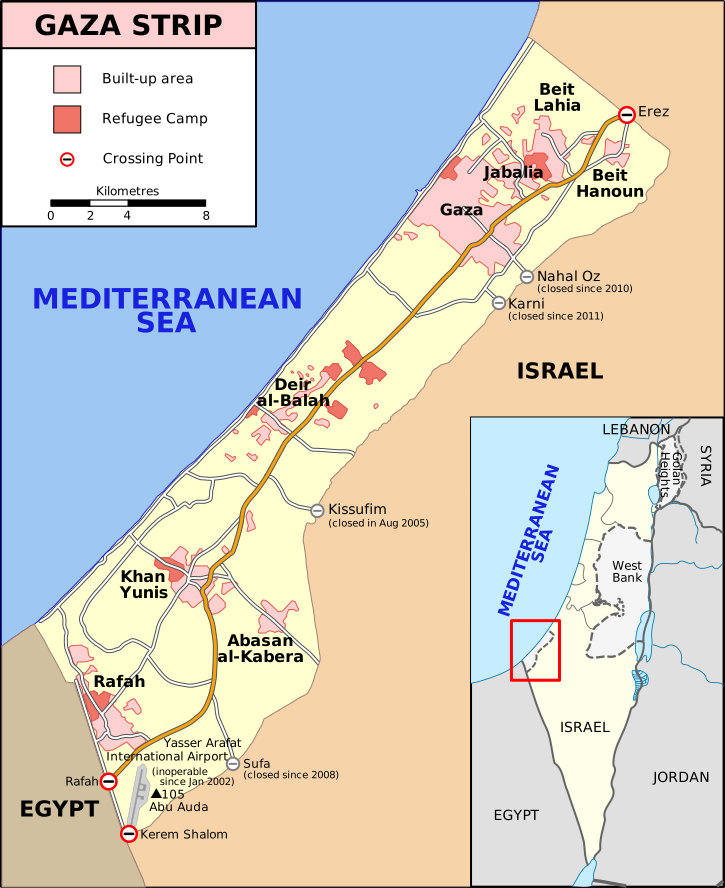
On 23 January 2008, Hamas militants in the Gaza Strip set off an explosion near the Rafah border crossing, destroying part of the 2003 wall. The United Nations estimates that as many as half the 1.5 million population of the Gaza Strip crossed the border into Egypt seeking food and supplies. Due to fears that militants would acquire weapons in Egypt, Israeli police went on increased alert.
Egypt had closed the Rafah border crossing in June 2007, days before Hamas took control of Gaza at the end of the Gaza civil war; A total blockade had begun on 17 January 2008 following a rise in rocket attacks on Israel emanating from Gaza.
Although Israel demanded Egypt reseal the border due to security concerns, Egyptian President Hosni Mubarak ordered his troops to allow crossings to alleviate the humanitarian crisis, while verifying that the Gazans did not attempt to bring weapons back into Gaza. In five days, Gazans spent some US$250 million in the North Sinai Governorate's capital of Arish alone. The sudden enormous demand there for staple products led to large local price rises and some shortages.
On 24 January, the United Nations Human Rights Council condemned Israel for the fifteenth time in less than two years, calling the blockade collective punishment. However, the proceedings were boycotted by Israel and the United States. On 27 January, Israeli Prime Minister Ehud Olmert promised that Israel would no longer disrupt the supply of food, medicine and necessary energy into the Gaza Strip.
On 3 February, Gaza's Foreign minister, Mahmoud al-Zahar, announced that Hamas and Egypt would cooperate in controlling the border without Israeli control, "perhaps jointly with [Mahmoud] Abbas". Abbas' Palestinian National Authority said that Egypt had agreed to restore the 2005 border agreement giving Abbas control over the Rafah crossing, but excluding Hamas. Israel, on the other hand resisted Abbas' control of any crossing point. The border was closed—except to travelers returning home—eleven days after the breach.
Background
After the 2005 Israeli disengagement, which ended their 38-year presence in Gaza, Egypt had pledged to help control their border with Gaza. U.S. Secretary of State Condoleezza Rice brokered a deal with Israel giving the Palestinian National Authority control over the Rafah Border crossing under the remote video observation of European Union and Israeli monitors.
After Hamas won the 2006 Palestinian legislative election in January 2006, an international diplomatic and financial boycott of the new Hamas-led government began. Beginning in June 2006, a series of battles erupted between Palestinian gunmen and the Israel Defense Forces (IDF) during 2006 Israel–Gaza conflict, which ended in a truce on 26 November.
In December 2006, Hamas began fighting to expel Fatah. Hundreds of rocket attacks on Israel from Gaza had continued despite the November truce. In March 2007, the Palestinian Legislative Council established a national unity government, with 83 representatives voting in favor and three against. Government ministers were sworn in by Mahmoud Abbas, the chairman on the Palestinian Authority, in a ceremony held simultaneously in Gaza and Ramallah. In June 2007, Hamas took control of the Gaza Strip and removed Fatah officials. Following the Battle of Gaza, the international sanctions were terminated in June 2007 while at the same time a new and more severe blockade of the Gaza Strip was initiated.
In response to the violent clashes, President Abbas declared a state of emergency and dissolved the national unity government on 14 June. Hamas gained complete control of the Gaza Strip on 15 June, after forcing out Fatah. The Israeli government closed all check-points along its border with Gaza in response to the violence. Hamas seized control of Gaza on 15 June.
Humanitarian crisis
Main article: Blockade of the Gaza Strip
Beginning in June 2007, Israel limited its exports to Gaza to nine basic materials. Out of 9,000 commodities (including foodstuffs) that were entering Gaza before the 2006 elections, only 20 commodities were to be allowed in.
In October 2007, Israel began limiting fuel supplies to the territory. Hamas responded that Israel had effectively declared war by labeling Gaza as an "enemy entity."
In December 2007, the International Committee of the Red Cross (ICRC) confirmed the need for humanitarian relief in the Palestinian territories. In a statement, the ICRC described the living conditions of Palestinians in the Gaza Strip as "alarming" and called for Israel to ease restrictions on the movement of goods into Gaza and the West Bank.
According to a United Nations study, by January 2008, the economic effects of the blockade had reached a critical threshold. Finally, on 17 January 2008, following a rise in the number of rocket attacks, Israel sealed the border completely.
On 20 January, the only power plant in Gaza shut down. The United Nations officials implored Israel to reverse its decision to seal all border crossings with the Gaza Strip, warning that the violence in the region and the lack of crucial supplies for 1.4 million Palestinians was provoking a humanitarian crisis. Israel accused Hamas of "fabricating" the power shortage, pointing out that the power plant in Gaza produces only a minority of the territory's power. Israel stated that the blackout occurred for media purposes and stated that Hamas had timed it themselves. Israel said it was still providing nearly 70 percent of the territory's power directly.
Following widespread international concern about an impending humanitarian crisis, and a warning from the United Nations that World Food Programme aid to about 860,000 Gazans could be halted within days because of the blockade, Israeli Defense Minister Ehud Barak decided to ease restrictions on the flow of goods into Gaza for a day on 22 January, permitting shipments of fuel for Gaza's power plant and cooking oil to enter Gaza.
Breaching of wall
On 22 January, gunfire erupted after a group of Hamas demonstrators, mostly women, forced open the door of the Rafah Border crossing and fled into Egypt.
Overnight on 23 January, gunmen set off a number of explosions along the wall near the crossing. Palestinians packed into cars and donkey carts, crossed the border into Egypt from Gaza on foot, to buy essential goods. Between 200,000 and 700,000 Palestinians crossed over to Egypt and bought items at shops at the Egyptian half of Rafah and the North Sinai Governorate's capital, Arish. A Palestinian security guard later told The Times of London that militants had been steadily cutting through the base of the Israeli Gaza Strip barrier with oxyacetylene torches for months.
While Egypt allowed Palestinians to enter Egypt, it did not let them travel very far; Palestinians were not allowed to travel further than Arish. Egypt said that it would not use force to send back Palestinians. Foreign ministry spokesman Hossam Zaki said the border would be closed again when all the Palestinians had returned.
Ahmed Yousef, a senior adviser to Gaza's Prime Minister Ismail Haniyeh, warned that "The next time there is a crisis in the Gaza Strip, Israel will have to face half a million Palestinians who will march toward Erez," a border crossing with Israel, and on to towns left during the 1948 Palestinian expulsion and flight. Israeli security officials said militants had exploited the breach in the border wall to send armed men into the Sinai to infiltrate Israel across the Sinai–Israel border.
On 25 January, Egyptian security forces blocked almost all illegal entry points along the border with Gaza to try to stem the flow of Palestinians wanting to leave. Egyptian forces in riot gear erected barbed wire and chain-link fences along the border to prevent more Palestinians from crossing. Palestinians attempted to break through, and several were injured in the resulting clashes.
After the repair, Palestinians used a bulldozer to knock over the new fence, creating an opening once more. As the border crossings entered their fifth day, Egyptian border police began stopping Gazans from entering in vehicles and blocked off the road beyond Rafah to Arish. In Rafah there was little left to buy, and it appeared Egypt had decided to restrict the resupply of goods to El Arish and Rafah in order to peacefully end the crossings and reestablish control over the border.
On 28 January, Egyptian security forces and Hamas militants strung barbed wire across one of the breaches, sealing it off.
UN reaction
On 24 January, the United Nations Human Rights Council condemned Israel for the fifteenth time in less than two years. The Council released a statement calling on Israel to stop its military operations in Gaza and to open the Strip's borders to allow the entry of food, fuel and medicine. It asked the international community to ensure that Israel stop its actions in Gaza, which it referred to as "collective punishment of the Palestinian civilians that leads to disastrous humanitarian and environmental consequences."
An official resolution was presented by Syria and Pakistan on behalf of the Organisation of the Islamic Conference to the United Nations Security Council but could not be agreed upon. Thirty nations voted in favor of the resolution, one (Canada) voted against the resolution, 15 countries abstained, and one (Gabon) was absent. Both Israel and the United States boycotted the proceedings, which ended with a call for Israel to lift its siege of Gaza but made no mention of the Palestinian rocket attacks on communities in the western Negev.
Israeli government response
Israel demanded Egypt reseal the border and launched air strikes against the Gazan half of Rafah overnight on 24 January, killing Mohammed Abu Harb, the commander of Hamas's military there.
At a court hearing on 27 January, the Israeli government promised to resume supplies of fuel, but not at normal levels, for another week. Later that day, Israeli Prime Minister Ehud Olmert promised that Israel would no longer disrupt the supply of food, medicine and necessary energy into the Gaza Strip.
Border-control talks
Ehud Olmert, the Israeli prime minister, and Mahmoud Abbas, President of the Palestinian National Authority which controls the West Bank, held talks on 27 January in Jerusalem on the border breach. Abbas reportedly wants to take over Gaza's border crossings, including the one with Egypt that Palestinians in Gaza breached, but Israel resisted the idea of giving the West Bank-based government control of the Gaza crossings, citing concerns about security.
Hamas and Fatah, who controlled Gaza before the last election, have accepted an invitation from Egypt to hold separate talks in Cairo on the border crisis. All sides hoped to create a plan to keep the border between Egypt and Gaza open.
An Israeli defense delegation secretly visited Cairo on 28 January and discussed the situation with top Egyptian officials the London-based Asharq Alawsat newspaper reported. According to the report, the delegation relayed to Egypt Israel's fears that Palestinian militants would smuggle weapons and explosives through Egypt's open border with the Gaza Strip.
Hamas stated they would accept a return of the EU monitoring mission if it were to reside in Egypt or the Gaza Strip, as opposed to being based in Israel.
Border closure
The border was closed by Egypt with Hamas's cooperation, except for travelers returning home, on 3 February.
Economic effects
In Arish alone, Gazans spent some US$250 million over five days.
The breach created tens of thousands of temporary new jobs in Gaza where the returning caravans set up shop; unemployment had been at 40 percent. The food brought in from Egypt during the first six days would last Gazans three months, fuel about two days and cement for two weeks if the borders are resealed, according to various estimates from economists, business leaders and gas station owners.
However, were the border to remain open long term, Gaza's workers and manufacturers who had worked in the more upscale Israeli market before layoffs during the Second Intifada would have trouble competing in Egypt's low-wage economy, according to West Bank economist Nasser Abdel Karim.
International response
; Iran: Tehran offered to send aid to Egypt to alleviate the effects of the breach.
; United States: U.S. President George W. Bush condemned Hamas for delivering "misery" to the Palestinian people, and called for talks to create a Palestinian state.
; European Union: The EU said it would consider sending its monitors back to Gaza's border with Egypt, and unveiled a new plan for getting aid to Palestinians.
References
References
- al-Sarraj, Eyad. (28 January 2008). "Ending the stranglehold on Gaza". The Boston Globe.
- (25 January 2008). "UNHRC slams Israel's actions in Gaza". The Jerusalem Post.
- Erlanger, Steven. (27 January 2008). "Israel to Allow Supply Flow into Gaza". The New York Times.
- al-Mughrabi, Nidal. (3 February 2008 ). "Hamas to control passage over breached Egypt border". Reuters.
- [https://web.archive.org/web/20150920163951/http://www.thestar.com.my/story/?file=%2F2008%2F1%2F27%2Fworldupdates%2F2008-01-27T181529Z_01_NOOTR_RTRMDNC_0_-316175-1&sec=Worldupdates Egypt vows to control Gaza border, assures Abbas]. Reuters, 27 January 2008
- [https://web.archive.org/web/20080204032903/http://www.iht.com/articles/2008/02/03/africa/04mideast-nyt.php "Egyptian Troops Seal Gaza Border"]. Isabel Kershner, ''The New York Times'', 3 February 2008
- Soueif, Ahdaf. (27 January 2008). "This exodus presents us Egyptians with a threat – and an opportunity". The Guardian (UK).
- (21 December 2006). "EU monitors to stop Hamas money at Egypt-Gaza border".
- (16 November 2006). "Rice deal opens Gaza Strip border". Taipei Times.
- (15 June 2007). "Hamas takes control of Gaza". Guardian.
- McGreal, Chris. (19 March 2003). "Arafat forced to give up most powers to new PM". The Guardian.
- Knickmeyer, Ellen. (18 June 2007). "Gaza Straining at Egypt's Door: Humanitarian, Security Worries Mount". The Washington Post.
- Katz, Yaakov. (5 July 2007). "Hamas threats keep crossing closed". Jerusalem Post.
- (19 September 2007). "Hamas says Gaza sanctions "declaration of war"". Reuters.
- (13 December 2007). "Occupied Palestinian territories: ICRC calls for immediate political action to contain deep crisis". International Committee of the Red Cross.
- Eldar, Akiva. (22 January 2008). "UN: Despite Israel's promises, West Bank barriers have increased". Haaretz.
- (21 January 2008). "UN warns of humanitarian crisis as Israel seals Gaza crossings". Haaretz.
- [http://www.mfa.gov.il/MFA/Terrorism-%2BObstacle%2Bto%2BPeace/Palestinian%2Bterror%2Bsince%2B2000/Terror%2Bin%2BGaza-%2BTwo%2Bmonths%2Bsince%2Bthe%2BHamas%2Btakeover%2B16-Aug-2007.htm Terror in Gaza: Eight months since the Hamas takeover] {{Webarchive. link. (5 August 2012 , Israel Ministry of Foreign Affairs, 14 February 2008.)
- (22 January 2008). "Israel eases restrictions on Gaza". BBC News.
- (24 January 2008). "Militants blow up Rafah barrier". World News Australia.
- (23 January 2008). "Gazans flood through Egypt border". BBC News.
- (25 January 2008). "At Gaza border with Egypt, masses make reverse exodus into Sinai". Haaretz.
- (25 January 2008). "UN fails to agree on Gaza statement". Radio Netherlands Worldwide.
- Hider, James. (6 March 2008). "The great escape – or perhaps it is just a gigantic shopping spree". Times (UK).
- Gutkin, Steven. (24 January 2008). "Egyptians Controlling Border Traffic".
- (23 January 2008). "Egypt 'won't force Gazans back'". BBC News.
- Toameh, Khaled Abu. (25 January 2008). "Hamas: 500,000 will march on Erez". The Jersalsem Post.
- (25 January 2008). "Gazans make new border wall hole: Palestinians have bulldozed down part of the Gaza-Egypt border wall again, hours after Egyptian troops blocked holes recently made by militants". BBC News.
- al-Mughrabi, Nidal. (25 January 2008). "Hamas challenges Egypt's bid to close Gaza border". Reuters.
- New Agencies. (29 January 2008). "Egypt begins repairing new section of destroyed Gaza-Egypt border wall". Haaretz.
- (25 January 2008). "Security Council fails yet again to agree Gaza statement". Agence France-Presse.
- (27 January 2008). "Israel 'to resume Gaza supplies': Israel says it will resume supplying fuel to Gaza, 10 days after it stopped shipments following continued rocket attacks by Palestinian militants". BBC News.
- (27 January 2008). "Talks focus on Gaza border control". Al Jaazera.
- Almeghari, Rami. (27 January 2008). "Haniya's former advisor expects reopening of other Gaza crossings". International Middle East Media Center.
- (27 January 2008). "Gaza Strip border still open as Cairo to host Fatah, Hamas leaders for separate crisis talks". Al Bawaba.
- (29 January 2008). "Israel, Egypt meet on Gaza status". The Jerusalem Post.
- "Hamas accepts EU at crossing point if they reside in Gaza or Egypt – Middle East".
- "Satellite News and latest stories | The Jerusalem Post".
- McDonough, Challiss. (28 January 2008). "Egypt Tightens Control Along Gaza Border". Voice of America.
- El Deeb, Sarah. (28 January 2008). "Border Breach Temporary Boost for Gaza". Associated Press.
- Butcher, Tim. (29 January 2008). "Iran offers aid to Egypt over Gaza crisis". The Telegraph (UK).
- (29 January 2008). "Bush to Gaza: 'Look what Hamas has brought you'".
- (28 January 2008). "EU Discusses Gaza, Unveils New Aid Plan for Palestinians". Deutsche Welle.
This article was imported from Wikipedia and is available under the Creative Commons Attribution-ShareAlike 4.0 License. Content has been adapted to SurfDoc format. Original contributors can be found on the article history page.
Ask Mako anything about 2008 breach of the Egypt–Gaza border — get instant answers, deeper analysis, and related topics.
Research with MakoFree with your Surf account
Create a free account to save articles, ask Mako questions, and organize your research.
Sign up freeThis content may have been generated or modified by AI. CloudSurf Software LLC is not responsible for the accuracy, completeness, or reliability of AI-generated content. Always verify important information from primary sources.
Report