From Surf Wiki (app.surf) — the open knowledge base
1937–38 NCAA football bowl games
College football postseason game series
College football postseason game series
| Field | Value | |
|---|---|---|
| season | 1937 | |
| image | [[Image:1937 Bowls-USA-states.png | 300px]] |
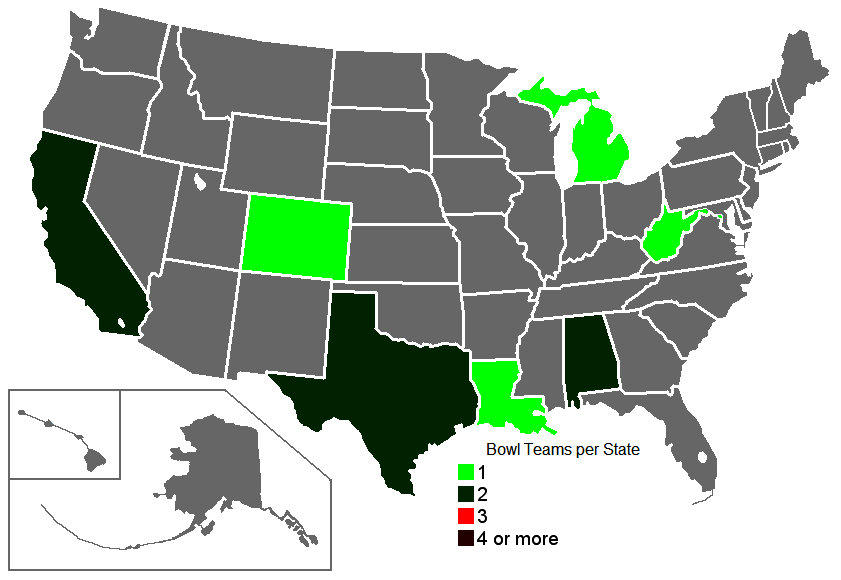
| image_caption | Number of bowl games per state | |
| number_of_bowls | 5 | |
| all_star_games | East–West Shrine Game | |
| bowl_start | January 1, 1938 | |
| champions | Pittsburgh Panthers (AP, Dickinson) | |
| California Golden Bears (Dunkel) | ||
| bowl_record_link | #Conference performance in bowl games | |
| conference1 | Independents | |
| conference1_teams | 3 | |
| conference1_wins | 2 | |
| conference1_losses | 1 | |
| conference1_ap_poll | 8 | |
| conference2 | SEC | |
| conference2_teams | 3 | |
| conference2_wins | 1 | |
| conference2_losses | 2 | |
| conference2_ap_poll | 2 | |
| conference3 | Pacific Coast | |
| conference3_teams | 1 | |
| conference3_wins | 1 | |
| conference3_losses | 0 | |
| conference3_ap_poll | 1 | |
| conference4 | SWC | |
| conference4_teams | 1 | |
| conference4_wins | 1 | |
| conference4_losses | 0 | |
| conference4_ap_poll | 3 | |
| conference5 | Border | |
| conference5_teams | 1 | |
| conference5_wins | 0 | |
| conference5_losses | 1 | |
| conference5_ap_poll | 0 | |
| conference6 | Rocky Mountain | |
| conference6_teams | 1 | |
| conference6_wins | 0 | |
| conference6_losses | 1 | |
| conference6_ap_poll | 1 | |
| conference7 | Big Six | |
| conference7_teams | 0 | |
| conference7_wins | 0 | |
| conference7_losses | 0 | |
| conference7_ap_poll | 1 | |
| conference8 | Big Ten | |
| conference8_teams | 0 | |
| conference8_wins | 0 | |
| conference8_losses | 0 | |
| conference8_ap_poll | 2 | |
| conference9 | Southern | |
| conference9_teams | 0 | |
| conference9_wins | 0 | |
| conference9_losses | 0 | |
| conference9_ap_poll | 2 |
California Golden Bears (Dunkel)
The 1937–38 NCAA football bowl games were the final games of the National Collegiate Athletic Association (NCAA) 1937 college football season and featured five bowl games, down one from the prior season, as the Bacardi Bowl was not held. All five bowls were played on January 1, 1938. Notably, the Orange Bowl was first held in Burdine Stadium, which was later renamed for the bowl game itself in 1959. The national championship, according to recognized selectors, was split by Pittsburgh and California.
Poll rankings
The below table lists top teams (per the AP poll taken after the completion of the regular season), their win–loss records (prior to bowl games), and the bowls they later played in.
| AP | Team | W–L | Conf. | Bowl |
|---|---|---|---|---|
| Pittsburgh Panthers | Ind. | — | ||
| California Golden Bears | PCC | Rose Bowl | ||
| Fordham Rams | Ind. | — | ||
| Alabama Crimson Tide | SEC | Rose Bowl | ||
| Minnesota Golden Gophers | Big Ten | — | ||
| Villanova Wildcats | Ind. | — | ||
| Dartmouth Indians | Ind. | — | ||
| LSU Tigers | SEC | Sugar Bowl | ||
| Notre Dame Fighting Irish | Ind. | — | ||
| Santa Clara Broncos | Ind. | Sugar Bowl | ||
| Nebraska Cornhuskers | Big Six | — | ||
| Yale Bulldogs | Ind. | — | ||
| Ohio State Buckeyes | Big Ten | — | ||
| Arkansas Razorbacks | SWC | — | ||
| Holy Cross Crusaders | Ind. | — | ||
| TCU Horned Frogs | SWC | — | ||
| Colorado Buffaloes | RMAC | Cotton Bowl Classic | ||
| Rice Owls | SWC | Cotton Bowl Classic | ||
| North Carolina Tar Heels | Southern | — | ||
| Duke Blue Devils | Southern | — |
The Big Ten Conference did not allow its members to participate in bowl games until the 1947 Rose Bowl.
Bowl schedule
Rankings are from the final regular season AP Poll.
| Date | Game | Site | Teams | Affiliations | Results |
|---|---|---|---|---|---|
| Jan. 1 | Rose Bowl | Rose Bowl | |||
| Pasadena, California | #2 California Golden Bears (9–0–1) | ||||
| #4 Alabama Crimson Tide (9–0) | PCC | ||||
| SEC | California 13 | ||||
| Alabama 0 | |||||
| Sugar Bowl | Tulane Stadium | ||||
| New Orleans, Louisiana | #9 Santa Clara Broncos (8–0) | ||||
| #8 LSU Tigers (9–1) | Independent | ||||
| SEC | Santa Clara 6 | ||||
| LSU 0 | |||||
| Orange Bowl | Burdine Stadium | ||||
| Miami, Florida | Auburn Tigers (5–2–3) | ||||
| Michigan State Spartans (8–1) | SEC | ||||
| Independent | Auburn 6 | ||||
| Michigan State 0 | |||||
| Sun Bowl | Kidd Field | ||||
| El Paso, Texas | West Virginia Mountaineers (7–1–1) | ||||
| Texas Tech Red Raiders (8–3) | Independent | ||||
| Border | West Virginia 7 | ||||
| Texas Tech 6 | |||||
| Cotton Bowl Classic | Cotton Bowl | ||||
| Dallas, Texas | #18 Rice Owls (5–3–2) | ||||
| #17 Colorado Buffaloes (8–0) | SWC | ||||
| Rocky Mountain | Rice 28 | ||||
| Colorado 14 |
Conference performance in bowl games
References
References
- (December 1, 1937). "Writers Pick Pitt Grid Players for First Place". [[Courier News]].
This article was imported from Wikipedia and is available under the Creative Commons Attribution-ShareAlike 4.0 License. Content has been adapted to SurfDoc format. Original contributors can be found on the article history page.
Ask Mako anything about 1937–38 NCAA football bowl games — get instant answers, deeper analysis, and related topics.
Research with MakoFree with your Surf account
Create a free account to save articles, ask Mako questions, and organize your research.
Sign up freeThis content may have been generated or modified by AI. CloudSurf Software LLC is not responsible for the accuracy, completeness, or reliability of AI-generated content. Always verify important information from primary sources.
Report